Gjøen Johanna, Cunha Felipe, Jensen Per
AVIAN Behavioural Physiology and Genomics Group, IFM Biology, Linköping University, 58183 Linköping, Sweden.
Brain Sci. 2023 Jun 23;13(7):988. doi: 10.3390/brainsci13070988.
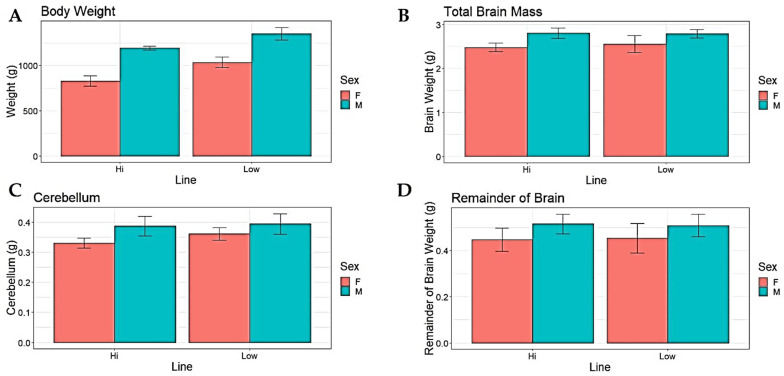
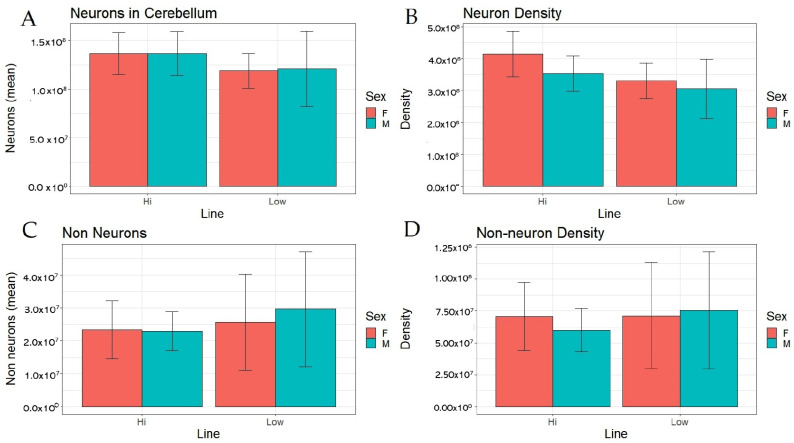
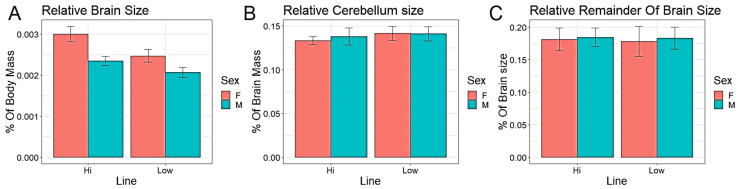
A central part of the domestication syndrome is a reduction in relative brain size. In chickens, it has previously been shown that domesticated birds have smaller relative brain mass, but larger relative mass of cerebellum, compared to their ancestors, the Red Junglefowl. It has been suggested that tameness may drive the domestication syndrome, so we examined the relationship between brain characteristics and tameness in 31 Red Junglefowl from lines divergently selected during ten generations for tameness. Our focus was on the whole brain, cerebellum, and the remainder of the brain. We used the isotropic fractionator technique to estimate the total number of cells in the cerebellum and differentiate between neurons and non-neuronal cells. We stained the cell nuclei with DAPI and performed cell counting using a fluorescence microscope. NeuN immunostaining was used to identify neurons. The absolute and relative masses of the brains and their regions were determined through weighing. Our analysis revealed that birds selected for low fear of humans (LF) had larger absolute brain mass, but smaller relative brain mass, compared to those selected for high fear of humans (HF). Sex had a significant impact only on the absolute size of the cerebellum, not its relative size. These findings support the notion that selection for increased tameness leads to an enlargement of the relative size of cerebellum in chickens consistent with comparisons of domesticated and ancestral chickens. Surprisingly, the HF birds had a higher density of neurons in the cerebellum compared to the LF line, despite having a smaller cerebellum overall. These findings highlight the intricate relationship between brain structure and behavior in the context of domestication.
驯化综合征的一个核心部分是相对脑容量的减少。在鸡身上,此前已有研究表明,与它们的祖先红原鸡相比,驯化后的鸡相对脑质量较小,但小脑的相对质量较大。有人提出温顺可能驱动了驯化综合征,因此我们研究了来自经过十代针对温顺程度进行不同选择的品系的31只红原鸡的大脑特征与温顺程度之间的关系。我们关注的是整个大脑、小脑以及大脑的其余部分。我们使用等体积分离技术来估计小脑中细胞的总数,并区分神经元和非神经元细胞。我们用DAPI对细胞核进行染色,并使用荧光显微镜进行细胞计数。使用NeuN免疫染色来识别神经元。通过称重确定大脑及其各区域的绝对质量和相对质量。我们的分析表明,与那些被选来表现出高度怕人的鸡(HF)相比,被选来表现出低度怕人的鸡(LF)绝对脑质量更大,但相对脑质量更小。性别仅对小脑的绝对大小有显著影响,对其相对大小没有影响。这些发现支持了这样一种观点,即选择增加温顺程度会导致鸡的小脑相对大小增大,这与驯化鸡和祖先鸡的比较结果一致。令人惊讶的是,尽管HF系的鸡总体小脑较小,但与LF系相比,其小脑中神经元的密度更高。这些发现凸显了驯化背景下大脑结构与行为之间的复杂关系。