• 文献检索
  • 文档翻译
  • 深度研究
  • 学术资讯
  • Suppr Zotero 插件Zotero 插件
  • 邀请有礼
  • 套餐&价格
  • 历史记录
应用&插件
Suppr Zotero 插件Zotero 插件浏览器插件Mac 客户端Windows 客户端微信小程序
定价
高级版会员购买积分包购买API积分包
服务
文献检索文档翻译深度研究API 文档MCP 服务
关于我们
关于 Suppr公司介绍联系我们用户协议隐私条款
关注我们

Suppr 超能文献

核心技术专利:CN118964589B侵权必究
粤ICP备2023148730 号-1Suppr @ 2026

文献检索

告别复杂PubMed语法,用中文像聊天一样搜索,搜遍4000万医学文献。AI智能推荐,让科研检索更轻松。

立即免费搜索

文件翻译

保留排版,准确专业,支持PDF/Word/PPT等文件格式,支持 12+语言互译。

免费翻译文档

深度研究

AI帮你快速写综述,25分钟生成高质量综述,智能提取关键信息,辅助科研写作。

立即免费体验

颅内动脉瘤破裂风险评估中的人工智能综述:应用与挑战

A Review of Artificial Intelligence in the Rupture Risk Assessment of Intracranial Aneurysms: Applications and Challenges.

作者信息

Li Xiaopeng, Zeng Lang, Lu Xuanzhen, Chen Kun, Yu Maling, Wang Baofeng, Zhao Min

机构信息

Department of Neurosurgery, Tongji Hospital, Tongji Medical College, Huazhong University of Science and Technology, Wuhan 430030, China.

Department of Neurology, The Third Hospital of Wuhan, Wuhan 430074, China.

出版信息

Brain Sci. 2023 Jul 11;13(7):1056. doi: 10.3390/brainsci13071056.

DOI:10.3390/brainsci13071056
PMID:37508988
原文链接:https://pmc.ncbi.nlm.nih.gov/articles/PMC10377544/
Abstract

Intracranial aneurysms (IAs) are highly prevalent in the population, and their rupture poses a significant risk of death or disability. However, the treatment of aneurysms, whether through interventional embolization or craniotomy clipping surgery, is not always safe and carries a certain proportion of morbidity and mortality. Therefore, early detection and prompt intervention of IAs with a high risk of rupture is of notable clinical significance. Moreover, accurately predicting aneurysms that are likely to remain stable can help avoid the risks and costs of over-intervention, which also has considerable social significance. Recent advances in artificial intelligence (AI) technology offer promising strategies to assist clinical trials. This review will discuss the state-of-the-art AI applications for assessing the rupture risk of IAs, with a focus on achievements, challenges, and potential opportunities.

摘要

颅内动脉瘤(IAs)在人群中高度普遍,其破裂会带来显著的死亡或残疾风险。然而,动脉瘤的治疗,无论是通过介入栓塞还是开颅夹闭手术,并不总是安全的,且存在一定比例的发病率和死亡率。因此,对具有高破裂风险的颅内动脉瘤进行早期检测和及时干预具有显著的临床意义。此外,准确预测可能保持稳定的动脉瘤有助于避免过度干预的风险和成本,这也具有相当大的社会意义。人工智能(AI)技术的最新进展提供了有前景的策略来辅助临床试验。本综述将讨论用于评估颅内动脉瘤破裂风险的最新人工智能应用,重点关注成果、挑战和潜在机遇。
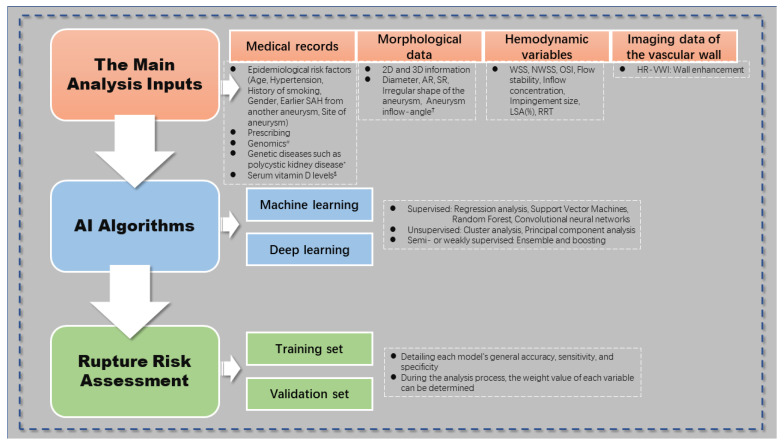
https://cdn.ncbi.nlm.nih.gov/pmc/blobs/fec3/10377544/5269d6d38329/brainsci-13-01056-g001.jpg

相似文献

1
A Review of Artificial Intelligence in the Rupture Risk Assessment of Intracranial Aneurysms: Applications and Challenges.颅内动脉瘤破裂风险评估中的人工智能综述:应用与挑战
Brain Sci. 2023 Jul 11;13(7):1056. doi: 10.3390/brainsci13071056.
2
Artificial Intelligence Applications in Intracranial Aneurysm: Achievements, Challenges and Opportunities.人工智能在颅内动脉瘤中的应用:成就、挑战与机遇。
Acad Radiol. 2022 Mar;29 Suppl 3:S201-S214. doi: 10.1016/j.acra.2021.06.013. Epub 2021 Aug 8.
3
Coil embolization for intracranial aneurysms: an evidence-based analysis.颅内动脉瘤的弹簧圈栓塞术:一项基于证据的分析。
Ont Health Technol Assess Ser. 2006;6(1):1-114. Epub 2006 Jan 1.
4
Role of Artificial Intelligence in Unruptured Intracranial Aneurysm: An Overview.人工智能在未破裂颅内动脉瘤中的作用:综述
Front Neurol. 2022 Feb 23;13:784326. doi: 10.3389/fneur.2022.784326. eCollection 2022.
5
Role of artificial intelligence and machine learning in the diagnosis of cerebrovascular disease.人工智能和机器学习在脑血管疾病诊断中的作用。
Front Hum Neurosci. 2023 Sep 7;17:1254417. doi: 10.3389/fnhum.2023.1254417. eCollection 2023.
6
Artificial Intelligence in the Management of Intracranial Aneurysms: Current Status and Future Perspectives.人工智能在颅内动脉瘤管理中的应用:现状与未来展望。
AJNR Am J Neuroradiol. 2020 Mar;41(3):373-379. doi: 10.3174/ajnr.A6468. Epub 2020 Mar 12.
7
Unruptured intracranial aneurysms: Why should we focus on small aneurysms? A comprehensive update of recent findings.未破裂颅内动脉瘤:我们为何应关注小动脉瘤?近期研究结果的全面更新
Pol J Radiol. 2024 Jan 12;89:e13-e23. doi: 10.5114/pjr.2024.134424. eCollection 2024.
8
Endovascular management of intracranial aneurysms: current experience and future advances.颅内动脉瘤的血管内治疗:当前经验与未来进展
Neurosurgery. 2006 Nov;59(5 Suppl 3):S93-102; discussion S3-13. doi: 10.1227/01.NEU.0000237512.10529.58.
9
Surgical Clipping of Previously Coiled Recurrent Intracranial Aneurysms: A Single-Center Experience.对先前已进行血管内栓塞治疗的复发性颅内动脉瘤进行手术夹闭:单中心经验
Front Neurol. 2021 Sep 21;12:680375. doi: 10.3389/fneur.2021.680375. eCollection 2021.
10
Deep Learning in the Management of Intracranial Aneurysms and Cerebrovascular Diseases: A Review of the Current Literature.深度学习在颅内动脉瘤和脑血管病管理中的应用:文献综述。
World Neurosurg. 2022 May;161:39-45. doi: 10.1016/j.wneu.2022.02.006. Epub 2022 Feb 5.

引用本文的文献

1
Revolutionizing aneurysm risk prediction: artificial intelligence's promise and challenges.变革动脉瘤风险预测:人工智能的前景与挑战。
Ann Med Surg (Lond). 2025 Feb 6;87(3):1092-1093. doi: 10.1097/MS9.0000000000002917. eCollection 2025 Mar.
2
Risk factors and predictive indicators of rupture in cerebral aneurysms.脑动脉瘤破裂的危险因素及预测指标
Front Physiol. 2024 Sep 5;15:1454016. doi: 10.3389/fphys.2024.1454016. eCollection 2024.
3
Revolutionizing Neurology: The Role of Artificial Intelligence in Advancing Diagnosis and Treatment.

本文引用的文献

1
Interpretable machine learning model to predict rupture of small intracranial aneurysms and facilitate clinical decision.可解释的机器学习模型预测颅内小动脉瘤破裂,辅助临床决策。
Neurol Sci. 2022 Nov;43(11):6371-6379. doi: 10.1007/s10072-022-06351-x. Epub 2022 Aug 23.
2
A Review of Artificial Intelligence in Cerebrovascular Disease Imaging: Applications and Challenges.人工智能在脑血管病影像中的应用及挑战述评
Curr Neuropharmacol. 2022;20(7):1359-1382. doi: 10.2174/1570159X19666211108141446.
3
The relationship between the level of vitamin D and ruptured intracranial aneurysms.
革新神经学:人工智能在推进诊断与治疗中的作用。
Cureus. 2024 Jun 5;16(6):e61706. doi: 10.7759/cureus.61706. eCollection 2024 Jun.
维生素 D 水平与颅内破裂动脉瘤的关系。
Sci Rep. 2021 Jun 4;11(1):11881. doi: 10.1038/s41598-021-90760-z.
4
Multi-View Convolutional Neural Networks in Rupture Risk Assessment of Small, Unruptured Intracranial Aneurysms.多视图卷积神经网络在小型未破裂颅内动脉瘤破裂风险评估中的应用
J Pers Med. 2021 Mar 24;11(4):239. doi: 10.3390/jpm11040239.
5
Multidimensional predicting model of intracranial aneurysm stability with backpropagation neural network: a preliminary study.基于反向传播神经网络的颅内动脉瘤稳定性多维预测模型:初步研究。
Neurol Sci. 2021 Dec;42(12):5007-5019. doi: 10.1007/s10072-021-05172-8. Epub 2021 Mar 16.
6
Clinical Factors Associated with the Risk of Intracranial Aneurysm Rupture in Autosomal Dominant Polycystic Kidney Disease.常染色体显性遗传多囊肾病患者颅内动脉瘤破裂风险的相关临床因素。
Cerebrovasc Dis. 2021;50(3):339-346. doi: 10.1159/000513709. Epub 2021 Mar 11.
7
A clinically applicable deep-learning model for detecting intracranial aneurysm in computed tomography angiography images.一种可应用于临床的基于深度学习的 CT 血管造影图像颅内动脉瘤检测模型。
Nat Commun. 2020 Nov 30;11(1):6090. doi: 10.1038/s41467-020-19527-w.
8
Predictive score for complete occlusion of intracranial aneurysms treated by flow-diverter stents using machine learning.基于机器学习的血流导向装置治疗颅内动脉瘤完全闭塞的预测评分。
J Neurointerv Surg. 2021 Apr;13(4):341-346. doi: 10.1136/neurintsurg-2020-016748. Epub 2020 Nov 20.
9
Artificial Intelligence Applications in Stroke.人工智能在中风中的应用。
Stroke. 2020 Aug;51(8):2573-2579. doi: 10.1161/STROKEAHA.119.027479. Epub 2020 Jul 22.
10
Fully automated intracranial aneurysm detection and segmentation from digital subtraction angiography series using an end-to-end spatiotemporal deep neural network.基于端到端时空深度学习网络的全自动化数字减影血管造影序列颅内动脉瘤检测与分割。
J Neurointerv Surg. 2020 Oct;12(10):1023-1027. doi: 10.1136/neurintsurg-2020-015824. Epub 2020 May 29.