Maes Michael, Rachayon Muanpetch, Jirakran Ketsupar, Sodsai Pimpayao, Sughondhabirom Atapol
Sichuan Provincial Center for Mental Health, Sichuan Provincial People's Hospital, School of Medicine, University of Electronic Science and Technology of China, Chengdu 610072, China.
Key Laboratory of Psychosomatic Medicine, Chinese Academy of Medical Sciences, Chengdu 610072, China.
Brain Sci. 2023 Jul 18;13(7):1090. doi: 10.3390/brainsci13071090.
Major depressive disorder (MDD) and its severe subtype, major dysmood disorder (MDMD), are distinguished by activation of inflammatory and growth factor subnetworks, which are associated with recurrence of illness (ROI) and adverse childhood experiences (ACEs). Nerve growth factor (NGF) plays a crucial role in facilitating neuro-immune communications and may regulate the inflammatory response.
The present study examined the effects of ACEs and ROI on culture supernatant NGF, stem cell factor (SCF), stem cell GF (SCGF), hepatocyte GF (HGF), and macrophage colony-stimulating factor (M-CSF), in relation to a neurotoxicity (NT) cytokine profile.
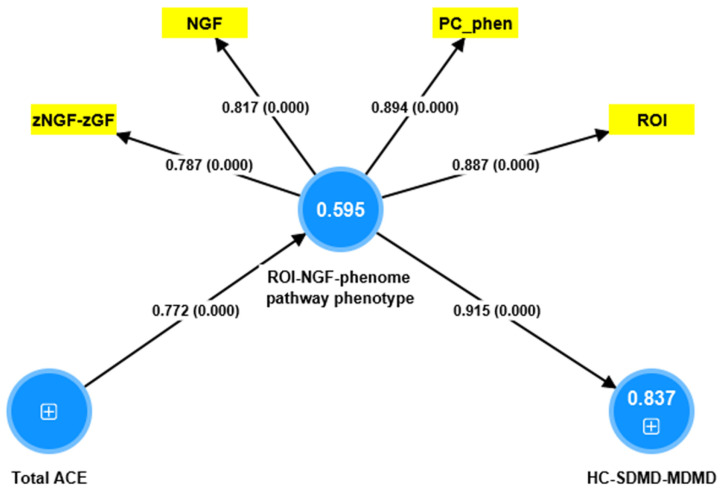
NGF levels are lower in MDD ( = 0.003), particularly MDMD ( < 0.001), as compared with normal controls. ROI and ACE were significantly and inversely associated with NGF (≤0.003) and the NGF/NT ratio (≤0.001), whereas there are no effects of ACEs and ROI on SCF, SCGF, HGF, or M-CSF. Lowered NGF ( = 0.003) and the NGF/NT ratio ( < 0.001) are highly significantly and inversely associated with the severity of the current depression phenome, conceptualized as a latent vector extracted from the current severity of depression, anxiety, and suicidal behaviors. We found that one validated and replicable latent vector could be extracted from NGF, ROI, and the depression phenome, which therefore constitutes a novel ROI-NGF-pathway-phenotype. ACEs explained 59.5% of the variance in the latter pathway phenotype ( < 0.001).
The imbalance between decreased NGF and increased neurotoxic cytokines during the acute phase of severe depression may contribute to decreased neuroprotection, increased neuro-affective toxicity, and chronic mild inflammation.
重度抑郁症(MDD)及其严重亚型,重度情绪障碍(MDMD),通过炎症和生长因子子网的激活来区分,这些子网与疾病复发(ROI)和童年不良经历(ACEs)相关。神经生长因子(NGF)在促进神经免疫通讯中起关键作用,并可能调节炎症反应。
本研究考察了ACEs和ROI对培养上清液中NGF、干细胞因子(SCF)、干细胞生长因子(SCGF)、肝细胞生长因子(HGF)和巨噬细胞集落刺激因子(M-CSF)的影响,以及与神经毒性(NT)细胞因子谱的关系。
与正常对照组相比,MDD患者( = 0.003),尤其是MDMD患者( < 0.001)的NGF水平较低。ROI和ACE与NGF(≤0.003)和NGF/NT比值(≤0.001)显著负相关,而ACEs和ROI对SCF、SCGF、HGF或M-CSF无影响。降低的NGF( = 0.003)和NGF/NT比值( < 0.001)与当前抑郁症状的严重程度高度显著负相关,当前抑郁症状被概念化为从当前抑郁、焦虑和自杀行为的严重程度中提取的潜在向量。我们发现可以从NGF、ROI和抑郁症状中提取一个经过验证和可复制的潜在向量,因此构成了一种新的ROI-NGF-途径-表型。ACEs解释了后一种途径表型中59.5%的变异( < 0.001)。
在重度抑郁症急性期,NGF降低与神经毒性细胞因子增加之间的失衡可能导致神经保护作用降低、神经情感毒性增加和慢性轻度炎症。