Lee Sang-Soo, Kim Jong-Ho, Lee Jae-Jun, Kwon Young-Suk, Seo Eun-Min
Department of Orthopedic Surgery, Chuncheon Sacred Heart Hospital, Hallym University College of Medicine, Chuncheon 24253, Republic of Korea.
Division of Big Data and Artificial Intelligence, Institute of New Frontier Research, Chuncheon Sacred Heart Hospital, Hallym University College of Medicine, Chuncheon 24253, Republic of Korea.
J Clin Med. 2023 Jul 14;12(14):4696. doi: 10.3390/jcm12144696.
Many studies have been conducted to explore the risk factors associated with postoperative delirium (POD) in order to understand its underlying causes and develop prevention strategies, especially for hip fracture surgery. However, the relationship between blood transfusion and POD has been heatedly debated. The purpose of this study was to evaluate the risk factors of POD and the relationship between blood transfusions and the occurrence of POD in hip fracture surgery through big data analysis.
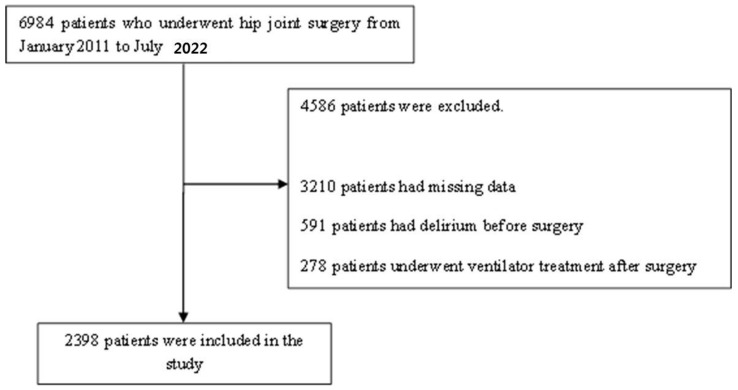
Medical data (including medication history, clinical and laboratory findings, and perioperative variables) were acquired from the clinical data warehouse (CDW) of the five hospitals of Hallym University Medical Center and were compared between patients without POD and with POD.
The occurrence of POD was 18.7% (228 of 2398 patients). The risk factors of POD included old age (OR 4.38, 95% CI 2.77-6.91; < 0.001), American Society of Anesthesiology physical status > 2 (OR 1.84 95% CI 1.4-2.42; < 0.001), dementia (OR 1.99, 95% CI 1.53-2.6; < 0.001), steroid (OR 0.53 95% CI 0.34-0.82; < 0.001), Antihistamine (OR 1.53 95% CI 1.19-1.96; < 0.001), and postoperative erythrocyte sedimentation rate (mm/h) (OR 0.97 95% CI 0.97-0.98; < 0.001) in multivariate logistic regression analysis. The postoperative transfusion (OR 2.53, 95% CI 1.88-3.41; < 0.001) had a significant effect on the incidence of POD.
big data analytics using a CDW was a good option to identify the risk factors of POD and to prevent POD in hip fracture surgery.
为了解术后谵妄(POD)的潜在病因并制定预防策略,尤其是针对髋部骨折手术,已经开展了许多研究来探索与之相关的风险因素。然而,输血与POD之间的关系一直存在激烈争论。本研究的目的是通过大数据分析评估髋部骨折手术中POD的风险因素以及输血与POD发生之间的关系。
从翰林大学医学中心五家医院的临床数据仓库(CDW)获取医疗数据(包括用药史、临床和实验室检查结果以及围手术期变量),并在未发生POD的患者和发生POD的患者之间进行比较。
POD的发生率为18.7%(2398例患者中的228例)。多因素逻辑回归分析显示,POD的风险因素包括老年(比值比[OR]4.38,95%置信区间[CI]2.77 - 6.91;P<0.001)、美国麻醉医师协会身体状况>2(OR 1.84,95%CI 1.4 - 2.42;P<0.001)、痴呆(OR 1.99,95%CI 1.53 - 2.6;P<0.001)、类固醇(OR 0.53,95%CI 0.34 - 0.82;P<0.001)、抗组胺药(OR 1.53,95%CI 1.19 - 1.96;P<0.001)以及术后红细胞沉降率(mm/h)(OR 0.97,95%CI 0.97 - 0.98;P<0.001)。术后输血(OR 2.53,95%CI 1.88 - 3.41;P<0.001)对POD的发生率有显著影响。
使用CDW进行大数据分析是识别髋部骨折手术中POD风险因素并预防POD的良好选择。