Department XIII, Discipline of Infectious Diseases, "Victor Babes" University of Medicine and Pharmacy, 300041 Timisoara, Romania.
Doctoral School, "Victor Babes" University of Medicine and Pharmacy, 300041 Timisoara, Romania.
Medicina (Kaunas). 2023 Jul 5;59(7):1253. doi: 10.3390/medicina59071253.
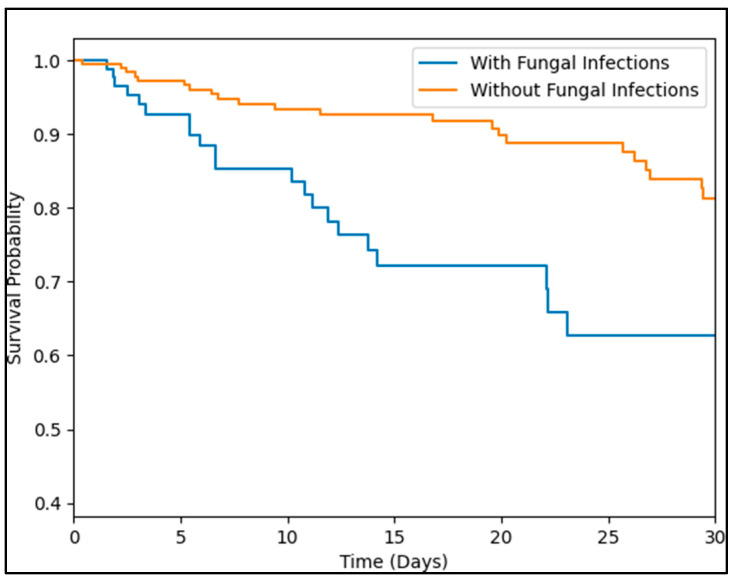
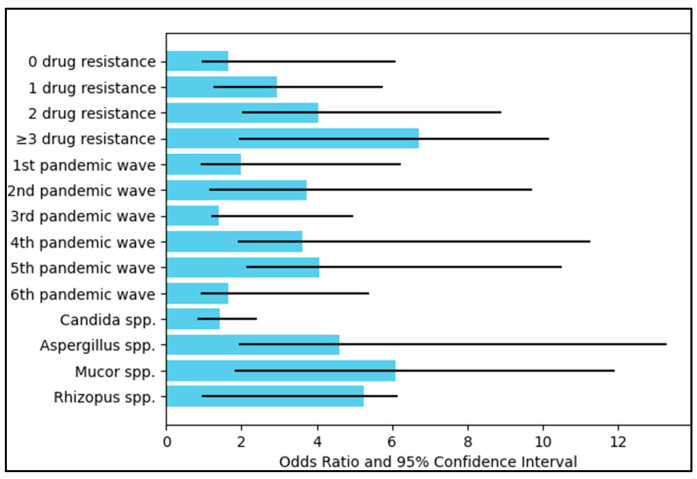
: With an increasing number of severe COVID-19 cases presenting with secondary fungal infections, this study aimed to determine the prevalence of fungal co-infections in severe COVID-19 patients across the six waves, identify the most common fungal pathogens associated with severe COVID-19, and explore any potential links between patient characteristics, therapeutic strategies, and the prevalence and type of fungal infection. : A retrospective analysis was conducted on severe COVID-19 patients admitted to the Infectious Diseases and Pulmonology Hospital, "Victor Babes", Romania, between March 2020 and August 2022. Samples were collected from respiratory specimens, blood, and urine, after which a standard nucleic acid extraction protocol was employed. Patients were divided into groups with and without fungal infections, identified using multiplex PCR. The groups were compared based on demographic data, comorbidities, pandemic wave number, and clinical outcomes. : Out of 288 patients, 96 (33.3%) had fungal infections, with spp. being the most common. Patients with fungal infections had higher rates of obesity (35.4% vs. 21.4%, = 0.010) and a higher Charlson comorbidity index (CCI > 2) (37.5% vs 25.0%, = 0.027). Ventilator use was significantly higher in the fungal infection group (45.8% vs. 18.8%; < 0.001), as was ICU admission (39.6% vs. 26.6%; = 0.024) and mortality (32.3% vs 12.0%; < 0.001). The distribution of different fungal species varied across the pandemic waves, with no statistical significance ( = 0.209). The mortality risk notably increased with the degree of drug resistance (OR for three or more drug resistances = 6.71, < 0.001). The second, fourth, and fifth pandemic waves were significantly associated with higher mortality risk (OR = 3.72, 3.61, and 4.08, respectively, all < 0.001). spp. and spp. infections were significantly associated with increased mortality risk (OR = 4.61 and 6.08, respectively, both < 0.001). : Our study indicates a significant presence of fungal co-infections among severe COVID-19 patients that is associated with increased morbidity and mortality, particularly in patients with drug-resistant infections. These findings underline the necessity for comprehensive diagnostic approaches and tailored treatment strategies in managing COVID-19 patients, especially during specific pandemic waves and in patients with particular fungal infections. Further research is required to understand the implications of these co-infections and their management.
: 由于越来越多的严重 COVID-19 病例出现继发性真菌感染,本研究旨在确定在六波疫情中,严重 COVID-19 患者中真菌感染的流行率,确定与严重 COVID-19 相关的最常见真菌病原体,并探讨患者特征、治疗策略与真菌感染的流行率和类型之间的任何潜在联系。 : 对 2020 年 3 月至 2022 年 8 月期间在罗马尼亚“维克托·巴巴斯”传染病和肺病医院住院的严重 COVID-19 患者进行了回顾性分析。从呼吸道标本、血液和尿液中采集样本,然后使用标准核酸提取方案。通过多重 PCR 鉴定有和没有真菌感染的患者。根据人口统计学数据、合并症、大流行波数和临床结果对两组进行比较。 : 在 288 名患者中,有 96 名(33.3%)患有真菌感染,其中 spp. 最为常见。患有真菌感染的患者肥胖率更高(35.4%比 21.4%, = 0.010),Charlson 合并症指数(CCI>2)更高(37.5%比 25.0%, = 0.027)。真菌感染组呼吸机使用率明显更高(45.8%比 18.8%; < 0.001),入住 ICU 率(39.6%比 26.6%; = 0.024)和死亡率(32.3%比 12.0%; < 0.001)也更高。不同真菌种的分布在大流行波中有所不同,但无统计学意义( = 0.209)。耐药程度越高,死亡风险显著增加(三种或三种以上耐药的 OR=6.71, < 0.001)。第二、第四和第五波大流行与更高的死亡率风险显著相关(OR=3.72、3.61 和 4.08,均 < 0.001)。 spp. 和 spp. 感染与死亡率增加显著相关(OR=4.61 和 6.08,均 < 0.001)。 : 我们的研究表明,严重 COVID-19 患者中存在显著的真菌感染,与发病率和死亡率增加有关,特别是在耐药感染患者中。这些发现强调了在管理 COVID-19 患者,特别是在特定大流行波和特定真菌感染患者中,需要采用全面的诊断方法和针对性的治疗策略。需要进一步研究以了解这些合并感染及其管理的影响。