Department of Medical Imaging, Radboud University Medical Center, Nijmegen, The Netherlands.
Department of Radiology, Jeroen Bosch Hospital, 's-Hertogenbosch, The Netherlands.
Eur Radiol. 2024 Jan;34(1):348-354. doi: 10.1007/s00330-023-09991-5. Epub 2023 Jul 29.
To map the clinical use of CE-marked artificial intelligence (AI)-based software in radiology departments in the Netherlands (n = 69) between 2020 and 2022.
Our AI network (one radiologist or AI representative per Dutch hospital organization) received a questionnaire each spring from 2020 to 2022 about AI product usage, financing, and obstacles to adoption. Products that were not listed on www.AIforRadiology.com by July 2022 were excluded from the analysis.
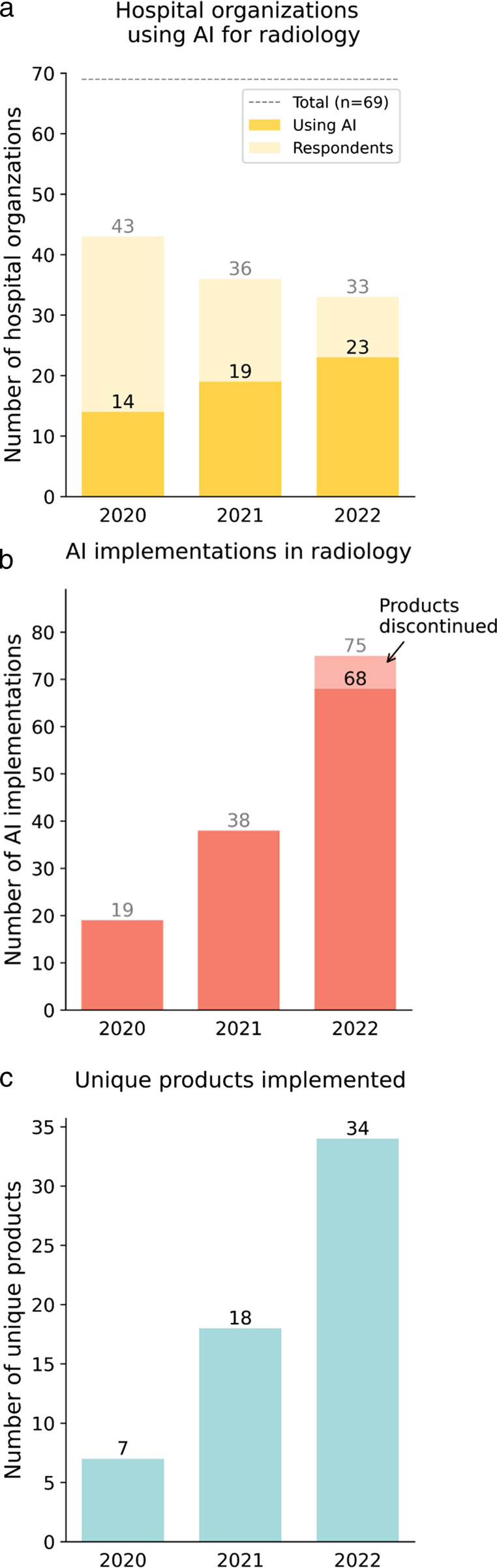
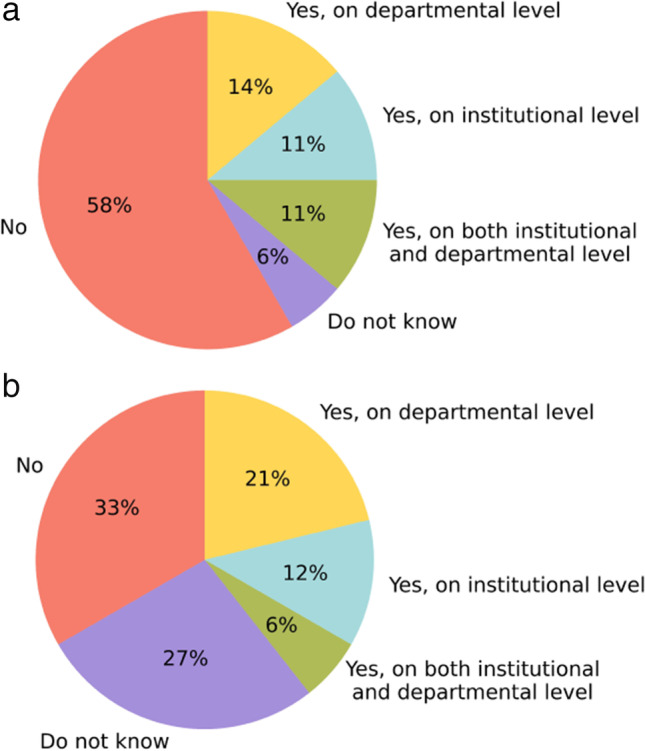
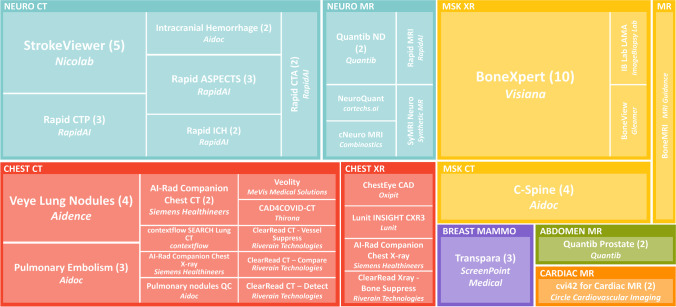
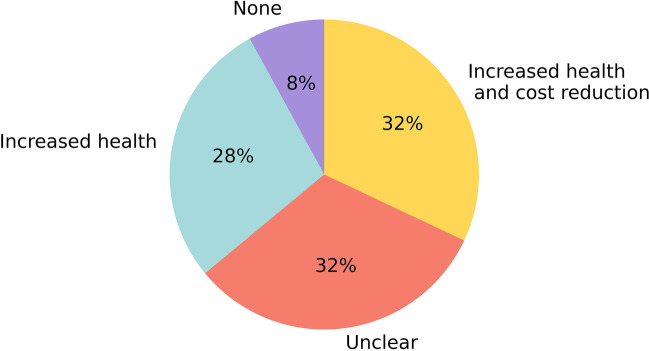
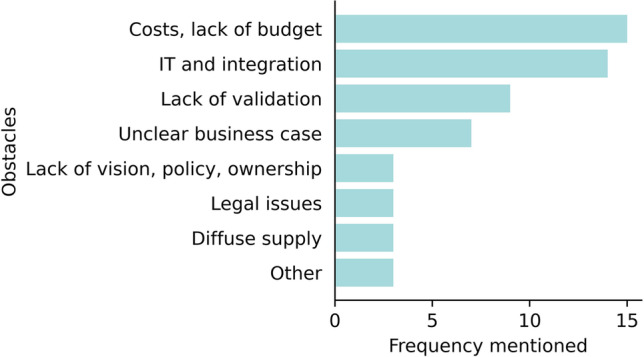
The number of respondents was 43 in 2020, 36 in 2021, and 33 in 2022. The number of departments using AI has been growing steadily (2020: 14, 2021: 19, 2022: 23). The diversity (2020: 7, 2021: 18, 2022: 34) and the number of total implementations (2020: 19, 2021: 38, 2022: 68) has rapidly increased. Seven implementations were discontinued in 2022. Four hospital organizations said to use an AI platform or marketplace for the deployment of AI solutions. AI is mostly used to support chest CT (17), neuro CT (17), and musculoskeletal radiograph (12) analysis. The budget for AI was reserved in 13 of the responding centers in both 2021 and 2022. The most important obstacles to the adoption of AI remained costs and IT integration. Of the respondents, 28% stated that the implemented AI products realized health improvement and 32% assumed both health improvement and cost savings.
The adoption of AI products in radiology departments in the Netherlands is showing common signs of a developing market. The major obstacles to reaching widespread adoption are a lack of financial resources and IT integration difficulties.
The clinical impact of AI starts with its adoption in daily clinical practice. Increased transparency around AI products being adopted, implementation obstacles, and impact may inspire increased collaboration and improved decision-making around the implementation and financing of AI products.
• The adoption of artificial intelligence products for radiology has steadily increased since 2020 to at least a third of the centers using AI in clinical practice in the Netherlands in 2022. • The main areas in which artificial intelligence products are used are lung nodule detection on CT, aided stroke diagnosis, and bone age prediction. • The majority of respondents experienced added value (decreased costs and/or improved outcomes) from using artificial intelligence-based software; however, major obstacles to adoption remain the costs and IT-related difficulties.
绘制 2020 年至 2022 年间荷兰放射科使用 CE 标记的人工智能(AI)软件的临床应用情况(n=69)。
我们的 AI 网络(每个荷兰医院组织一名放射科医生或 AI 代表)在 2020 年至 2022 年的每个春季都会收到一份关于 AI 产品使用、融资和采用障碍的问卷。截至 2022 年 7 月,未在 www.AIforRadiology.com 上列出的产品将被排除在分析之外。
2020 年有 43 名受访者,2021 年有 36 名,2022 年有 33 名。使用 AI 的部门数量稳步增长(2020 年:14 个,2021 年:19 个,2022 年:23 个)。多样性(2020 年:7 个,2021 年:18 个,2022 年:34 个)和总实施数量(2020 年:19 个,2021 年:38 个,2022 年:68 个)迅速增加。2022 年有 7 个实施项目被停止。有四个医院组织表示使用 AI 平台或市场来部署 AI 解决方案。AI 主要用于支持胸部 CT(17)、神经 CT(17)和骨骼 X 光片(12)分析。在 2021 年和 2022 年,有 13 个中心在预算中预留了 AI 资金。采用 AI 的主要障碍仍然是成本和 IT 集成。28%的受访者表示实施的 AI 产品实现了健康改善,32%的受访者认为实现了健康改善和成本节约。
荷兰放射科采用 AI 产品显示出一个不断发展的市场的共同迹象。广泛采用的主要障碍是缺乏财务资源和 IT 集成困难。
AI 的临床影响始于其在日常临床实践中的采用。增加对采用的 AI 产品、实施障碍和影响的透明度,可能会激发更多的合作,并改善 AI 产品的实施和融资决策。
自 2020 年以来,荷兰放射科使用人工智能产品的数量稳步增加,到 2022 年,至少有三分之一的中心在临床实践中使用人工智能产品。
人工智能产品的主要应用领域是 CT 上的肺结节检测、辅助中风诊断和骨龄预测。
大多数受访者认为使用基于人工智能的软件具有附加价值(降低成本和/或改善结果);然而,采用的主要障碍仍然是成本和与 IT 相关的困难。