Nagasaka Misako, Brazel Danielle, Baca Yasmine, Xiu Joanne, Al-Hallak Mohammed Najeeb, Kim Chul, Nieva Jorge, Swensen Jeffrey J, Spetzler David, Korn Wolfgang Michael, Socinski Mark A, Raez Luis E, Halmos Balazs, Ou Sai-Hong Ignatius
University of California Irvine School of Medicine, Orange, CA, USA; Chao Family Comprehensive Cancer Center, Orange, CA, USA; Division of Neurology, Department of Internal Medicine, St. Marianna University School of Medicine, Kawasaki, Kanagawa, Japan.
University of California Irvine School of Medicine, Orange, CA, USA.
Transl Oncol. 2023 Oct;36:101744. doi: 10.1016/j.tranon.2023.101744. Epub 2023 Jul 27.
RET fusions are driver alterations in cancer and are most commonly found in non-small cell lung cancer and well-differentiated thyroid cancer. However, RET fusion have been reported in other solid tumors.
A retrospective analysis of RET+ solid malignancies identified by targeted RNA sequencing and whole transcriptome sequencing of clinical tumor samples performed at Caris Life Science (Phoenix, AZ).
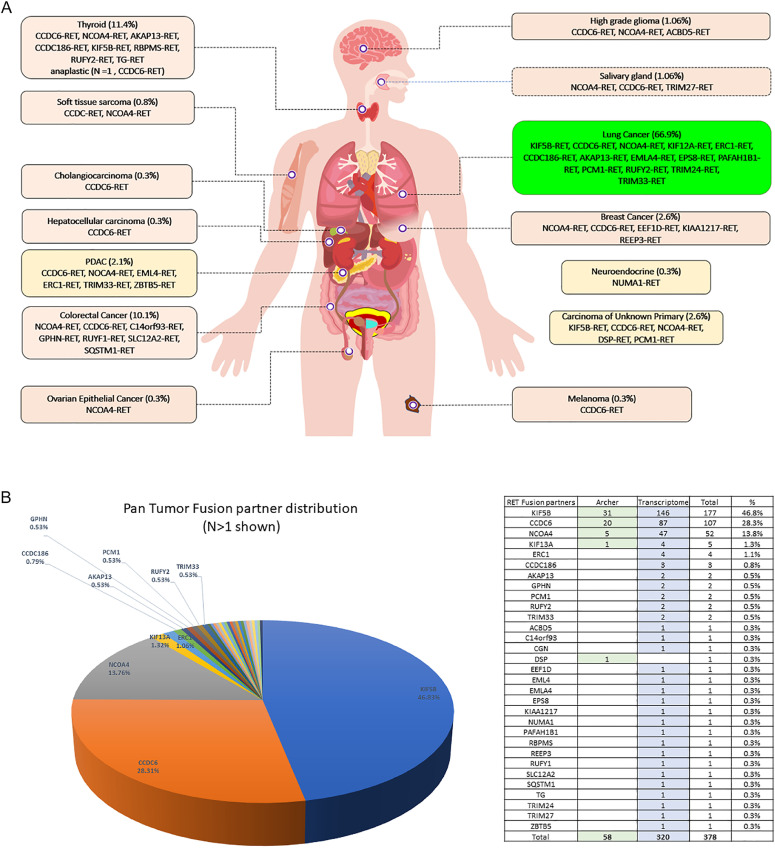
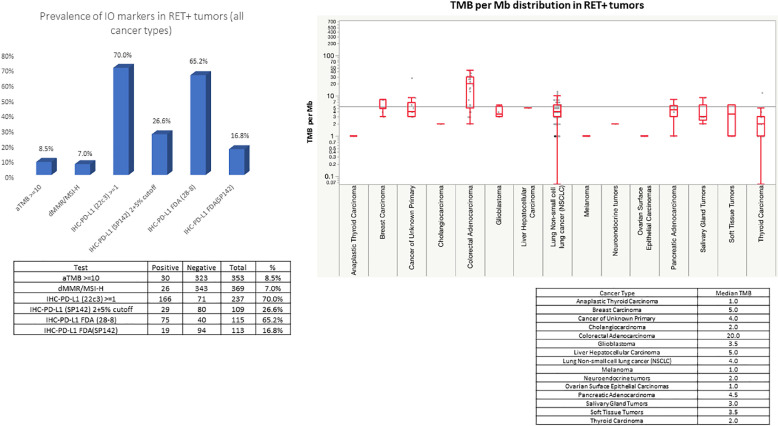
As of March 22, 2022, a total of 378 RET+ solid malignancies were identified in 15 different tumor types and carcinoma of unknown primary (CUP) that underwent next-generation RNA sequencing. RET+ NSCLC and RET+ thyroid cancer constituted 66.9% and 11.1% of the RET+ solid malignancies, respectively. RET+ colorectal adenocarcinoma and RET+ breast adenocarcinoma constituted 10.1% and 2.6%, respectively. The estimated frequency of RET fusions within specific tumor types were NSCLC 0.7%, thyroid cancer 3.1%, colorectal cancer 0.2% and breast cancer 0.1%. KIF5B (46.8%) was the most common fusion partner followed by CCDC6 (28.3%) and NCOA4 (13.8%) in RET+ solid tumors. KIF5B-RET was the dominant fusion variant in RET+ NSCLC, NCOA4-RET was the dominant variant in RET+ colorectal carcinoma, and CCDC6-RET was the dominant variant in thyroid cancer. The most common single gene alterations in RET+ tumors were TP53 (34.8%), RASA1 (14.3%) and ARIAD1A (11.6%). RET+ CRC had a high median TMB of 20.0 and were commonly MSI-H.
RET fusions were identified in multiple tumor types. With a higher median TMB and commonly MSI-H, RET fusion positive CRC may be a unique molecular subset of CRC.
RET融合是癌症中的驱动性改变,最常见于非小细胞肺癌和高分化甲状腺癌。然而,其他实体瘤中也有RET融合的报道。
对在Caris生命科学公司(亚利桑那州凤凰城)对临床肿瘤样本进行靶向RNA测序和全转录组测序鉴定出的RET+实体恶性肿瘤进行回顾性分析。
截至2022年3月22日,在15种不同肿瘤类型和原发灶不明癌(CUP)中,通过下一代RNA测序共鉴定出378例RET+实体恶性肿瘤。RET+非小细胞肺癌和RET+甲状腺癌分别占RET+实体恶性肿瘤的66.9%和11.1%。RET+结直肠腺癌和RET+乳腺腺癌分别占10.1%和2.6%。特定肿瘤类型中RET融合的估计频率为:非小细胞肺癌0.7%,甲状腺癌3.1%,结直肠癌0.2%,乳腺癌0.1%。在RET+实体瘤中,KIF5B(46.8%)是最常见的融合伴侣,其次是CCDC6(28.3%)和NCOA4(13.8%)。KIF5B-RET是RET+非小细胞肺癌中的主要融合变体,NCOA4-RET是RET+结直肠癌中的主要变体,CCDC6-RET是甲状腺癌中的主要变体。RET+肿瘤中最常见的单基因改变是TP53(34.8%)、RASA1(14.3%)和ARIAD1A(11.6%)。RET+结直肠癌的中位肿瘤突变负荷(TMB)较高,为20.0,且通常为微卫星高度不稳定(MSI-H)。
在多种肿瘤类型中发现了RET融合。RET融合阳性的结直肠癌中位TMB较高且通常为MSI-H,可能是结直肠癌的一个独特分子亚群。