MOX - Department of Mathematics, Politecnico di Milano, Milan, Italy.
HDS, Health Data Science Center, Human Technopole, Milan, Italy.
BMC Med Res Methodol. 2023 Jul 29;23(1):174. doi: 10.1186/s12874-023-01993-7.
Care pathways are increasingly being used to enhance the quality of care and optimize the use of resources for health care. Nevertheless, recommendations regarding the sequence of care are mostly based on consensus-based decisions as there is a lack of evidence on effective treatment sequences. In a real-world setting, classical statistical tools were insufficient to consider a phenomenon with such high variability adequately and have to be integrated with novel data mining techniques suitable for identifying patterns in complex data structures. Data-driven techniques can potentially support empirically identifying effective care sequences by extracting them from data collected routinely. The purpose of this study is to perform a state sequence analysis (SSA) to identify different patterns of treatment and to asses whether sequence analysis may be a useful tool for profiling patients according to the treatment pattern.
The clinical application that motivated the study of this method concerns the mental health field. In fact, the care pathways of patients affected by severe mental disorders often do not correspond to the standards required by the guidelines in this field. In particular, we analyzed patients with schizophrenic disorders (i.e., schizophrenia, schizotypal or delusional disorders) using administrative data from 2015 to 2018 from Lombardy Region. This methodology considers the patient's therapeutic path as a conceptual unit, composed of a succession of different states, and we show how SSA can be used to describe longitudinal patient status.
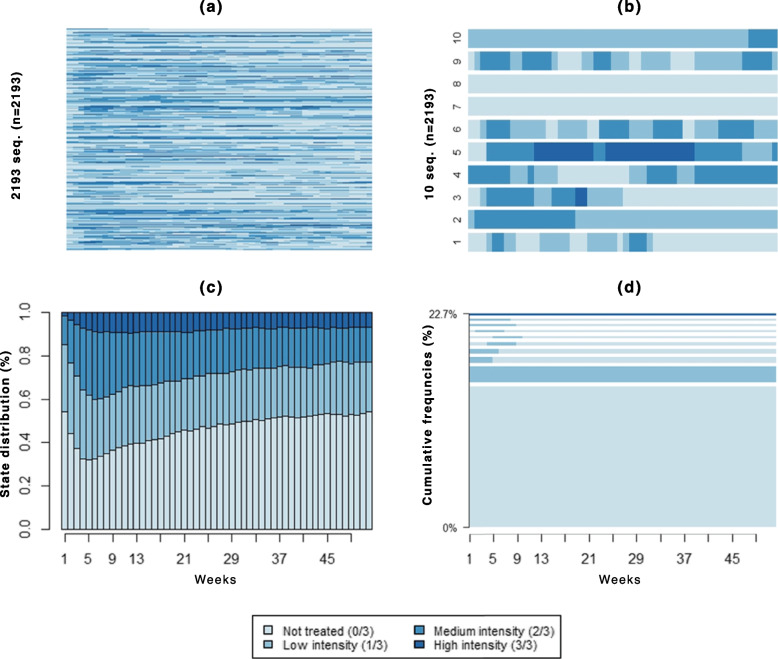
We define the states to be the weekly coverage of different treatments (psychiatric visits, psychosocial interventions, and anti-psychotic drugs), and we use the longest common subsequences (dis)similarity measure to compare and cluster the sequences. We obtained three different clusters with very different patterns of treatments.
This kind of information, such as common patterns of care that allowed us to risk profile patients, can provide health policymakers an opportunity to plan optimum and individualized patient care by allocating appropriate resources, analyzing trends in the health status of a population, and finding the risk factors that can be leveraged to prevent the decline of mental health status at the population level.
护理路径正被越来越多地用于提高医疗保健质量和优化资源利用。然而,由于缺乏关于有效治疗顺序的证据,关于护理顺序的建议主要基于基于共识的决策。在现实环境中,经典的统计工具不足以充分考虑具有如此高可变性的现象,必须与适合识别复杂数据结构中模式的新型数据挖掘技术相结合。数据驱动的技术可以通过从常规收集的数据中提取来潜在地支持经验性地识别有效的护理顺序。本研究的目的是进行状态序列分析(SSA),以识别不同的治疗模式,并评估序列分析是否可以成为根据治疗模式对患者进行分析的有用工具。
该方法的临床应用源于精神卫生领域。实际上,严重精神障碍患者的护理路径通常不符合该领域指南要求的标准。具体来说,我们使用 2015 年至 2018 年伦巴第大区的行政数据分析了患有精神分裂症障碍的患者(即精神分裂症、精神分裂样或妄想障碍)。该方法将患者的治疗路径视为一个概念单元,由不同状态的连续组成,我们展示了 SSA 如何用于描述纵向患者状态。
我们将状态定义为不同治疗方法(精神科就诊、心理社会干预和抗精神病药物)的每周覆盖范围,并使用最长公共子序列(不)相似性度量来比较和聚类序列。我们得到了三个具有非常不同治疗模式的不同集群。
这种信息,例如常见的护理模式,可以帮助我们对患者进行风险分析,为卫生政策制定者提供机会,通过分配适当的资源来规划最佳和个体化的患者护理,分析人口健康状况的趋势,并找到可以利用的风险因素,以防止人口层面的精神健康状况下降。