Zakiudin Dinastry Pramadita, Rø Anne Dorthea Bjerkenes, Videm Vibeke, Øien Torbjørn, Simpson Melanie Rae
Department of Public Health and Nursing, NTNU, Norwegian University of Science and Technology, Håkon Jarls Gate 11, 7030, Trondheim, Norway.
Clinic for Laboratory Medicine, St Olavs Hospital, Trondheim, Norway.
Clin Mol Allergy. 2023 Jul 29;21(1):5. doi: 10.1186/s12948-023-00186-3.
Maternal probiotic supplementation has a promising effect on atopic dermatitis (AD) prevention in infancy. In the randomised controlled study, Probiotics in the Prevention of Allergy among Children in Trondheim (ProPACT), maternal probiotics reduced the cumulative incidence of AD in their offspring by 40% at 2 years of age. However, our understanding on how probiotics prevented AD is still limited, and the role of inflammatory proteins in infants following maternal probiotic supplementation is unclear. We hypothesised that maternal probiotics lowered pro-inflammatory proteins and increased anti-inflammatory proteins in their 2-year-old children as a mechanism of AD prevention. We aimed to explore this hypothesis and the association between these proteins and the presence of AD, severity of AD, and the degree of preventive effect of probiotics.
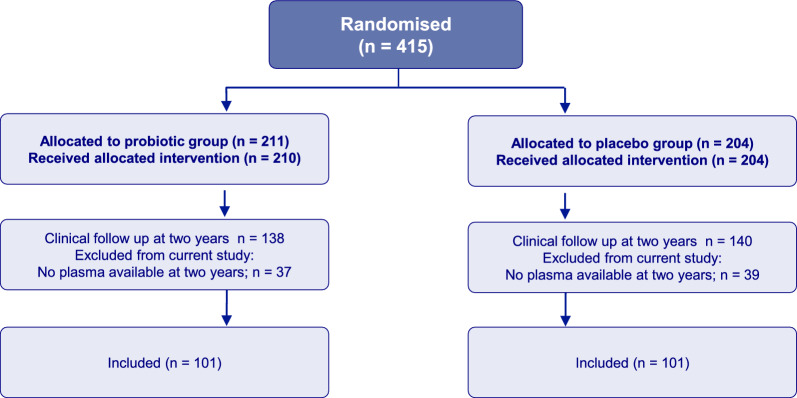
Plasma samples were collected from 2-year-old children (n = 202) during the ProPACT study, a randomised placebo-controlled trial of maternal probiotic supplementation. These samples were analysed for 92 inflammatory proteins using a multiplex proximity extension assay. Associations between inflammatory proteins and the presence and severity of AD, and the degree of preventive effect, was estimated individually using regression analysis and then collectively using unsupervised cluster analysis.
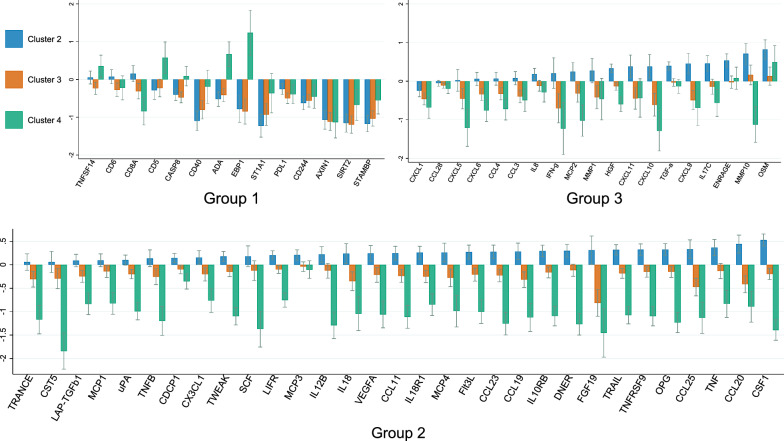
Several proteins were observed to differ between the groups. The probiotic group had lower CCL11 and IL-17C, while children with AD had higher IL-17C, MCP-4, uPA, and CD6. Cytokine CCL20 and IL-18 had moderate correlation (r = 0.35 and r = 0.46) with the severity of AD. The cluster analysis revealed that children in the cluster of samples with the highest value of immune checkpoint receptors and inflammatory suppressor enzymes showed the greatest AD preventive effect from probiotics.
The proteins associated with both maternal probiotic supplementation and the presence and severity of AD warrant attention because of their potential biological relevance. Cluster analysis may provide a new insight when considering which subgroups benefit from probiotic supplementation. Larger studies are needed to confirm the results.
The study was retrospectively registered at ClinicalTrials.gov (NCT00159523) on 12nd September 2005.
孕期补充益生菌对预防婴儿特应性皮炎(AD)具有潜在作用。在特隆赫姆儿童过敏预防中的益生菌(ProPACT)随机对照研究中,孕期补充益生菌可使后代在2岁时AD的累积发病率降低40%。然而,我们对益生菌预防AD的机制仍了解有限,且孕期补充益生菌后婴儿体内炎症蛋白的作用尚不清楚。我们推测,孕期补充益生菌可降低2岁儿童体内的促炎蛋白水平并增加抗炎蛋白水平,以此作为预防AD的一种机制。我们旨在探究这一假设以及这些蛋白与AD的发生、AD的严重程度和益生菌预防效果之间的关联。
在ProPACT研究(一项关于孕期补充益生菌的随机安慰剂对照试验)期间,收集了2岁儿童(n = 202)的血浆样本。使用多重邻近延伸分析对这些样本中的92种炎症蛋白进行分析。分别采用回归分析,然后使用无监督聚类分析,评估炎症蛋白与AD的发生、严重程度以及预防效果之间的关联。
观察到几组之间有几种蛋白存在差异。益生菌组的CCL11和IL-17C水平较低,而患AD的儿童IL-17C、MCP-4、uPA和CD6水平较高。细胞因子CCL20和IL-18与AD的严重程度呈中度相关(r = 0.35和r = 0.46)。聚类分析显示,免疫检查点受体和炎症抑制酶值最高的样本组中的儿童,益生菌对AD的预防效果最佳。
与孕期补充益生菌以及AD的发生和严重程度相关的蛋白因其潜在的生物学相关性值得关注。在考虑哪些亚组能从益生菌补充中获益时,聚类分析可能会提供新的见解。需要更大规模的研究来证实这些结果。
该研究于2005年9月12日在ClinicalTrials.gov(NCT00159523)进行回顾性注册。