Department of Epidemiology, Johns Hopkins University Bloomberg School of Public Health, Baltimore, MD, USA.
Department of Population and Public Health Sciences, University of Southern California, Los Angeles, CA, USA.
Environ Res. 2023 Nov 1;236(Pt 2):116772. doi: 10.1016/j.envres.2023.116772. Epub 2023 Jul 28.
Drinking water is a common source of exposure to inorganic arsenic. In the US, the Safe Drinking Water Act (SDWA) was enacted to protect consumers from exposure to contaminants, including arsenic, in public water systems (PWS). The reproductive effects of preconception and prenatal arsenic exposure in regions with low to moderate arsenic concentrations are not well understood.
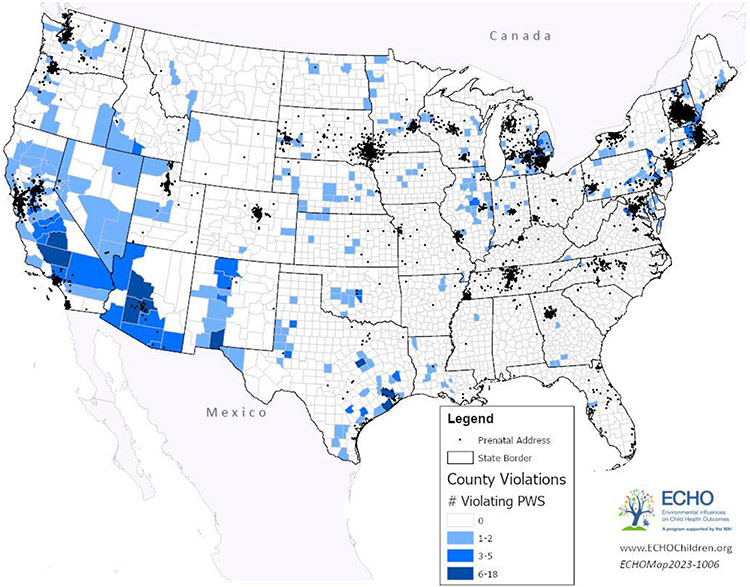
This study examined associations between preconception and prenatal exposure to arsenic violations in water, measured via residence in a county with an arsenic violation in a regulated PWS during pregnancy, and five birth outcomes: birth weight, gestational age at birth, preterm birth, small for gestational age (SGA), and large for gestational age (LGA).
Data for arsenic violations in PWS, defined as concentrations exceeding 10 parts per billion, were obtained from the Safe Drinking Water Information System. Participants of the Environmental influences on Child Health Outcomes Cohort Study were matched to arsenic violations by time and location based on residential history data. Multivariable, mixed effects regression models were used to assess the relationship between preconception and prenatal exposure to arsenic violations in drinking water and birth outcomes.
Compared to unexposed infants, continuous exposure to arsenic from three months prior to conception through birth was associated with 88.8 g higher mean birth weight (95% CI: 8.2, 169.5), after adjusting for individual-level confounders. No statistically significant associations were observed between any preconception or prenatal violations exposure and gestational age at birth, preterm birth, SGA, or LGA.
Our study did not identify associations between preconception and prenatal arsenic exposure, defined by drinking water exceedances, and adverse birth outcomes. Exposure to arsenic violations in drinking water was associated with higher birth weight. Future studies would benefit from more precise geodata of water system service areas, direct household drinking water measurements, and exposure biomarkers.
饮用水是接触无机砷的常见来源。在美国,《安全饮用水法》(SDWA)的颁布是为了保护消费者免受公共供水系统(PWS)中包括砷在内的污染物的暴露。在砷浓度较低和中等的地区, preconception 和产前暴露于砷的生殖影响尚未得到很好的理解。
本研究通过怀孕期间居住在受管制 PWS 砷违规的县,检查 preconception 和产前暴露于水中砷违规与五种出生结局之间的关联:出生体重、出生时的胎龄、早产、小于胎龄(SGA)和大于胎龄(LGA)。
从安全饮用水信息系统中获取 PWS 砷违规的数据,定义为浓度超过 10 十亿分之一。环境对儿童健康结果队列研究的参与者根据居住史数据按时间和地点与砷违规相匹配。使用多变量、混合效应回归模型来评估 preconception 和产前暴露于饮用水中砷违规与出生结局之间的关系。
与未暴露的婴儿相比,从受孕前三个月到出生连续暴露于砷与平均出生体重增加 88.8g 相关(95%CI:8.2,169.5),调整了个体水平的混杂因素后。在任何 preconception 或产前违规暴露与胎龄、早产、SGA 或 LGA 之间均未观察到统计学上显著的关联。
我们的研究没有发现 preconception 和产前暴露于饮用水中砷超标与不良出生结局之间的关联。暴露于饮用水中的砷违规与较高的出生体重有关。未来的研究将受益于更精确的供水系统服务区地理数据、直接的家庭饮用水测量和暴露生物标志物。