Division of Cardiology Department of Medicine Northwestern University Feinberg School of Medicine Chicago IL.
Department of Preventive Medicine Northwestern University Feinberg School of Medicine Chicago IL.
J Am Heart Assoc. 2022 Jun 7;11(11):e025050. doi: 10.1161/JAHA.121.025050. Epub 2022 May 18.
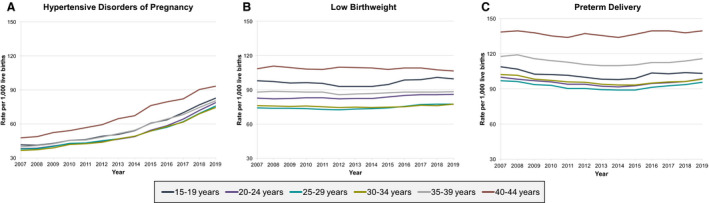
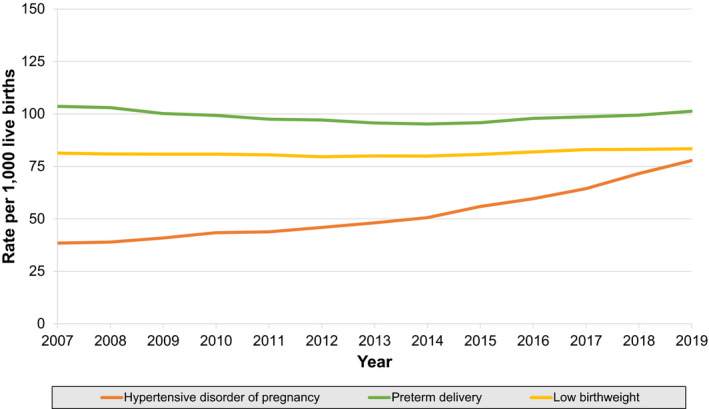
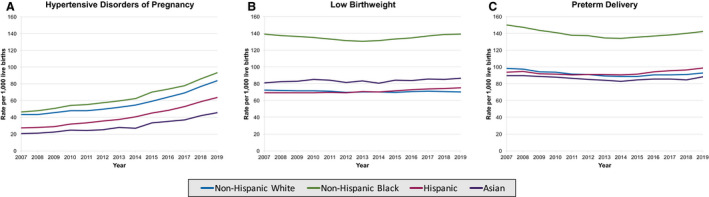
Background Adverse pregnancy outcomes (APOs) (hypertensive disorders of pregnancy [HDP], preterm delivery [PTD], or low birth weight [LBW]) are associated adverse maternal and offspring cardiovascular outcomes. Therefore, we sought to describe nationwide temporal trends in the burden of each APO (HDP, PTD, LBW) from 2007 to 2019 to inform strategies to optimize maternal and offspring health outcomes. Methods and Results We performed a serial cross-sectional analysis of APO subtypes (HDP, PTD, LBW) from 2007 to 2019. We included maternal data from all live births that occurred in the United States using the National Center for Health Statistics Natality Files. We quantified age-standardized and age-specific rates of APOs per 1000 live births and their respective mean annual percentage change. All analyses were stratified by self-report of maternal race and ethnicity. Among 51 685 525 live births included, 15% were to non-Hispanic Black individuals, 24% Hispanic individuals, and 6% Asian individuals. Between 2007 and 2019, age standardized HDP rates approximately doubled, from 38.4 (38.2-38.6) to 77.8 (77.5-78.1) per 1000 live births. A significant inflection point was observed in 2014, with an acceleration in the rate of increase of HDP from 2007 to 2014 (+4.1% per year [3.6-4.7]) to 2014 to 2019 (+9.1% per year [8.1-10.1]). Rates of PTD and LBW increased significantly when co-occurring in the same pregnancy with HDP. Absolute rates of APOs were higher in non-Hispanic Black individuals and in older age groups. However, similar relative increases were seen across all age,racial and ethnic groups. Conclusions In aggregate, APOs now complicate nearly 1 in 5 live births. Incidence of HDP has increased significantly between 2007 and 2019 and contributed to the reversal of favorable trends in PTD and LBW. Similar patterns were observed in all age groups, suggesting that increasing maternal age at pregnancy does not account for these trends. Black-White disparities persisted throughout the study period.
不良妊娠结局(APO)(妊娠高血压疾病[HDP]、早产[PTD]或低出生体重[LBW])与母婴心血管不良结局相关。因此,我们旨在描述 2007 年至 2019 年期间每种 APO(HDP、PTD、LBW)的全国性时间趋势,为优化母婴健康结局的策略提供信息。
我们对 2007 年至 2019 年期间的 APO 亚型(HDP、PTD、LBW)进行了一系列的横断面分析。我们使用国家卫生统计中心生育档案,纳入了美国所有活产儿的产妇数据。我们量化了每 1000 例活产儿中 APO 的年龄标准化和年龄特异性发生率及其各自的年均百分比变化。所有分析均按产妇的种族和民族的自我报告进行分层。在纳入的 5168.525 例活产儿中,15%为非西班牙裔黑人,24%为西班牙裔,6%为亚裔。2007 年至 2019 年期间,HDP 的年龄标准化发生率增加了近一倍,从每 1000 例活产儿 38.4(38.2-38.6)增加到 77.8(77.5-78.1)。2014 年观察到一个明显的拐点,HDP 的增长率从 2007 年至 2014 年(每年 4.1%[3.6-4.7])加速到 2014 年至 2019 年(每年 9.1%[8.1-10.1])。当 HDP 与 PTD 同时发生在同一妊娠中时,PTD 和 LBW 的发生率显著增加。非西班牙裔黑人个体和年龄较大的年龄组中 APO 的绝对发生率较高。然而,所有年龄、种族和族裔群体中都观察到了类似的相对增加。
总的来说,APO 现在使近五分之一的活产儿复杂化。2007 年至 2019 年期间,HDP 的发病率显著增加,导致 PTD 和 LBW 的有利趋势逆转。所有年龄组都观察到类似的模式,表明妊娠时产妇年龄的增加并不是造成这些趋势的原因。黑人和白人之间的差距在整个研究期间持续存在。