Lv Nan, Ajilore Olusola A, Xiao Lan, Venditti Elizabeth M, Lavori Philip W, Gerber Ben S, Snowden Mark B, Wittels Nancy E, Ronneberg Corina R, Stetz Patrick, Barve Amruta, Shrestha Rohit, Dosala Sushanth, Kumar Vikas, Eckley Tessa L, Goldstein-Piekarski Andrea N, Smyth Joshua M, Rosas Lisa G, Kannampallil Thomas, Zulueta John, Suppes Trisha, Williams Leanne M, Ma Jun
Institute for Health Research and Policy, University of Illinois at Chicago, Chicago, Illinois.
Department of Psychiatry, University of Illinois at Chicago, Chicago, Illinois.
Biol Psychiatry Glob Open Sci. 2022 Apr 5;3(3):430-442. doi: 10.1016/j.bpsgos.2022.03.012. eCollection 2023 Jul.
Integrated treatments for comorbid depression (often with anxiety) and obesity are lacking; mechanisms are poorly investigated.
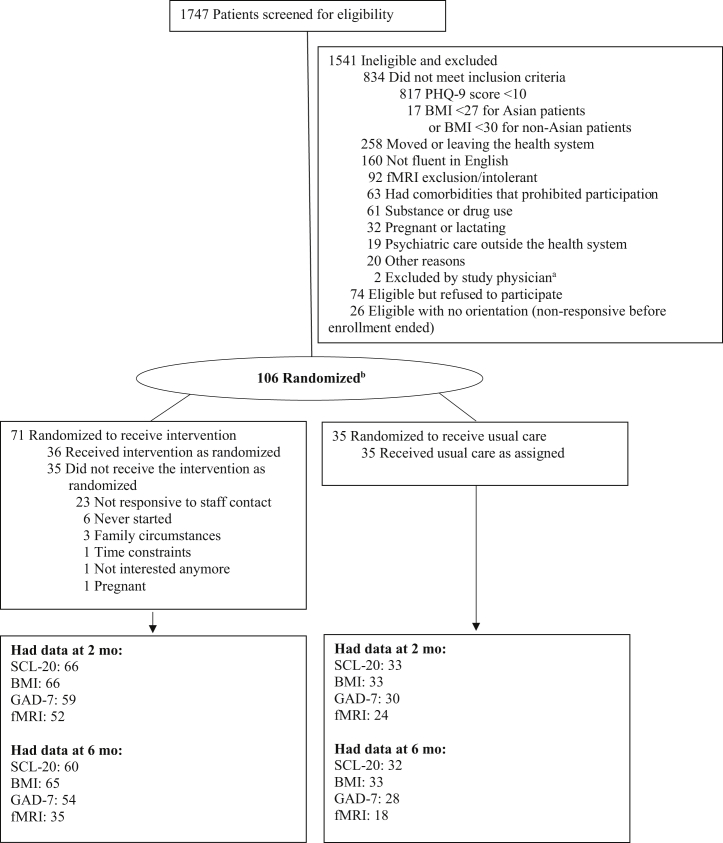
In a mechanistic pilot trial, adults with body mass index ≥30 and Patient Health Questionnaire-9 scores ≥10 were randomized to usual care ( = 35) or an integrated behavioral intervention ( = 71). Changes at 6 months in body mass index and Depression Symptom Checklist-20 scores were co-primary outcomes, and Generalized Anxiety Disorder Scale-7 score was a secondary outcome. Changes at 2 months in the activation and functional connectivity of regions of interest in the negative affect circuit were primary neural targets, and secondary targets were in the cognitive control, default mode, and positive affect circuits.
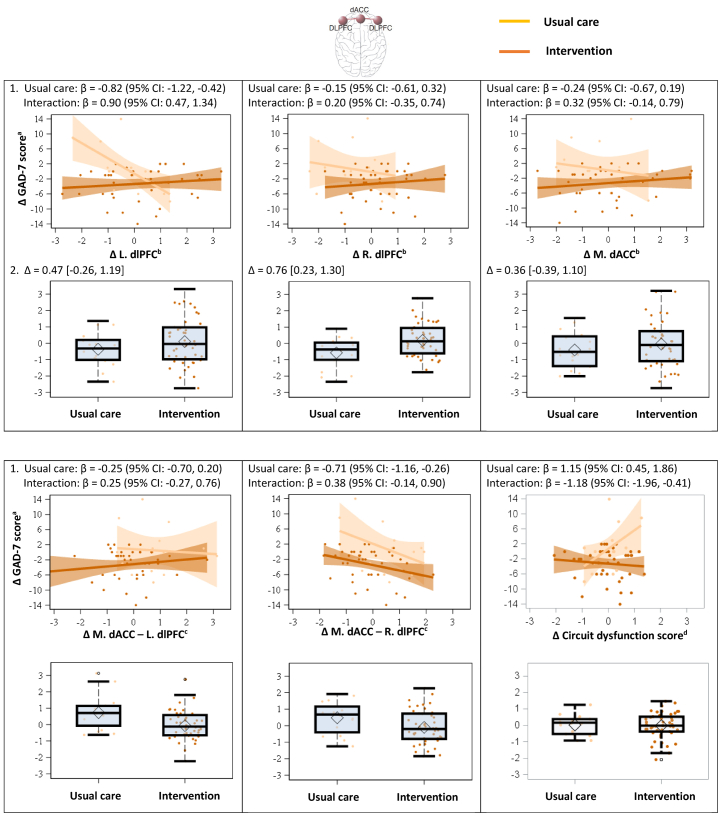
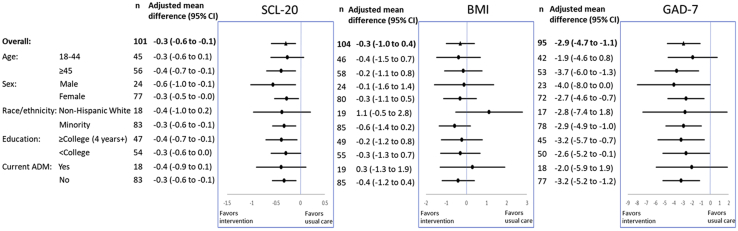
Participants were 47.0 years (SD = 11.9 years), 76% women, 55% Black, and 20% Latino. Depression Symptom Checklist-20 (between-group difference, -0.3 [95% CI: -0.6 to -0.1]) and Generalized Anxiety Disorder Scale-7 (-2.9 [-4.7 to -1.1]) scores, but not body mass index, decreased significantly at 6 months in the intervention versus usual care groups. Only Generalized Anxiety Disorder Scale-7 score changes at 6 months significantly correlated with neural target changes at 2 months in the negative affect (anterior insula, subgenual/pregenual anterior cingulate cortex, amygdala) and cognitive control circuits (dorsal lateral prefrontal cortex, dorsal anterior cingulate cortex). Effects were medium to large (0.41-1.18 SDs). Neural target changes at 2 months in the cognitive control circuit only differed by treatment group. Effects were medium (0.58-0.79 SDs).
Compared with usual care, the study intervention led to significantly improved depression but not weight loss, and the results on neural targets were null for both outcomes. The significant intervention effect on anxiety might be mediated through changes in the cognitive control circuit, but this warrants replication.
针对合并抑郁症(常伴有焦虑症)和肥胖症的综合治疗方法匮乏;相关机制研究不足。
在一项机制性先导试验中,将体重指数≥30且患者健康问卷-9得分≥10的成年人随机分为常规护理组(n = 35)或综合行为干预组(n = 71)。体重指数和抑郁症状清单-20得分在6个月时的变化为共同主要结局,广泛性焦虑障碍量表-7得分是次要结局。消极情绪回路中感兴趣区域的激活和功能连接在2个月时的变化是主要神经靶点,次要靶点位于认知控制、默认模式和积极情绪回路。
参与者的年龄为47.0岁(标准差 = 11.9岁),76%为女性,55%为黑人,20%为拉丁裔。与常规护理组相比,干预组在6个月时抑郁症状清单-20得分(组间差异,-0.3 [95%置信区间:-0.6至-0.1])和广泛性焦虑障碍量表-7得分(-2.9 [-4.7至-1.1])显著降低,但体重指数未显著降低。仅6个月时广泛性焦虑障碍量表-7得分的变化与消极情绪(前脑岛、膝下/膝前扣带回皮质、杏仁核)和认知控制回路(背外侧前额叶皮质、背侧前扣带回皮质)在2个月时的神经靶点变化显著相关。效应为中等至较大(0.41 - 1.18标准差)。仅认知控制回路在2个月时的神经靶点变化因治疗组而异。效应为中等(0.58 - 0.79标准差)。
与常规护理相比,该研究干预显著改善了抑郁症状,但未导致体重减轻,且对两个结局的神经靶点结果均为无效。对焦虑症的显著干预效果可能是通过认知控制回路的变化介导的,但这需要重复验证。