Teferi Marta, Makhoul Walid, Deng Zhi-De, Oathes Desmond J, Sheline Yvette, Balderston Nicholas L
Center for Neuromodulation in Depression and Stress, Department of Psychiatry, University of Pennsylvania, Philadelphia, Pennsylvania.
Noninvasive Neuromodulation Unit, Experimental Therapeutics and Pathophysiology Branch, National Institute of Mental Health, National Institutes of Health, Bethesda, Maryland.
Biol Psychiatry Glob Open Sci. 2022 Apr 25;3(3):470-479. doi: 10.1016/j.bpsgos.2022.04.001. eCollection 2023 Jul.
Convergent neuroimaging and neuromodulation studies implicate the right dorsolateral prefrontal cortex (dlPFC) as a key region involved in anxiety-cognition interactions. However, neuroimaging data are correlational, and neuromodulation studies often lack appropriate methodological controls. Accordingly, this work was designed to explore the role of right prefrontal cognitive control mechanisms in the expression/regulation of anxiety using continuous theta-burst transcranial magnetic stimulation (cTBS) and threat of unpredictable shock. Based on prior neuromodulation studies, we hypothesized that the right dlPFC contributed to anxiety expression, and that cTBS should downregulate this expression.
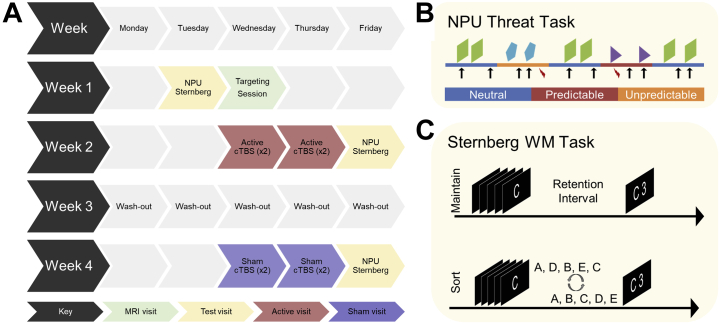
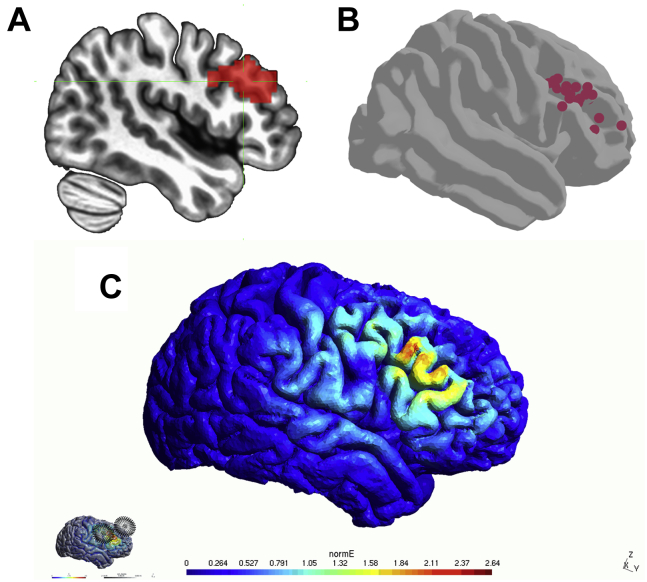
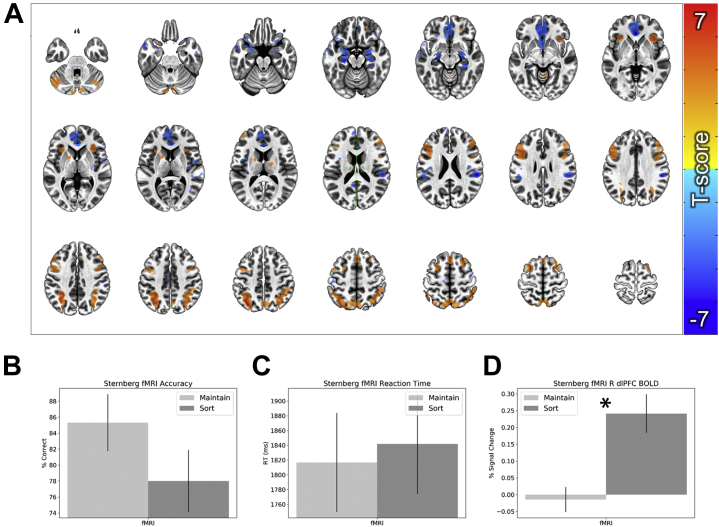
We measured potentiated startle and performance on the Sternberg working memory paradigm in 28 healthy participants before and after 4 sessions (600 pulses/session) of active or sham cTBS. Stimulation was individualized to the right dlPFC site of maximal working memory-related activity and optimized using electric-field modeling.
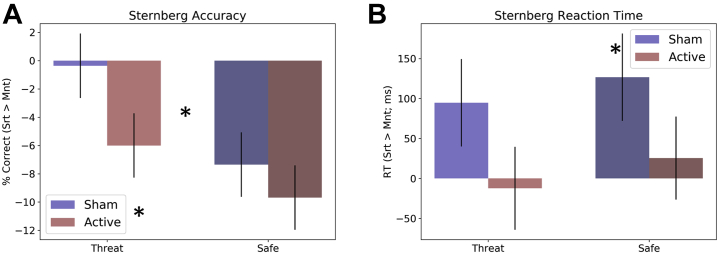
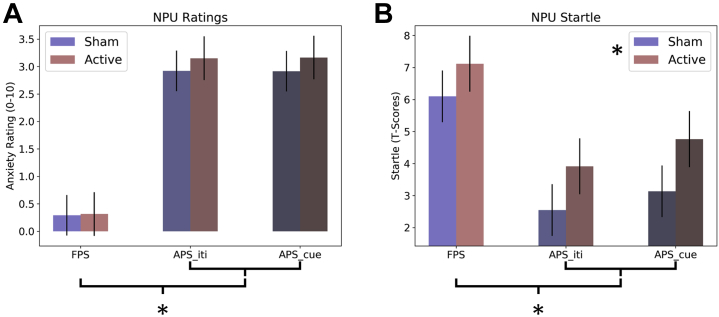
Compared with sham cTBS, active cTBS, which is thought to induce long-term depression-like synaptic changes, increased startle during threat of shock, but the effect was similar for predictable and unpredictable threat. As a measure of target (dis)engagement, we also showed that active but not sham cTBS decreased accuracy on the Sternberg task.
Counter to our initial hypothesis, cTBS to the right dlPFC made individuals more anxious, rather than less anxious. Although preliminary, these results are unlikely to be due to transient effects of the stimulation, because anxiety was measured 24 hours after cTBS. In addition, these results are unlikely to be due to off-target effects, because target disengagement was evident from the Sternberg performance data.
神经影像学和神经调节研究趋同表明,右侧背外侧前额叶皮质(dlPFC)是参与焦虑与认知相互作用的关键区域。然而,神经影像学数据具有相关性,且神经调节研究往往缺乏适当的方法学对照。因此,本研究旨在利用连续theta爆发式经颅磁刺激(cTBS)和不可预测的电击威胁,探讨右侧前额叶认知控制机制在焦虑表达/调节中的作用。基于先前的神经调节研究,我们假设右侧dlPFC促成焦虑表达,且cTBS应下调这种表达。
我们在28名健康参与者进行4次(每次600脉冲)主动或假cTBS前后,测量了惊吓增强以及在斯特恩伯格工作记忆范式中的表现。刺激针对与工作记忆相关活动最强的右侧dlPFC位点进行个体化设置,并使用电场模型进行优化。
与假cTBS相比,被认为可诱导类似长期抑郁样突触变化的主动cTBS,在电击威胁期间增加了惊吓反应,但可预测和不可预测威胁的效果相似。作为目标(脱离)参与的一项指标,我们还表明,主动而非假cTBS降低了斯特恩伯格任务的准确性。
与我们最初的假设相反,对右侧dlPFC进行cTBS使个体更加焦虑,而非减轻焦虑。尽管这些结果是初步的,但不太可能是由于刺激的短暂效应,因为在cTBS后24小时测量了焦虑。此外,这些结果不太可能是由于非靶向效应,因为从斯特恩伯格表现数据中可明显看出目标脱离。