Sheber Melissa, McKnight Mackenzie, Liebzeit Daniel, Seaman Aaron, Husser Erica K, Buck Harleah, Reisinger Heather S, Lee Sangil
Department of Emergency Medicine University of Iowa Carver College of Medicine Iowa City Iowa USA.
University of Iowa College of Nursing Iowa City Iowa USA.
J Am Coll Emerg Physicians Open. 2023 Jul 28;4(4):e13012. doi: 10.1002/emp2.13012. eCollection 2023 Aug.
We sought to identify what matters to older adults (60 years and older) presenting to the emergency department (ED) and the challenges or concerns they identify related to medication, mobility, and mentation to inform how the 4Ms framework could improve care of older adults in the ED setting.
A qualitative study was conducted using the 4Ms to identify what matters to older adults (≥60 years old) presenting to the ED and what challenges or concerns they identify related to medication, mobility, and mentation. We conducted semi-structured interviews with a convenience sample of patients in a single ED. Interview guide responses and interviewer field notes were entered into REDCap. Interviews were reviewed by the research team (2 coders per interview) who inductively assigned codes. A codebook was created through an iterative process and was used to group codes into themes and sub-themes within the 4Ms framework.
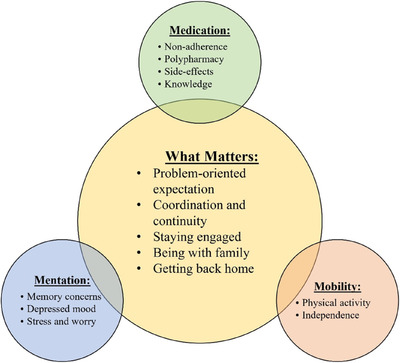
A total of 20 ED patients participated in the interviews lasting 30-60 minutes. Codes identified for "what matters" included problem-oriented expectation, coordination and continuity, staying engaged, being with family, and getting back home. Codes related to the other 4Ms (medication, mobility, and mentation) described challenges. Medication challenges included: non-adherence, side effects, polypharmacy, and knowledge. Mobility challenges included physical activity and independence. Last, mentation challenges included memory concerns, depressed mood, and stress and worry.
Our study used the 4Ms to identify "what matters" to older adults presenting to the ED and the challenges they face regarding medication, mobility, and mentation. Understanding what matters to patients and the specific challenges they face can help shape and individualize a patient-centered approach to care to facilitate the goals of care discussion and handoff to the next care team.
我们试图确定对于前往急诊科(ED)就诊的老年人(60岁及以上)而言重要的事项,以及他们所确定的与药物治疗、行动能力和认知相关的挑战或担忧,以便为4Ms框架如何改善急诊科环境中老年人的护理提供信息。
采用4Ms进行了一项定性研究,以确定前往急诊科就诊的老年人(≥60岁)认为重要的事项,以及他们所确定的与药物治疗、行动能力和认知相关的挑战或担忧。我们对一家急诊科的便利样本患者进行了半结构化访谈。访谈指南的回答和访谈者的现场记录被录入REDCap。研究团队(每次访谈2名编码员)对访谈进行了审查,他们通过归纳法分配代码。通过迭代过程创建了一个编码手册,并用于将代码分组为4Ms框架内的主题和子主题。
共有20名急诊科患者参与了时长30至60分钟的访谈。为“重要事项”确定的代码包括以问题为导向的期望、协调与连续性、保持参与、与家人在一起以及回家。与其他4Ms(药物治疗、行动能力和认知)相关的代码描述了挑战。药物治疗挑战包括:不依从、副作用、多重用药和知识问题。行动能力挑战包括身体活动和独立性。最后,认知挑战包括记忆力问题、情绪低落以及压力和担忧。
我们的研究使用4Ms确定了前往急诊科就诊的老年人认为“重要的事项”以及他们在药物治疗、行动能力和认知方面面临的挑战。了解对患者重要的事项以及他们面临的具体挑战有助于形成并个性化以患者为中心的护理方法,以促进护理讨论的目标以及向下一个护理团队的交接。