Tarfa Adati, Sayles Harlan, Bares Sara H, Havens Joshua P, Fadul Nada
School of Pharmacy, University of Wisconsin-Madison, Madison, Wisconsin, USA.
College of Public Health, University of Nebraska Medical Center, University of Nebraska, Omaha, Nebraska, USA.
Open Forum Infect Dis. 2023 Jul 7;10(7):ofad341. doi: 10.1093/ofid/ofad341. eCollection 2023 Jul.
The approval of long-acting injectable cabotegravir/rilpivirine (LAI CAB/RPV) heightened the urgency of ensuring effective implementation. Our study assesses readiness and barriers to implement LAI CAB/RPV across Ryan White-funded clinics in the United States.
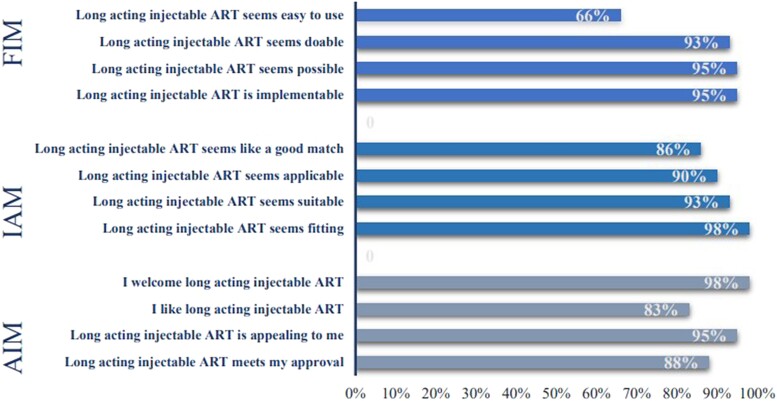
We conducted a cross-sectional survey between December 2020 and January 2021 using validated 4-item measures: acceptability of intervention measure (AIM), intervention appropriateness measure (IAM), and feasibility of intervention measure (FIM). Associations between measures and clinic characteristics were evaluated via Spearman rank correlations. A 5-point Likert scale ranked potential barriers of implementation responses. Open-ended questions were analyzed through a thematic approach.
Of 270 clinics, 44 (16%) completed the survey: 38% federally qualified health centers, 36% academic, 20% community-based organizations, 14% hospital outpatient, and 9% nonprofit. Means (SD; range) were as follows: AIM, 17.6 (2.4; 12-20); IAM, 17.6 (2.4; 13-20); and FIM, 16.8 (2.9; 7-20). Twenty percent were not at all ready to implement LAI CAB/RPV, and 52% were slightly or somewhat ready. There was a significant association between AIM and the proportion of Medicaid patients (AIM, rho = 0.312, = .050). Community-based organizations scored the highest readiness measures (mean [SD]: AIM, 19.50 [1.41]; IAM, 19.25 [1.49]; FIM, 19.13 [1.36]) as compared with other clinics. Implementation barriers were cost and patients' nonadherence to visits.
There is variability of readiness yet high levels of perceived acceptability and appropriateness of implementing LAI CAB/RPV among Ryan White clinics, necessitating tailored interventions for successful implementation. A special focus on addressing the barriers of adherence and the cost of implementation is needed.
长效注射用卡博特韦/利匹韦林(LAI CAB/RPV)的获批增加了确保有效实施的紧迫性。我们的研究评估了美国瑞安·怀特基金资助诊所实施LAI CAB/RPV的准备情况和障碍。
我们在2020年12月至2021年1月期间进行了一项横断面调查,使用经过验证的4项指标:干预措施可接受性指标(AIM)、干预措施适宜性指标(IAM)和干预措施可行性指标(FIM)。通过斯皮尔曼等级相关性评估指标与诊所特征之间的关联。采用5点李克特量表对实施反应的潜在障碍进行排名。通过主题分析法对开放式问题进行分析。
在270家诊所中,44家(16%)完成了调查:38%为联邦合格健康中心,36%为学术机构,20%为社区组织,14%为医院门诊,9%为非营利组织。均值(标准差;范围)如下:AIM为17.6(2.4;12 - 20);IAM为17.6(2.4;13 - 20);FIM为16.8(2.9;7 - 20)。20%的诊所完全没有准备好实施LAI CAB/RPV,52%的诊所准备程度为轻微或一般。AIM与医疗补助患者比例之间存在显著关联(AIM,rho = 0.312,P = 0.050)。与其他诊所相比,社区组织的准备程度指标得分最高(均值[标准差]:AIM为19.50[1.41];IAM为19.25[1.49];FIM为19.13[1.36])。实施障碍包括成本和患者不按时就诊。
瑞安·怀特诊所对实施LAI CAB/RPV的准备程度存在差异,但感知到的可接受性和适宜性水平较高,因此需要针对性的干预措施以成功实施。需要特别关注解决依从性障碍和实施成本问题。