Rasouli Milad, Blair Helen, Troester Selina, Szoltysek Katarzyna, Cameron Rachel, Ashtiani Minoo, Krippner-Heidenreich Anja, Grebien Florian, McGeehan Gerard, Zwaan C Michel, Heidenreich Olaf
Princess Maxima Center for pediatric Oncology, Utrecht, The Netherlands.
Department of Pediatric Hematology/Oncology, Erasmus MC-Sophia Children's Hospital, Rotterdam, The Netherlands.
Hemasphere. 2023 Jul 27;7(8):e935. doi: 10.1097/HS9.0000000000000935. eCollection 2023 Aug.
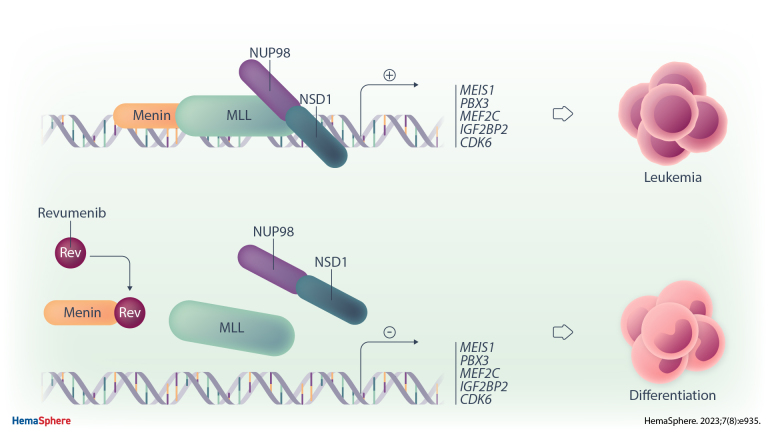
Chromosomal translocations involving the locus are among the most prevalent rearrangements in pediatric acute myeloid leukemia (AML). AML with fusions is characterized by high expression of and genes and is associated with poor clinical outcome. NUP98 fusion proteins are recruited to their target genes by the mixed lineage leukemia (MLL) complex, which involves a direct interaction between MLL and Menin. Here, we show that therapeutic targeting of the Menin-MLL interaction inhibits the propagation of -rearrranged AML both ex vivo and in vivo. Treatment of primary AML cells with the Menin inhibitor revumenib (SNDX-5613) impairs proliferation and clonogenicity ex vivo in long-term coculture and drives myeloid differentiation. These phenotypic effects are associated with global gene expression changes in primary AML samples that involve the downregulation of many critical NUP98 fusion protein-target genes, such as and . In addition, Menin inhibition reduces the expression of both wild-type and mutated -ITD, and in combination with FLT3 inhibitor, suppresses patient-derived -r AML cells in a synergistic manner. Revumenib treatment blocks leukemic engraftment and prevents leukemia-associated death of immunodeficient mice transplanted with NUP98::NSD1 FLT3-ITD-positive patient-derived AML cells. These results demonstrate that -rearranged AMLs are highly susceptible to inhibition of the MLL-Menin interaction and suggest the inclusion of AML patients harboring fusions into the clinical evaluation of Menin inhibitors.
涉及该位点的染色体易位是小儿急性髓系白血病(AML)中最常见的重排之一。伴有该融合的AML的特征是该基因和另一基因的高表达,并与不良临床预后相关。NUP98融合蛋白通过混合谱系白血病(MLL)复合物被募集到其靶基因,该复合物涉及MLL和Menin之间的直接相互作用。在此,我们表明,对Menin-MLL相互作用进行治疗性靶向可在体外和体内抑制该重排AML的增殖。用Menin抑制剂瑞武尼布(SNDX-5613)处理原发性AML细胞会在长期共培养中损害其体外增殖和克隆形成能力,并驱动髓系分化。这些表型效应与原发性AML样本中的整体基因表达变化相关,这些变化涉及许多关键的NUP98融合蛋白靶基因(如某些基因)的下调。此外,抑制Menin可降低野生型该基因和突变型该基因内部串联重复序列(-ITD)的表达,并且与FLT3抑制剂联合使用时,可协同抑制患者来源的该重排AML细胞。瑞武尼布治疗可阻止白血病植入,并防止移植了NUP98::NSD1 FLT3-ITD阳性患者来源AML细胞的免疫缺陷小鼠发生白血病相关死亡。这些结果表明,该重排AML对抑制MLL-Menin相互作用高度敏感,并建议将伴有该融合的AML患者纳入Menin抑制剂的临床评估。