Hare K S, Wood K M, Sargent R, Steele M A
Department of Animal Biosciences, Animal Science and Nutrition, Ontario Agricultural College, University of Guelph, Guelph, ON, Canada N1G 1Y2.
Saskatoon Colostrum Company Ltd., Saskatoon, SK, Canada S7K 6A2.
JDS Commun. 2023 Mar 16;4(4):313-317. doi: 10.3168/jdsc.2022-0351. eCollection 2023 Jul.
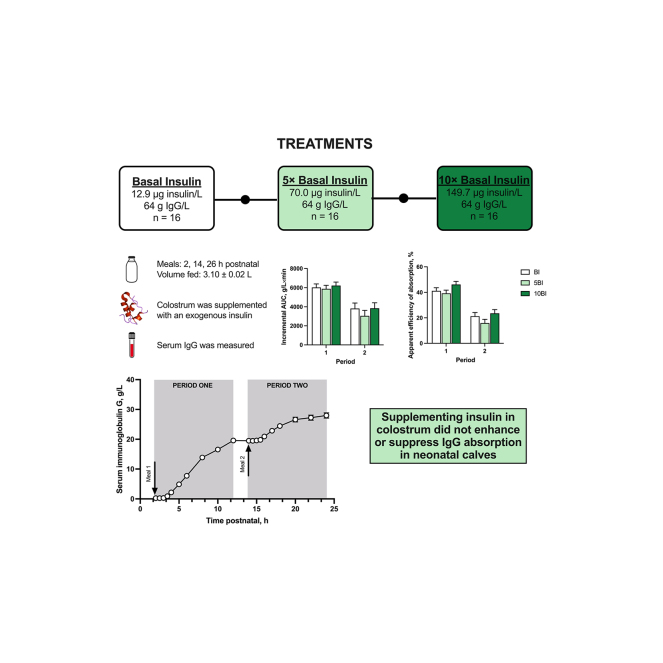
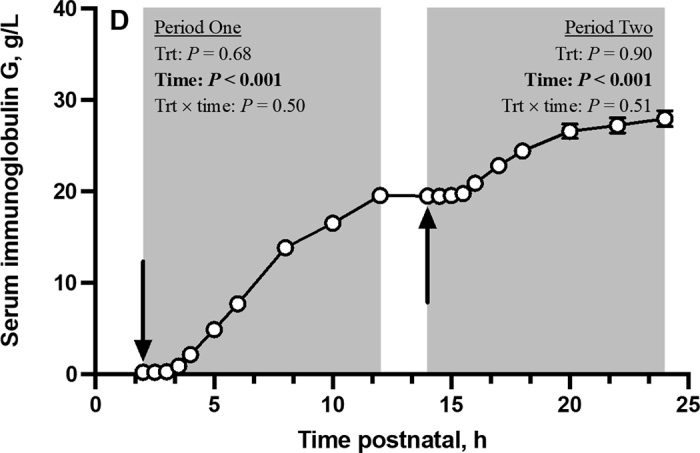
Since insulin has been demonstrated to suppress IgG absorption in other neonatal species, we had the objective to delineate how colostral insulin concentrations affect IgG absorption in neonatal bovines. We enrolled Holstein bull calves (n = 48; body weight = 46.3 ± 0.84 kg) at birth and randomized them by birth order to receive (1) colostrum that contained basal insulin concentrations (12.9 μg/L; n = 16), or colostrum that had been supplemented with an exogenous insulin to increase the insulin concentration to either (2) 5 times (70.0 μg/L; n = 16) or (3) 10 times (149.7 μg/L; n = 16) that of the basal colostrum. Gross colostrum composition (crude fat: 4.1 ± 0.06%; crude protein: 11.7 ± 0.05%; lactose: 1.9 ± 0.01%; IgG: 63.9 ± 1.19 g/L) was similar between treatments and calves were fed (7% body weight, 3.1 ± 0.06 L) their treatments at 2, 14, and 26 h postnatal. Serum was collected at 0, 30, 60, 90, 120, 180, 240, 360, 480, and 600 min postprandial respective to the first and second colostrum feeding and analyzed for IgG concentration. The incremental area under the curve (I-AUC) and apparent efficiency of absorption (AEA) were calculated for the 10-h periods following the first and second colostrum meal. Serum IgG concentrations over time, I-AUC, and AEA were statistically analyzed as a complete randomized design. Colostrum insulin concentration did not affect serum IgG concentrations or the I-AUC or AEA after calves were fed colostrum at 2 and 14 h postnatal. High colostral insulin content is not detrimental or promotive to IgG absorption in neonatal Holstein bulls.
由于胰岛素已被证明可抑制其他新生动物物种中的IgG吸收,我们的目标是确定初乳中的胰岛素浓度如何影响新生牛的IgG吸收。我们在出生时招募了荷斯坦公牛犊(n = 48;体重 = 46.3 ± 0.84 kg),并按出生顺序将它们随机分组,以接受:(1)含有基础胰岛素浓度(12.9 μg/L;n = 16)的初乳,或已添加外源性胰岛素以使胰岛素浓度增加至(2)基础初乳的5倍(70.0 μg/L;n = 16)或(3)10倍(149.7 μg/L;n = 16)的初乳。各处理组之间的初乳总体成分(粗脂肪:4.1 ± 0.06%;粗蛋白:11.7 ± 0.05%;乳糖:1.9 ± 0.01%;IgG:63.9 ± 1.19 g/L)相似,并且在出生后2、14和26小时给犊牛饲喂(7%体重,3.1 ± 0.06 L)其相应处理的初乳。在第一次和第二次初乳饲喂后的餐后0、30、60、90、120、180、240、360、480和600分钟分别采集血清,并分析IgG浓度。计算第一次和第二次初乳饲喂后10小时期间的曲线下增量面积(I-AUC)和表观吸收效率(AEA)。血清IgG浓度随时间的变化、I-AUC和AEA作为完全随机设计进行统计分析。在出生后2小时和14小时给犊牛饲喂初乳后,初乳胰岛素浓度不影响血清IgG浓度或I-AUC或AEA。初乳中高胰岛素含量对新生荷斯坦公牛的IgG吸收既无有害影响也无促进作用。