Gao Hai-Ling, Cui Qingbin, Wang Jing-Quan, Ashby Charles R, Chen Yanchun, Shen Zhi-Xin, Chen Zhe-Sheng
Department of Histology and Embryology, Weifang Medical University, Weifang, Shandong, China.
Department of Pharmaceutical Sciences, College of Pharmacy and Health Sciences, St. John's University, Queens, NY, United States.
Front Pharmacol. 2023 Jul 13;14:1235285. doi: 10.3389/fphar.2023.1235285. eCollection 2023.
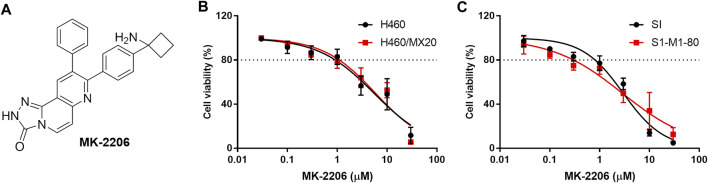
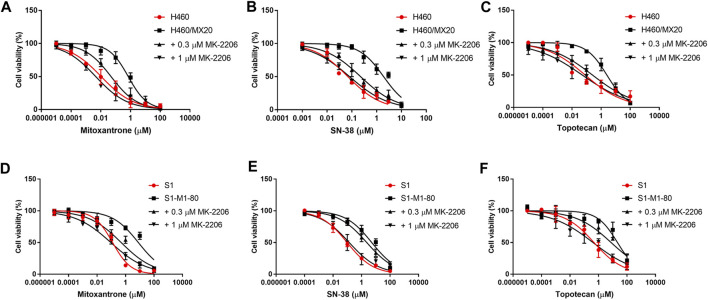
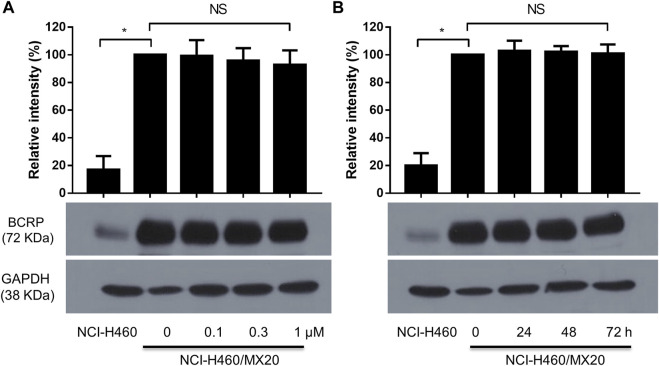
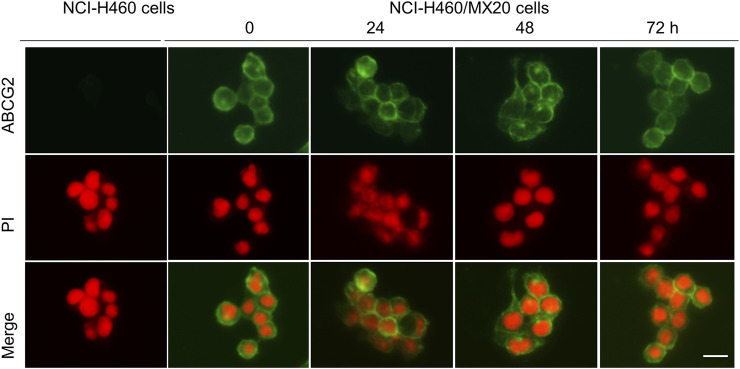
The overexpression of ATP-binding cassette (ABC) transporters, ABCB1 and ABCG2, are two of the major mediators of multidrug resistance (MDR) in cancers. Although multiple ABCB1 and ABCG2 inhibitors have been developed and some have undergone evaluation in clinical trials, none have been clinically approved. The compound, MK-2206, an inhibitor of the protein kinases AKT1/2/3, is undergoing evaluation in multiple clinical trials for the treatment of certain types of cancers, including those resistant to erlotinib. In this study, we conducted experiments to determine if MK-2206 attenuates multidrug resistance in cancer cells overexpressing the ABCB1 or ABCG2 transporter. The efficacy of MK-2206 (0.03-1 μM), in combination with the ABCB1 transporter sub-strates doxorubicin and paclitaxel, and ABCG2 transporter substrates mitoxantrone, SN-38 and topotecan, were determined in the cancer cell lines, KB-C2 and SW620/Ad300, which overexpress the ABCB1 transporter or H460/MX20 and S1-M1-80, which overexpress the ABCG2 transporter, respectively. The expression level and the localization of ABCG2 transporter on the cancer cells membranes were determined using western blot and immunofluorescence assays, respectively, following the incubation of cells with MK-2206. Finally, the interaction between MK-2206 and human ABCG2 transporter was predicted using computer-aided molecular modeling. MK-2206 significantly increased the efficacy of anticancer compounds that were substrates for the ABCG2 but not the ABCB1 transporter. MK-2206 alone (0.03-1 μM) did not significantly alter the viability of H460/MX20 and S1-M1-80 cancer cells, which overexpress the ABCG2 transporter, compared to cells incubated with vehicle. However, MK-2206 (0.3 and 1 μM) significantly increased the anticancer efficacy of mitoxantrone, SN-38 and topotecan, in H460/MX20 and S1-M1-80 cancer cells, as indicated by a significant decrease in their IC50 values, compared to cells incubated with vehicle. MK-2206 significantly increased the basal activity of the ABCG2 ATPase (EC50 = 0.46 μM) but did not significantly alter its expression level and sub-localization in the membrane. The molecular modeling results suggested that MK-2206 binds to the active pocket of the ABCG2 transporter, by a hydrogen bond, hydrophobic interactions and π-π stacking. These data indicated that MK-2206 surmounts resistance to mitoxantrone, SN-38 and topotecan in cancer cells overexpressing the ABCG2 transporter. If these results can be translated to humans, it is possible that MK-2206 could be used to surmount MDR in cancer cells overexpressing the ABCG2 transporter.
ATP结合盒(ABC)转运蛋白ABCB1和ABCG2的过表达是癌症多药耐药(MDR)的两个主要介导因素。尽管已经开发了多种ABCB1和ABCG2抑制剂,并且有些已在临床试验中进行了评估,但尚无一种获得临床批准。化合物MK-2206是蛋白激酶AKT1/2/3的抑制剂,正在多项临床试验中进行评估,用于治疗某些类型的癌症,包括对厄洛替尼耐药的癌症。在本研究中,我们进行了实验,以确定MK-2206是否能减弱过表达ABCB1或ABCG2转运蛋白的癌细胞中的多药耐药性。在分别过表达ABCB1转运蛋白的癌细胞系KB-C2和SW620/Ad300,或分别过表达ABCG2转运蛋白的H460/MX20和S1-M1-80中,测定了MK-2206(0.03 - 1 μM)与ABCB1转运蛋白底物阿霉素和紫杉醇,以及ABCG2转运蛋白底物米托蒽醌、SN-38和拓扑替康联合使用时的效果。在用MK-2206孵育细胞后,分别使用蛋白质印迹法和免疫荧光测定法测定癌细胞膜上ABCG2转运蛋白的表达水平和定位。最后,使用计算机辅助分子建模预测了MK-2206与人类ABCG2转运蛋白之间的相互作用。MK-2206显著提高了作为ABCG2而非ABCB1转运蛋白底物的抗癌化合物的疗效。与用赋形剂孵育的细胞相比,单独的MK-2206(0.03 - 1 μM)并未显著改变过表达ABCG2转运蛋白的H460/MX20和S1-M1-80癌细胞的活力。然而,与用赋形剂孵育的细胞相比,MK-2206(0.3和1 μM)显著提高了米托蒽醌、SN-38和拓扑替康在H460/MX20和S1-M1-80癌细胞中的抗癌疗效,表现为其IC50值显著降低。MK-2206显著提高了ABCG2 ATP酶的基础活性(EC50 = 0.46 μM),但并未显著改变其在膜中的表达水平和亚定位。分子建模结果表明,MK-2206通过氢键、疏水相互作用和π-π堆积与ABCG2转运蛋白的活性口袋结合。这些数据表明,MK-2206克服了过表达ABCG2转运蛋白的癌细胞对米托蒽醌、SN-38和拓扑替康的耐药性。如果这些结果能够转化到人体,那么MK-2206有可能用于克服过表达ABCG2转运蛋白的癌细胞中的多药耐药性。