Department of Molecular Biology, Princeton University, Princeton, New Jersey, United States of America.
Howard Hughes Medical Institute, Chevy Chase, Maryland, United States of America.
PLoS Genet. 2023 Jul 31;19(7):e1010809. doi: 10.1371/journal.pgen.1010809. eCollection 2023 Jul.
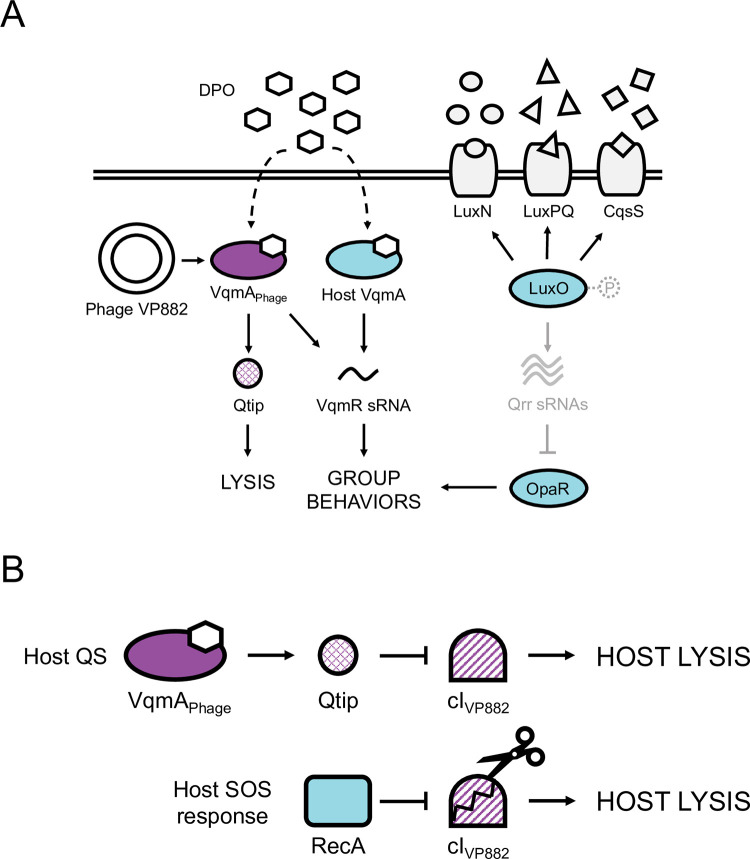
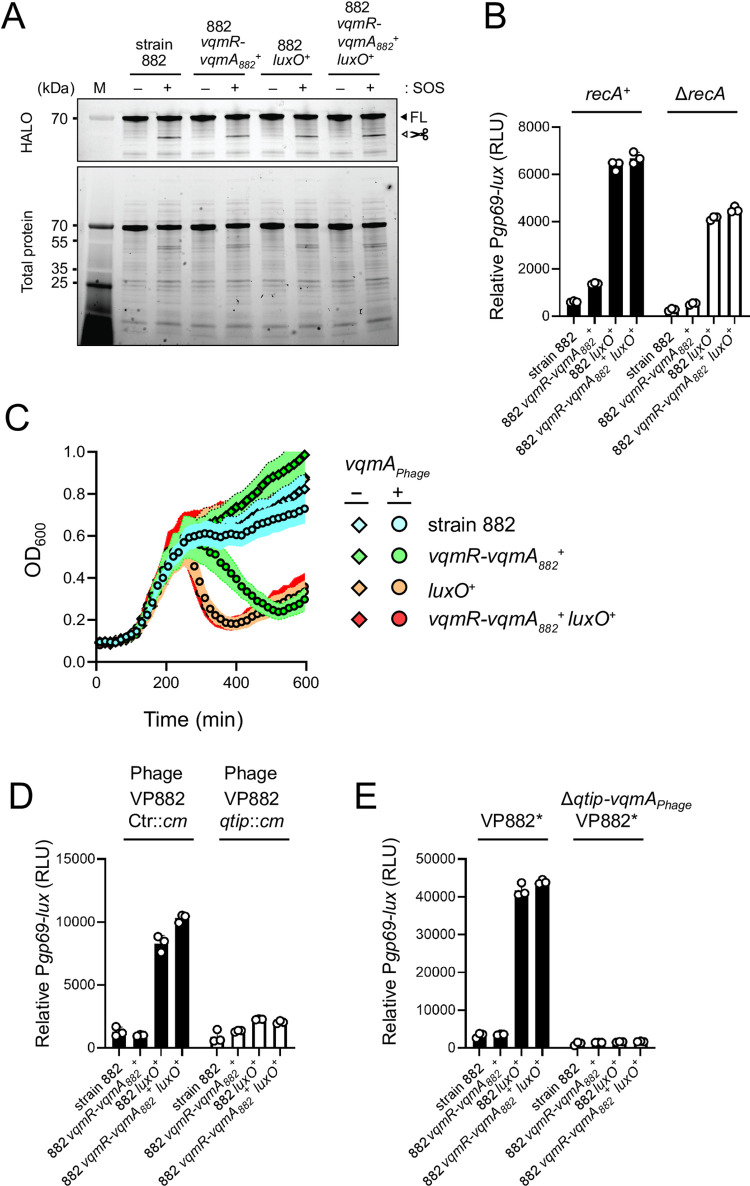
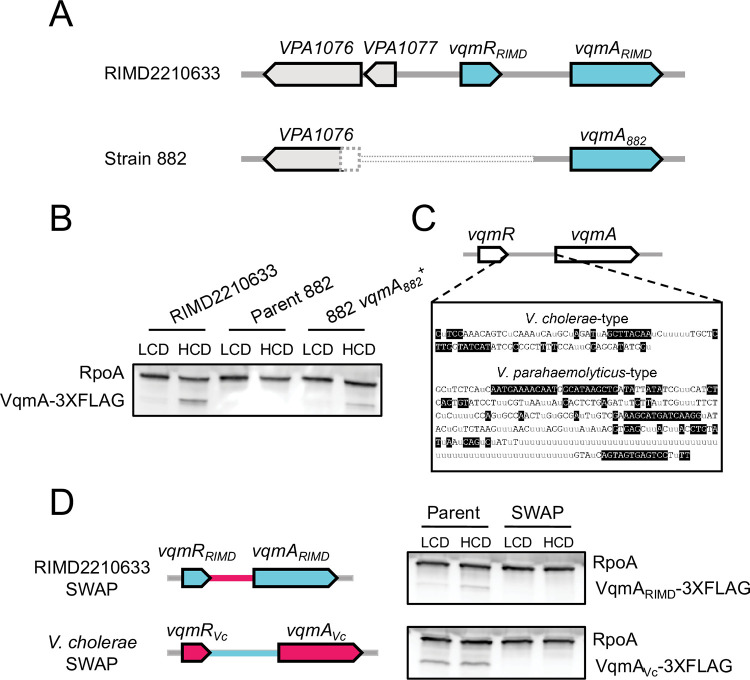
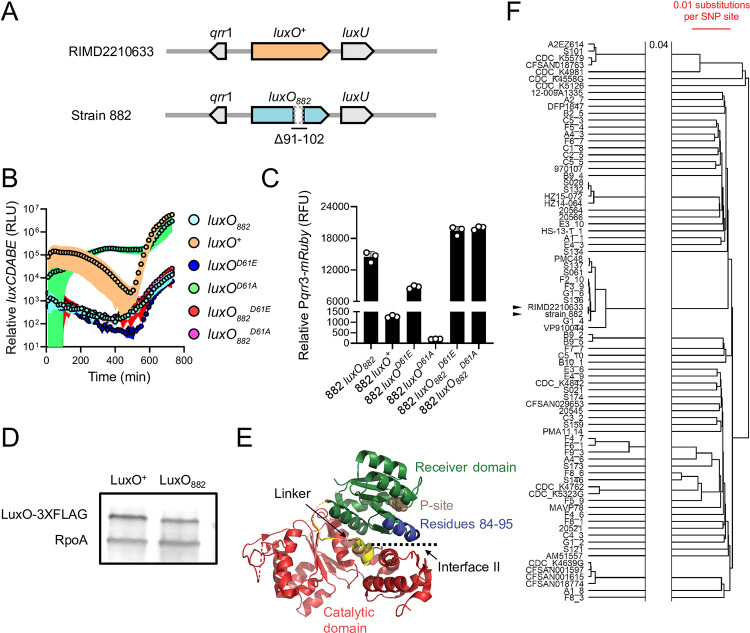
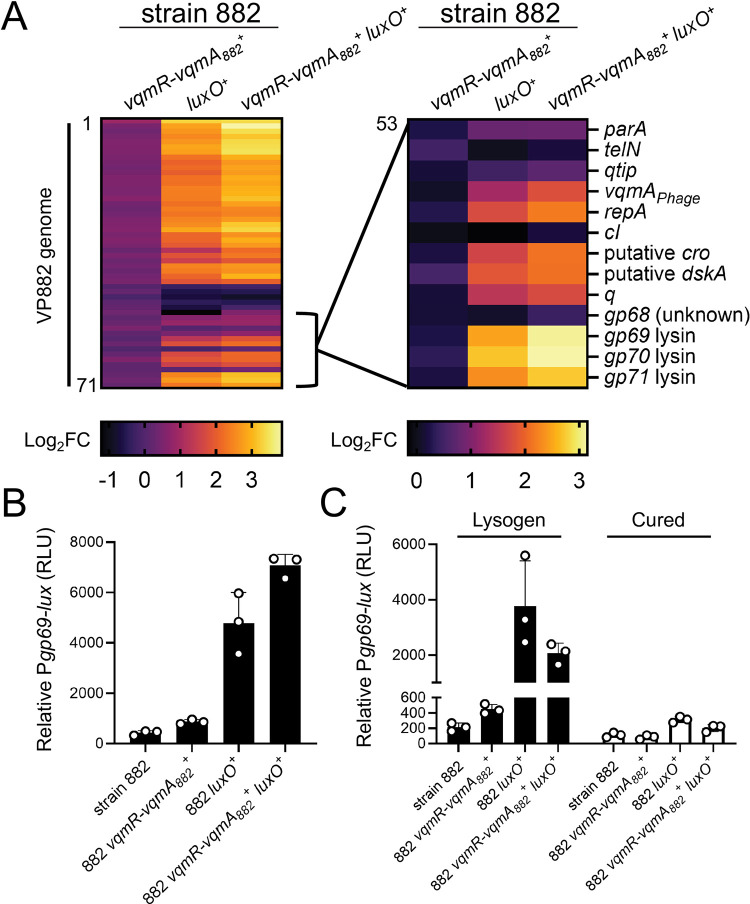
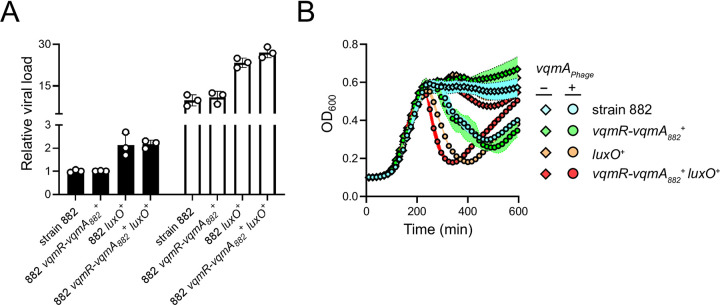
Quorum sensing (QS) is a chemical communication process that bacteria use to track population density and orchestrate collective behaviors. QS relies on the production, accumulation, and group-wide detection of extracellular signal molecules called autoinducers. Vibriophage 882 (phage VP882), a bacterial virus, encodes a homolog of the Vibrio QS receptor-transcription factor, called VqmA, that monitors the Vibrio QS autoinducer DPO. Phage VqmA binds DPO at high host-cell density and activates transcription of the phage gene qtip. Qtip, an antirepressor, launches the phage lysis program. Phage-encoded VqmA when bound to DPO also manipulates host QS by activating transcription of the host gene vqmR. VqmR is a small RNA that controls downstream QS target genes. Here, we sequence Vibrio parahaemolyticus strain O3:K6 882, the strain from which phage VP882 was initially isolated. The chromosomal region normally encoding vqmR and vqmA harbors a deletion encompassing vqmR and a portion of the vqmA promoter, inactivating that QS system. We discover that V. parahaemolyticus strain O3:K6 882 is also defective in its other QS systems, due to a mutation in luxO, encoding the central QS transcriptional regulator LuxO. Both the vqmR-vqmA and luxO mutations lock V. parahaemolyticus strain O3:K6 882 into the low-cell density QS state. Reparation of the QS defects in V. parahaemolyticus strain O3:K6 882 promotes activation of phage VP882 lytic gene expression and LuxO is primarily responsible for this effect. Phage VP882-infected QS-competent V. parahaemolyticus strain O3:K6 882 cells lyse more rapidly and produce more viral particles than the QS-deficient parent strain. We propose that, in V. parahaemolyticus strain O3:K6 882, constitutive maintenance of the low-cell density QS state suppresses the launch of the phage VP882 lytic cascade, thereby protecting the bacterial host from phage-mediated lysis.
群体感应(QS)是一种细菌用于跟踪种群密度并协调集体行为的化学通讯过程。QS 依赖于细胞外信号分子(称为自诱导物)的产生、积累和全组检测。弧菌噬菌体 882(噬菌体 VP882)是一种细菌病毒,它编码了一种与弧菌 QS 受体-转录因子同源的物质,称为 VqmA,它可以监测弧菌 QS 自动诱导剂 DPO。噬菌体 VqmA 在高宿主细胞密度下结合 DPO,并激活噬菌体基因 qtip 的转录。Qtip 是一种反阻遏物,启动噬菌体裂解程序。噬菌体编码的 VqmA 与 DPO 结合时,还通过激活宿主基因 vqmR 的转录来操纵宿主 QS。VqmR 是一种控制下游 QS 靶基因的小 RNA。在这里,我们对最初分离噬菌体 VP882 的弧菌 O3:K6 882 菌株进行了测序。通常编码 vqmR 和 vqmA 的染色体区域包含一个缺失,该缺失涵盖了 vqmR 和 vqmA 启动子的一部分,从而使该 QS 系统失活。我们发现,由于 luxO 基因突变,编码中央 QS 转录调节剂 LuxO 的弧菌 O3:K6 882 菌株也存在其他 QS 系统缺陷。LuxO 突变使弧菌 O3:K6 882 菌株锁定在低细胞密度 QS 状态。修复弧菌 O3:K6 882 菌株的 QS 缺陷会促进噬菌体 VP882 裂解基因表达的激活,而 LuxO 主要负责这种效应。与 QS 缺陷的亲本菌株相比,噬菌体 VP882 感染 QS 有效的弧菌 O3:K6 882 细胞更快地裂解,并产生更多的病毒颗粒。我们提出,在弧菌 O3:K6 882 菌株中,低细胞密度 QS 状态的持续维持抑制了噬菌体 VP882 裂解级联的启动,从而保护细菌宿主免受噬菌体介导的裂解。