Department of Orthodontics, Institute of Odontology, Sahlgrenska Academy, University of Gothenburg, Gothenburg, Sweden.
Department of Cariology, Institute of Odontology, University of Umeå, Umeå, Sweden.
Eur J Orthod. 2023 Sep 18;45(5):477-484. doi: 10.1093/ejo/cjad044.
To evaluate the effect of high-fluoride mouth rinse and high-fluoride toothpaste on the development of demineralized lesions (DLs) during orthodontic treatment.
Three-armed parallel-group randomized controlled trial.
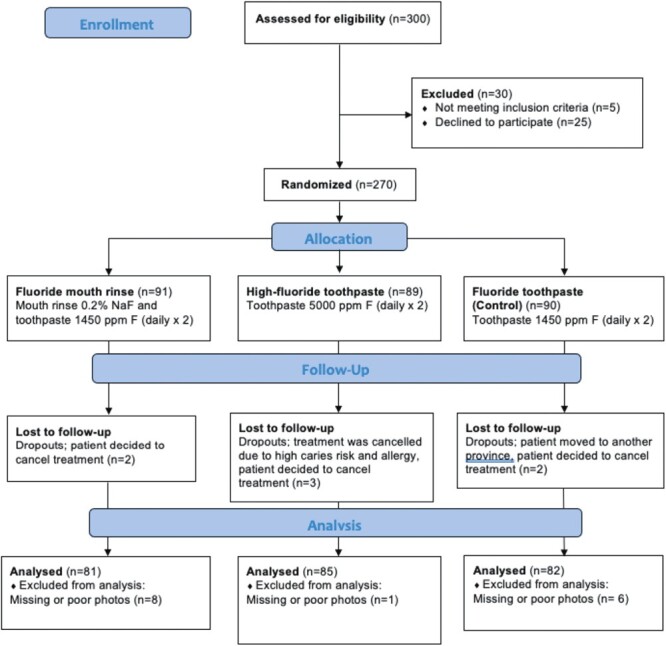
The trial was performed with 270 adolescent orthodontic patients. Randomization was performed in blocks of 30, enrolling the patients into one of the following groups: the fluoride mouth rinse (FMR) group receiving 0.2% sodium fluoride (NaF) mouth rinse plus 1450 ppm fluoride (F) toothpaste; high-fluoride toothpaste (HFT) group receiving 5000 ppm F toothpaste; and the Control (CTR) group receiving 1450 ppm F toothpaste. Inclusion criteria were patients scheduled for treatment in both arches with fixed appliances and age between 12 and 20 years. The primary outcome variable was the proportion of participants with at least one new demineralized lesion as assessed on digital photos taken before and after treatment, analysed by a blinded clinician. The analysis included all teeth or teeth in the aesthetic zone, i.e. all central incisors, lateral incisors, and canines. A random sample of 30 participants was assessed to check intra- and inter-reliability. For pairwise comparison between groups, Fisher's non-parametric permutation test was used for continuous variables. Blinding was employed during the caries registration and data analysis.
October 2010 to December 2012.
In total, 270 patients were randomized, of which 22 were excluded during treatment. Therefore, 248 participants were included in the study. The number of patients with an increase of ≥1 DL, including only central- and lateral incisors and canines, during orthodontic treatment, was significantly lower in the HFT group, 51/85 60%, compared to the CTR group, 64/82 78%, RR 0.77 (CI 0.62; 0.95), P = .01 and in the FMR group, 47/81 58%, compared to the CTR group, RR 0.74 (CI 0.60; 0.92), P < .01.
To prevent demineralized lesions in the aesthetic zone, high-fluoride mouth rinse and high-fluoride toothpaste may be recommended.
The protocol was not registered, and the present study did not use a double-blinded design.
评估高氟漱口水和高氟牙膏在正畸治疗过程中对脱矿病变(DLs)发展的影响。
三臂平行组随机对照试验。
该试验纳入了 270 名青少年正畸患者。采用 30 例的分组块进行随机分组,将患者纳入以下组之一:氟化物漱口水(FMR)组接受 0.2% 氟化钠(NaF)漱口水加 1450ppm 氟(F)牙膏;高氟牙膏(HFT)组接受 5000ppm F 牙膏;和对照组(CTR)组接受 1450ppm F 牙膏。纳入标准为接受双牙弓固定矫治且年龄在 12 至 20 岁之间的患者。主要结局变量是由盲法临床医生评估的治疗前后数码照片上至少有一个新脱矿区的参与者比例。分析包括所有中切牙、侧切牙和尖牙的牙齿或美学区的牙齿。对 30 名随机参与者进行评估以检查内部和外部可靠性。对于组间的两两比较,采用 Fisher 非参数置换检验进行连续变量分析。在龋齿登记和数据分析过程中采用了盲法。
2010 年 10 月至 2012 年 12 月。
共有 270 名患者被随机分配,其中 22 名在治疗期间被排除。因此,共有 248 名参与者纳入研究。在正畸治疗过程中,HFT 组的患者中,只有中切牙和侧切牙和尖牙的 DL 增加≥1 的患者数量明显低于 CTR 组,51/85(60%),RR 0.77(CI 0.62;0.95),P =.01,FMR 组 47/81(58%),RR 0.74(CI 0.60;0.92),P <.01,低于 CTR 组。
为了预防美学区的脱矿区,建议使用高氟漱口水和高氟牙膏。
该方案未注册,本研究未采用双盲设计。