The George Institute for Global Health India, Delhi, India.
Prasanna School of Public Health, Manipal Academy of Higher Education, Manipal, India.
BMJ Open. 2023 Jul 31;13(7):e071842. doi: 10.1136/bmjopen-2023-071842.
Few studies have examined frailty in Indian adults, despite an increasing population of older adults and an escalating burden of chronic diseases. We aimed to study the prevalence and correlates of frailty in middle-aged and older Indian adults.
Cross-sectional data from Wave 1 of Longitudinal Ageing Study in India, conducted in 2017-2018 across all states and union territories, were used.
The final analytical sample included 57 649 participants aged 45 years and above who had information on frailty status.
The deficits accumulation approach to measuring frailty was employed, creating a frailty index between 0 and 1, based on 40 deficits. Individuals with a frailty index of 0.25 or more were defined as 'frail'.
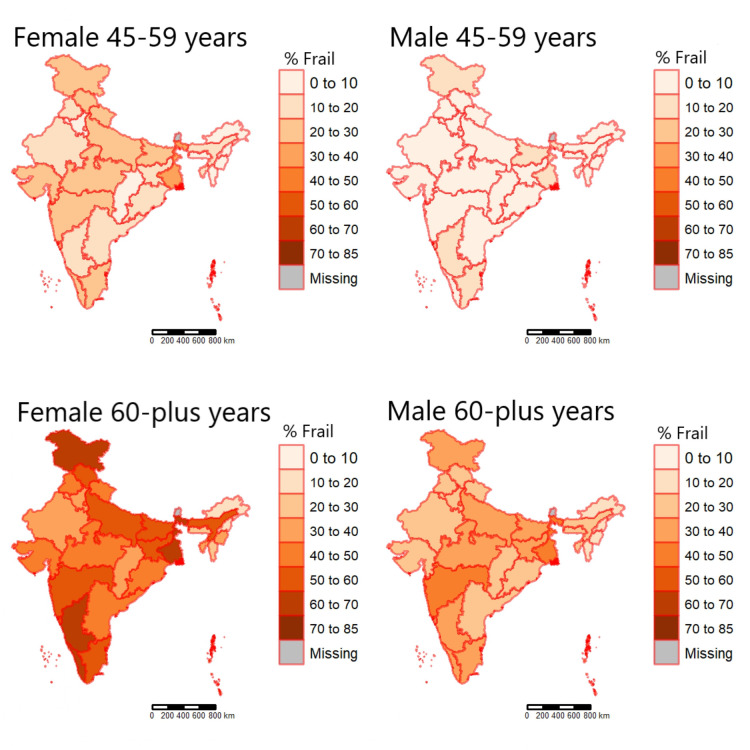
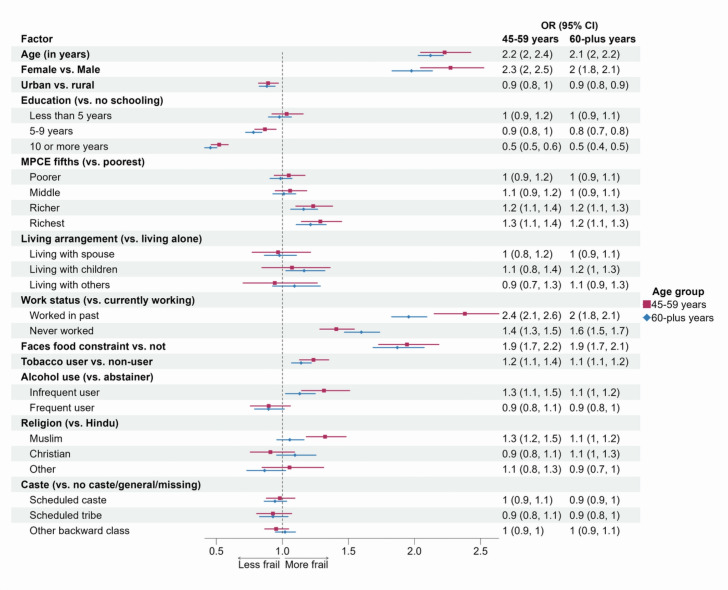
Prevalence of frailty among 45+ adults was 30%. 60+ women were two times as likely to be frail compared with 60+ men, after adjusting for a wide range of sociodemographic, economic and lifestyle factors. The sex difference was more pronounced in adults aged 45-59 years. Odds of hospitalisation in the last 12 months, and having falls in the past 2 years, were two times as high in frail adults compared with non-frail adults. Frail middle-aged and older adults had 33% and 39% higher odds, respectively, of having poor cognition than non-frail adults. The relative increase was higher in women for all three outcomes, although not statistically significant.
There needs to be careful consideration of sex differences when addressing frailty, particularly for optimising frailty interventions. Frailty, although typically assessed in older adults, was shown in this study to be also prevalent and associated with adverse outcomes in middle-aged Indian adults. More research into assessment of frailty in younger populations, its trajectory and correlates may help develop public health measures for prevention of frailty.
尽管印度老年人口不断增加,慢性病负担不断加重,但对印度成年人衰弱的研究却很少。本研究旨在探讨中年和老年印度成年人衰弱的流行率及其相关因素。
本研究使用了 2017-2018 年在印度进行的纵向老龄化研究第一波的横断面数据,该研究覆盖了所有邦和联邦属地。
最终分析样本包括 57649 名年龄在 45 岁及以上、有衰弱状况信息的参与者。
采用缺陷积累法测量衰弱,根据 40 项缺陷计算衰弱指数,范围为 0 到 1。衰弱指数为 0.25 或更高的个体被定义为“衰弱”。
45 岁以上成年人衰弱的患病率为 30%。调整了广泛的社会人口、经济和生活方式因素后,60 岁以上女性比 60 岁以上男性发生衰弱的可能性高两倍。在 45-59 岁的成年人中,这种性别差异更为明显。与非衰弱成年人相比,衰弱成年人在过去 12 个月内住院的可能性以及过去 2 年内跌倒的可能性均增加了一倍。衰弱的中年和老年成年人认知能力差的可能性分别比非衰弱成年人高 33%和 39%。尽管在所有三个结果中,女性的相对增加更高,但没有统计学意义。
在解决衰弱问题时,需要仔细考虑性别差异,特别是为了优化衰弱干预措施。本研究表明,衰弱不仅在老年人中常见,而且在印度中年成年人中也很普遍,并与不良结局相关。更多关于评估较年轻人群衰弱、其轨迹和相关性的研究可能有助于制定预防衰弱的公共卫生措施。