Chemical Biology Program, Memorial Sloan Kettering Institute, New York, NY, USA.
Department of Medicine, Memorial Sloan Kettering Institute, New York, NY, USA.
Nat Rev Mol Cell Biol. 2023 Nov;24(11):797-815. doi: 10.1038/s41580-023-00640-9. Epub 2023 Jul 31.
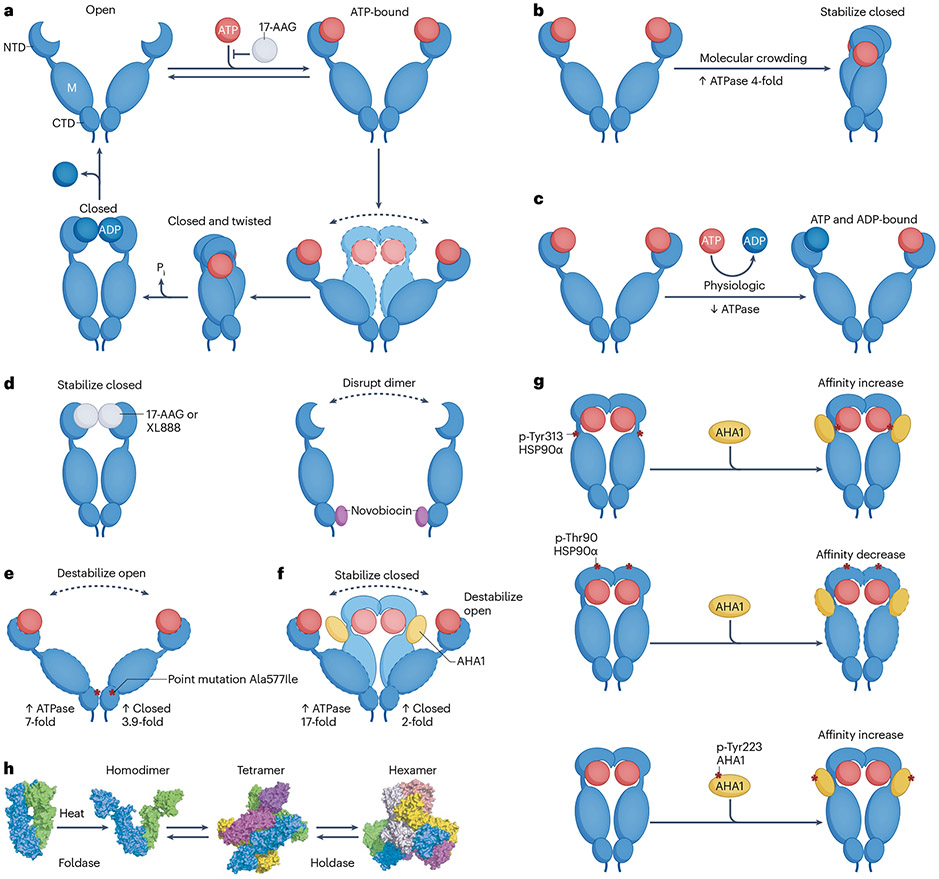
Heat shock protein 90 (HSP90) is a chaperone with vital roles in regulating proteostasis, long recognized for its function in protein folding and maturation. A view is emerging that identifies HSP90 not as one protein that is structurally and functionally homogeneous but, rather, as a protein that is shaped by its environment. In this Review, we discuss evidence of multiple structural forms of HSP90 in health and disease, including homo-oligomers and hetero-oligomers, also termed epichaperomes, and examine the impact of stress, post-translational modifications and co-chaperones on their formation. We describe how these variations influence context-dependent functions of HSP90 as well as its interaction with other chaperones, co-chaperones and proteins, and how this structural complexity of HSP90 impacts and is impacted by its interaction with small molecule modulators. We close by discussing recent developments regarding the use of HSP90 inhibitors in cancer and how our new appreciation of the structural and functional heterogeneity of HSP90 invites a re-evaluation of how we discover and implement HSP90 therapeutics for disease treatment.
热休克蛋白 90(HSP90)是一种伴侣蛋白,在调节蛋白质稳态方面发挥着重要作用,其功能早已被人们认识到,包括蛋白质折叠和成熟。目前出现了一种观点,认为 HSP90 不是一种结构和功能均一的蛋白质,而是一种由其环境塑造的蛋白质。在这篇综述中,我们讨论了 HSP90 在健康和疾病中的多种结构形式的证据,包括同型寡聚体和异型寡聚体,也称为表观伴侣体,并研究了应激、翻译后修饰和共伴侣对其形成的影响。我们描述了这些变化如何影响 HSP90 的上下文相关功能及其与其他伴侣蛋白、共伴侣蛋白的相互作用,以及 HSP90 的这种结构复杂性如何影响和受到小分子调节剂相互作用的影响。最后,我们讨论了 HSP90 抑制剂在癌症中的应用的最新进展,以及我们对 HSP90 结构和功能异质性的新认识如何促使我们重新评估发现和实施 HSP90 治疗疾病的方法。