Division of Hematological Malignancies and Bone Marrow Transplantation, Sidney Kimmel Comprehensive Cancer Center, Johns Hopkins University, Baltimore, MD, USA.
Public Health Sciences Division, Fred Hutchinson Cancer Center, Seattle, WA, USA.
Leukemia. 2023 Sep;37(9):1915-1918. doi: 10.1038/s41375-023-01985-y. Epub 2023 Jul 31.
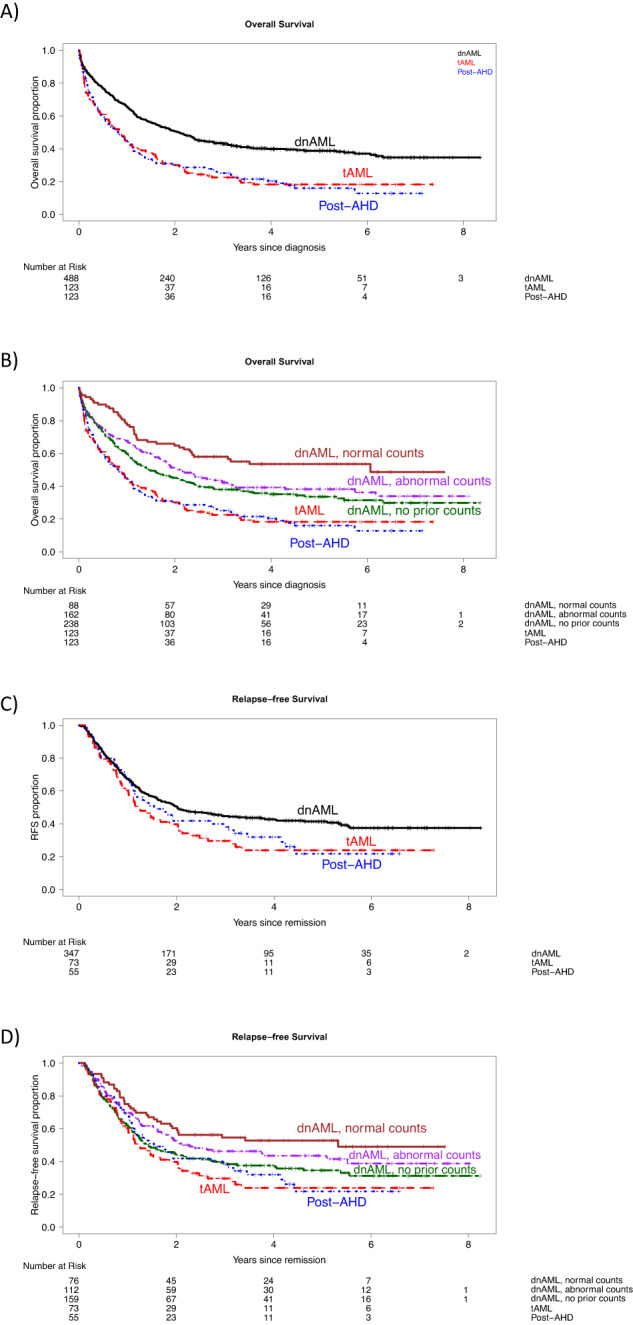
Secondary AML (sAML), defined by either history of antecedent hematologic disease (AHD) or prior genotoxic therapy (tAML), is classically regarded as having worse prognosis than de novo disease (dnAML). Clinicians may infer a new AML diagnosis is secondary based on a history of antecedent blood count (ABC) abnormalities in the absence of known prior AHD, but whether abnormal ABCs are associated with worse outcomes is unclear. Secondary-type mutations have recently been incorporated into the European LeukemiaNet (ELN) 2022 guidelines as adverse-risk features, raising the question of whether clinical descriptors of ontogeny (i.e., de novo or secondary) are prognostically significant when accounting for genetic risk by ELN 2022. In a large multicenter cohort of patients (n = 734), we found that abnormal ABCs are not independently prognostic after adjusting for genetic characteristics in dnAML patients. Furthermore, history of AHD and tAML do not confer increased risk of death compared to dnAML on multivariate analysis, suggesting the prognostic impact of ontogeny is accounted for by disease genetics as stratified by ELN 2022 risk and TP53 mutation status. These findings emphasize the importance that disease genetics should play in risk stratification and clinical trial eligibility in AML.
继发性急性髓系白血病(sAML),定义为既往存在血液系统疾病史(AHD)或既往有遗传毒性治疗史(tAML),其预后通常比初发性疾病(dnAML)差。临床医生可能会根据无已知既往 AHD 的情况下先前的血液计数(ABC)异常推断出新的 AML 诊断为继发性,但 ABC 异常是否与更差的结局相关尚不清楚。最近,继发性突变已被纳入欧洲白血病网络(ELN)2022 指南作为不良风险特征,这就提出了一个问题,即在考虑到 ELN 2022 遗传风险时,发病机制(即初发性或继发性)的临床描述是否具有预后意义。在一项大型多中心患者队列研究(n=734)中,我们发现,在调整 dnAML 患者的遗传特征后,ABC 异常与预后无关。此外,与 dnAML 相比,AHD 和 tAML 的病史在多变量分析中并未增加死亡风险,这表明发病机制的预后影响通过 ELN 2022 风险和 TP53 突变状态分层的疾病遗传学来解释。这些发现强调了疾病遗传学在 AML 中的风险分层和临床试验资格中的重要性。