Boscaro Eleonora, Urbino Irene, Catania Federica Maria, Arrigo Giulia, Secreto Carolina, Olivi Matteo, D'Ardia Stefano, Frairia Chiara, Giai Valentina, Freilone Roberto, Ferrero Dario, Audisio Ernesta, Cerrano Marco
Division of Hematology, Department of Oncology, Presidio Molinette, AOU Città della Salute e della Scienza di Torino, 10126 Turin, Italy.
Division of Hematology, Department of Molecular Biotechnology and Health Sciences, University of Torino, 10126 Turin, Italy.
Cancers (Basel). 2023 Jul 6;15(13):3512. doi: 10.3390/cancers15133512.
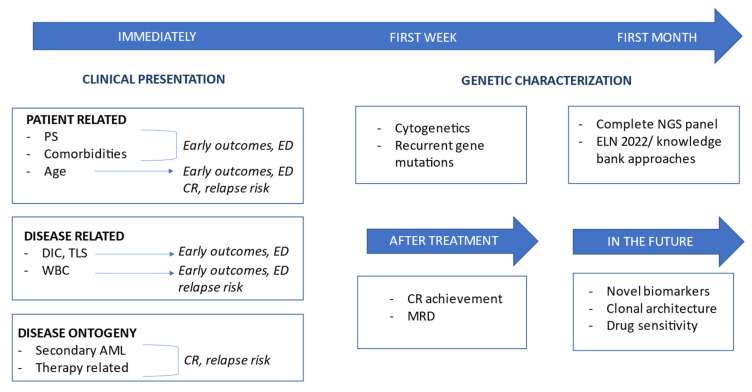
An accurate estimation of AML prognosis is complex since it depends on patient-related factors, AML manifestations at diagnosis, and disease genetics. Furthermore, the depth of response, evaluated using the level of MRD, has been established as a strong prognostic factor in several AML subgroups. In recent years, this rapidly evolving field has made the prognostic evaluation of AML more challenging. Traditional prognostic factors, established in cohorts of patients treated with standard intensive chemotherapy, are becoming less accurate as new effective therapies are emerging. The widespread availability of next-generation sequencing platforms has improved our knowledge of AML biology and, consequently, the recent ELN 2022 recommendations significantly expanded the role of new gene mutations. However, the impact of rare co-mutational patterns remains to be fully disclosed, and large international consortia such as the HARMONY project will hopefully be instrumental to this aim. Moreover, accumulating evidence suggests that clonal architecture plays a significant prognostic role. The integration of clinical, cytogenetic, and molecular factors is essential, but hierarchical methods are reaching their limit. Thus, innovative approaches are being extensively explored, including those based on "knowledge banks". Indeed, more robust prognostic estimations can be obtained by matching each patient's genomic and clinical data with the ones derived from very large cohorts, but further improvements are needed.
准确估计急性髓系白血病(AML)的预后很复杂,因为它取决于患者相关因素、诊断时的AML表现以及疾病遗传学。此外,使用微小残留病(MRD)水平评估的缓解深度已被确立为几个AML亚组中的一个强有力的预后因素。近年来,这个快速发展的领域使AML的预后评估更具挑战性。在接受标准强化化疗的患者队列中确立的传统预后因素,随着新的有效疗法的出现,其准确性越来越低。新一代测序平台的广泛应用提高了我们对AML生物学的认识,因此,最近的2022年欧洲白血病网络(ELN)建议显著扩大了新基因突变的作用。然而,罕见共突变模式的影响仍有待充分揭示,像HARMONY项目这样的大型国际联盟有望有助于实现这一目标。此外,越来越多的证据表明克隆结构起着重要的预后作用。整合临床、细胞遗传学和分子因素至关重要,但分层方法正达到其极限。因此,正在广泛探索创新方法,包括基于“知识库”的方法。确实,通过将每个患者的基因组和临床数据与来自非常大的队列的数据相匹配,可以获得更可靠的预后估计,但仍需要进一步改进。