Center for Health Systems Research, The National Institute of Public Health, 62100, Cuernavaca, Morelos, Mexico.
Center for International Studies, College of Mexico, A.C., Mexico City, Mexico.
Health Res Policy Syst. 2023 Jul 31;21(1):80. doi: 10.1186/s12961-023-01025-2.
One of the central debates in health policy is related to the fragmentation of health systems. Fragmentation is perceived as a major obstacle to UHC. This article presents the results of a consultation with a group of actors of the Mexican policy arena on the origins and impacts of the fragmentation of the Mexican health system.
We used a consultation to nine key actors to collect thoughts on the fragmentation of the Mexican health system. The group included national and local decision makers with experience in health care issues and researchers with background in health systems and/or public policies. The sessions were recorded, transcribed verbatim and analyzed thematically.
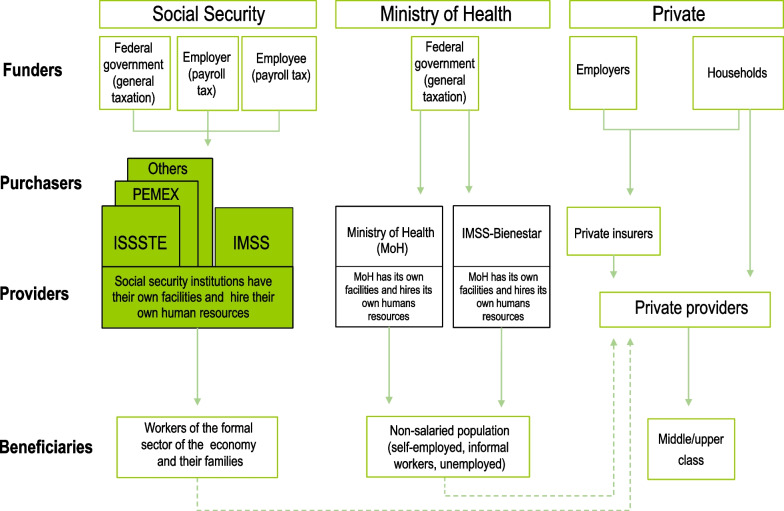
Participants defined the term 'fragmentation' as the separation of the various groups of the population based on characteristics which define their access to health care services. This is a core characteristic of health systems in Latin America (LA). In general, those affiliated to social security institutions have a higher per capita expenditure than those without social security, which translates into differential health benefits. According to the actors in this consultation, fragmentation is the main structural problem of the Mexican health system. Actors agreed that the best way to end fragmentation is through the creation of a universal health system. Defragmentation plans should include a research component to document the impacts of fragmentation, and design and test the instruments needed for the integration process.
First, health system fragmentation in Mexico has created problems of equity since different population groups have unequal access to public resources and different health benefits. Second, Mexico needs to move beyond the fragmentation of its health system and guarantee, through its financial integration, access to the same package of health services to all its citizens. Third, defragmentation plans should include a research component to document the impacts of fragmentation, and design and test the instruments needed for the integration process. Fourth, defragmentation of health systems is not an easy task because there are vested interests that oppose its implementation. Political strategies to meet the resistance of these groups are an essential component of any defragmentation plan.
卫生政策的核心争论之一与卫生系统碎片化有关。碎片化被视为全民健康覆盖的主要障碍。本文介绍了与墨西哥政策领域的一组行为者就墨西哥卫生系统碎片化的起源和影响进行磋商的结果。
我们使用与九位关键行为者的磋商来收集有关墨西哥卫生系统碎片化的意见。该小组包括具有医疗保健问题经验的国家和地方决策者以及具有卫生系统和/或公共政策背景的研究人员。会议进行了录音、逐字记录,并进行了主题分析。
与会者将“碎片化”一词定义为根据定义其获得医疗保健服务的特征,将不同人群群体分开。这是拉丁美洲(LA)卫生系统的核心特征。一般来说,那些加入社会保险机构的人比没有社会保险的人人均支出更高,这转化为不同的健康效益。根据本次磋商中的行为者,碎片化是墨西哥卫生系统的主要结构性问题。行为者一致认为,结束碎片化的最佳方法是建立全民健康系统。去碎片化计划应包括一个研究部分,以记录碎片化的影响,并设计和测试整合过程所需的工具。
首先,墨西哥卫生系统的碎片化造成了公平问题,因为不同人群群体获得公共资源和不同健康效益的机会不平等。其次,墨西哥需要超越其卫生系统的碎片化,通过其财务整合,保障所有公民都能获得相同的一揽子卫生服务。第三,去碎片化计划应包括一个研究部分,以记录碎片化的影响,并设计和测试整合过程所需的工具。第四,卫生系统的碎片化不是一项容易的任务,因为存在反对实施碎片化的既得利益。应对这些群体抵制的政治策略是任何去碎片化计划的重要组成部分。