Afrash Sana, Saemi Esmaeel, Gong Anmin, Doustan Mohammadreza
Department of Motor Behavior and Sport Psychology, Faculty of Sport Sciences, Shahid Chamran University of Ahvaz, Ahvaz, 6135783151, Iran.
School of Information Engineering, Engineering University of People's Armed Police, Xi'an, 710086, China.
BMC Sports Sci Med Rehabil. 2023 Jul 31;15(1):93. doi: 10.1186/s13102-023-00706-3.
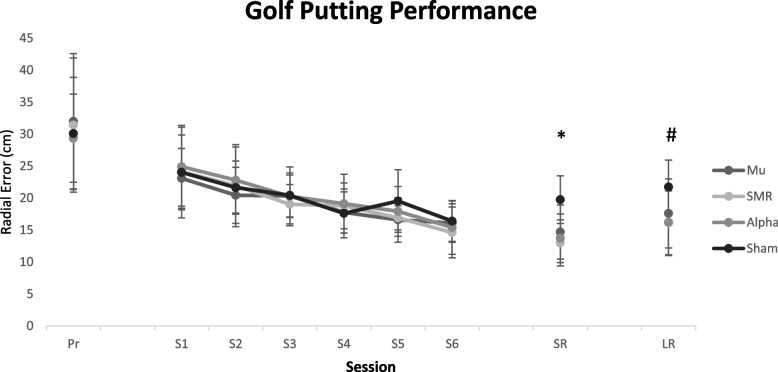
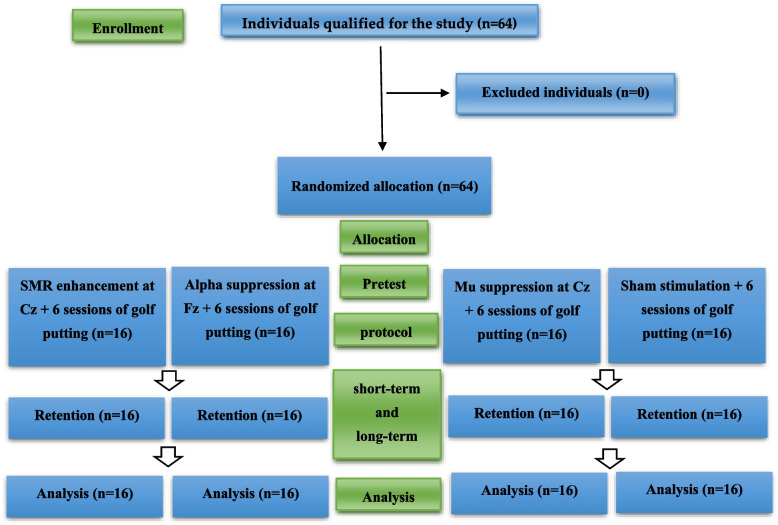
A large number of previous studies have examined how different neurofeedback-based techniques may influence motor learning. However, only a few studies attempted to compare the effects of these different techniques on motor learning. Therefore, the present study attempts to examine the effects of neurofeedback training on motor learning in novice golfers, using three protocols, namely enhanced sensorimotor rhythm (SMR) at Cz, suppressed alpha waves at Fz, and suppressed mu waves at Cz. The participants were 64 adults (32 females; mean age = 22.31 ± 2.25 years). The study consisted of a pretest stage (day 1), intervention (6 sessions, over two weeks, 3 sessions per week), short-term retention (one day after intervention), and long-term retention (two weeks after intervention); in the pretest and short-term and long-term retention, motor performance for golf putting (12 trials) as well as amplitudes of SMR wave at Cz, alpha at Fz, and Mu at Cz were recorded. During each intervention session, the participants in three neurofeedback groups and a sham group first performed neurofeedback training (enhanced SMR at Cz, suppressed alpha at Fz, and suppressed Mu at Cz) for 20 min. Then, the participants in all groups performed three blocks of 12 trials consisting of golf putting training. The results indicated no difference between the sham and the experimental groups in the acquisition stage, as individuals in all groups experienced similar improvement in putting accuracy. However, in the short-term retention, all the three neurofeedback groups outperformed the sham group, although in the long-term retention, only the SMR group and the Alpha group showed a better performance than the sham group while the Mu group did not exhibit a notably better performance than the sham group. Our results also showed significant variations in the amplitudes of the SMR, alpha, and mu waves depending on the neurofeedback intervention provided, while no significant variation was observed in the sham group. Based on these results, it is recommended that coaches should make further use of enhanced SMR at Cz or suppressed alpha at Fz as their neurofeedback interventions to facilitate longer-term motor learning in golfers.
此前有大量研究探讨了不同的基于神经反馈的技术如何影响运动学习。然而,只有少数研究尝试比较这些不同技术对运动学习的影响。因此,本研究试图使用三种方案,即Cz电极处增强的感觉运动节律(SMR)、Fz电极处抑制的阿尔法波以及Cz电极处抑制的缪波,来检验神经反馈训练对新手高尔夫球手运动学习的影响。参与者为64名成年人(32名女性;平均年龄 = 22.31 ± 2.25岁)。该研究包括一个预测试阶段(第1天)、干预阶段(6次训练,为期两周,每周3次)、短期保持阶段(干预后一天)和长期保持阶段(干预后两周);在预测试、短期和长期保持阶段,记录高尔夫球推杆的运动表现(12次试验)以及Cz电极处的SMR波幅、Fz电极处的阿尔法波幅和Cz电极处的缪波幅。在每次干预训练期间,三个神经反馈组和一个假刺激组的参与者首先进行20分钟的神经反馈训练(Cz电极处增强SMR、Fz电极处抑制阿尔法波以及Cz电极处抑制缪波)。然后,所有组的参与者进行由高尔夫球推杆训练组成的三个12次试验的组块。结果表明,在习得阶段,假刺激组和实验组之间没有差异,因为所有组的个体在推杆准确性方面都有相似的提高。然而,在短期保持阶段,所有三个神经反馈组的表现均优于假刺激组,尽管在长期保持阶段,只有SMR组和阿尔法组的表现优于假刺激组,而缪波组的表现并未显著优于假刺激组。我们的结果还表明,根据所提供的神经反馈干预,SMR波、阿尔法波和缪波的波幅存在显著差异,而在假刺激组中未观察到显著差异。基于这些结果,建议教练进一步将Cz电极处增强的SMR或Fz电极处抑制的阿尔法波作为他们的神经反馈干预措施,以促进高尔夫球手的长期运动学习。