Kumar Lakshya, Khuwaja Sundal, Kumar Aanand, Memon Unaib Ahmed, Kumar Munesh, Ashok Arpana, Lohana Manisha, Qudoos Ahmed, Kashif Maham, Khatri Mahima, Kumar Satesh, Sapna Fnu, Dass Arjan, Varrassi Giustino
General Medicine, Pandit Dindayal Upadhyay (PDU) Medical College, Rajkot, IND.
Medicine, Liaquat University of Medical and Health Sciences, Jamshoro, PAK.
Cureus. 2023 Jun 30;15(6):e41198. doi: 10.7759/cureus.41198. eCollection 2023 Jun.
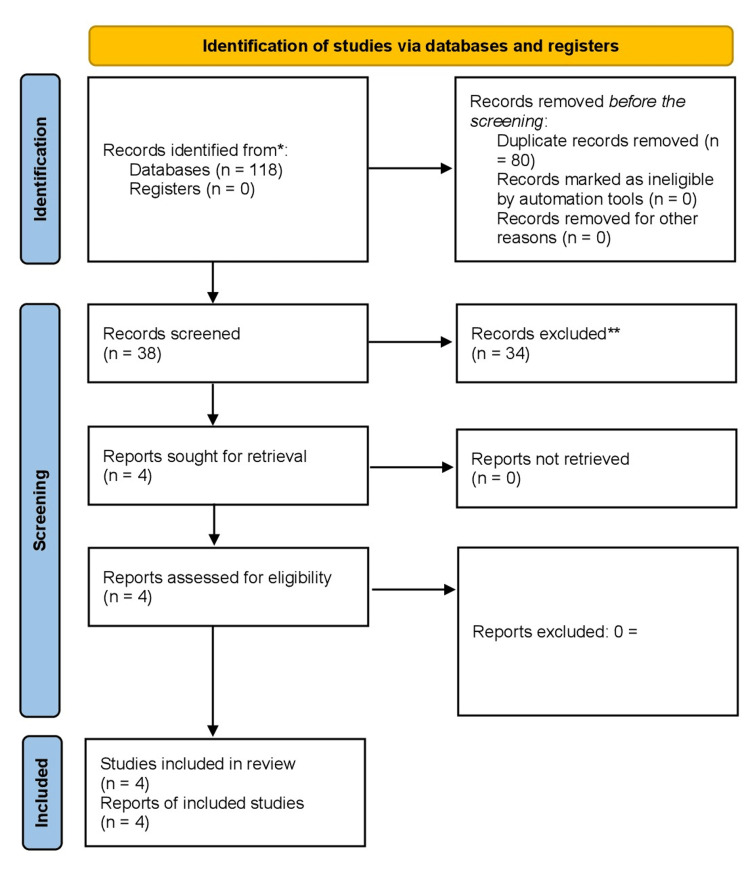
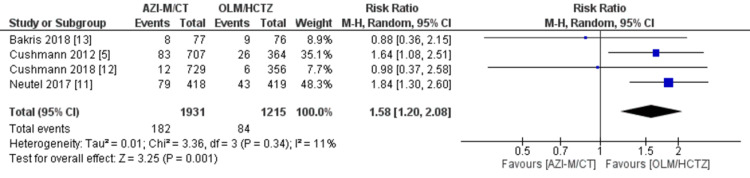
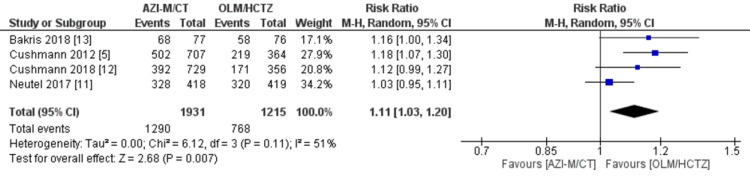
This study aims to assess the effectiveness and safety of azilsartan-medoxomil/chlorthalidone (AZI-M/CT) compared to olmesartan-medoxomil/hydrochlorothiazide (OLM/HCTZ) in patients with hypertension. Systematic searches were conducted on PubMed, Google Scholar, and ClinicalTrials.gov, starting from their establishment until March 15, 2023. The purpose of these searches was to locate original reports that compare the effectiveness of AZI-M/CT and OLM/HCTZ in treating hypertension. Data on various characteristics at the beginning and end of the studies were gathered. The analyses were carried out using Review Manager 5.4.1 (The Nordic Cochrane Center, The Cochrane Collaboration, 2014, Odense, Denmark) and STATA 16.0 software (Stata Corp. LP, College Station, TX, USA). Risk ratios (RRs) and weighted mean differences (WMDs) with 95% confidence intervals (CIs) were calculated as part of the study. A total of 3,146 individuals from four separate investigations were included in the study, with 1,931 individuals receiving AZI-M/CT and 1,215 individuals receiving OLM/HCTZ. The combined analysis revealed that the average diastolic blood pressure (DBP) was significantly lower in the AZI-M/CT group compared to the OLM/HCTZ group (WMD -2.64 [-2.78, -2.51]; = 0.00001; = 1%). However, there were no significant differences in mean systolic blood pressure (SBP; WMD -2.95 [-6.64, 0.73]; = 0). Furthermore, the AZI-M/CT group had a notably higher incidence of major adverse events (RR 1.58 [1.20, 2.08]; = 0.001; = 11%) and any treatment-emergent adverse events (RR 1.11 [1.03, 1.20]; = 0.007; = 51%). However, there was no significant difference in the mortality risk between the two groups (RR 0.74 [0.14, 3.91]; = 0.72; = 0%). Based on the results of our meta-analysis, AZI-M/CT is more effective than OLM/HCTZ at reducing blood pressure in elderly hypertensive patients. However, because of the small sample size, favorable results must be carefully reevaluated, and more studies are needed.
本研究旨在评估阿齐沙坦美多昔康/氯噻酮(AZI-M/CT)与奥美沙坦美多昔康/氢氯噻嗪(OLM/HCTZ)相比,在高血压患者中的有效性和安全性。从PubMed、谷歌学术和ClinicalTrials.gov创建开始,直至2023年3月15日进行了系统检索。这些检索的目的是找到比较AZI-M/CT和OLM/HCTZ治疗高血压有效性的原始报告。收集了研究开始和结束时各种特征的数据。使用Review Manager 5.4.1(北欧科克伦中心,科克伦协作网,2014年,丹麦欧登塞)和STATA 16.0软件(美国德克萨斯州大学站Stata公司)进行分析。作为研究的一部分,计算了风险比(RRs)和加权平均差(WMDs)以及95%置信区间(CIs)。该研究共纳入了来自四项独立调查的3146名个体,其中1931名个体接受AZI-M/CT治疗,1215名个体接受OLM/HCTZ治疗。综合分析显示,与OLM/HCTZ组相比,AZI-M/CT组的平均舒张压(DBP)显著更低(WMD -2.64 [-2.78, -2.51];P = 0.00001;I² = 1%)。然而,平均收缩压(SBP)没有显著差异(WMD -2.95 [-6.64, 0.73];P = 0)。此外,AZI-M/CT组的主要不良事件发生率显著更高(RR 1.58 [1.20, 2.08];P = 0.001;I² = 11%)以及任何治疗中出现的不良事件发生率也更高(RR 1.11 [1.03, 1.20];P = 0.007;I² = 51%)。然而,两组之间的死亡风险没有显著差异(RR 0.74 [0.14, 3.91];P = 0.72;I² = 0%)。基于我们的荟萃分析结果,在降低老年高血压患者血压方面,AZI-M/CT比OLM/HCTZ更有效。然而,由于样本量较小,必须仔细重新评估有利结果,并且需要更多的研究。