Department of Hematology/Medical Oncology.
Department of Pathology and Laboratory Medicine, and.
J Clin Invest. 2023 Aug 1;133(15):e167629. doi: 10.1172/JCI167629.
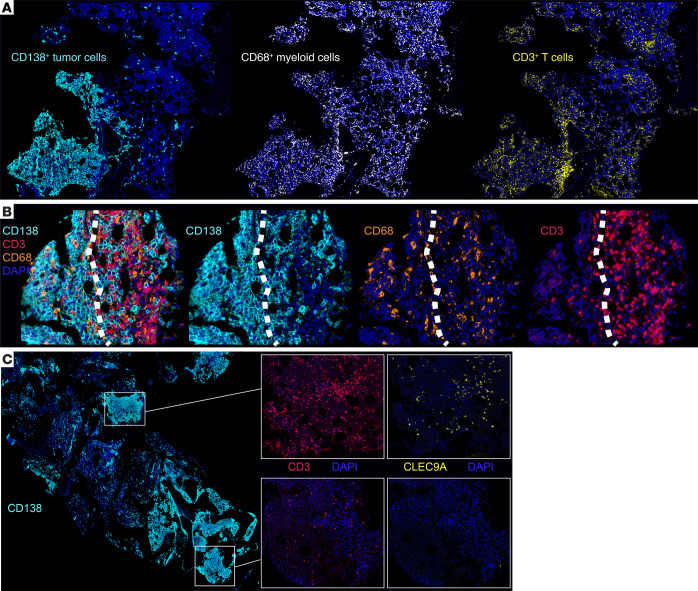
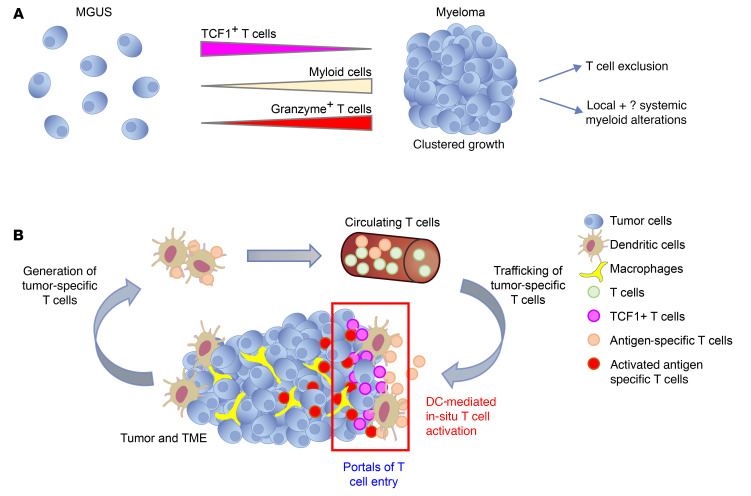
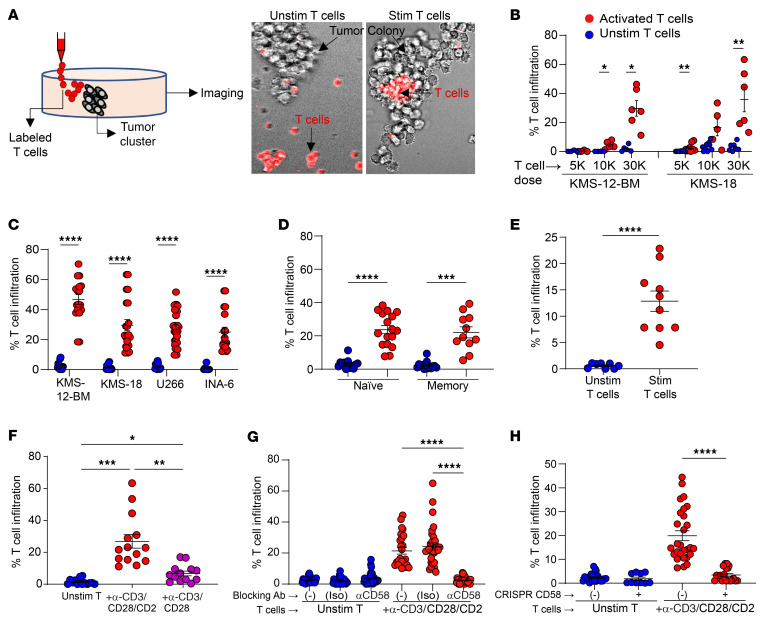
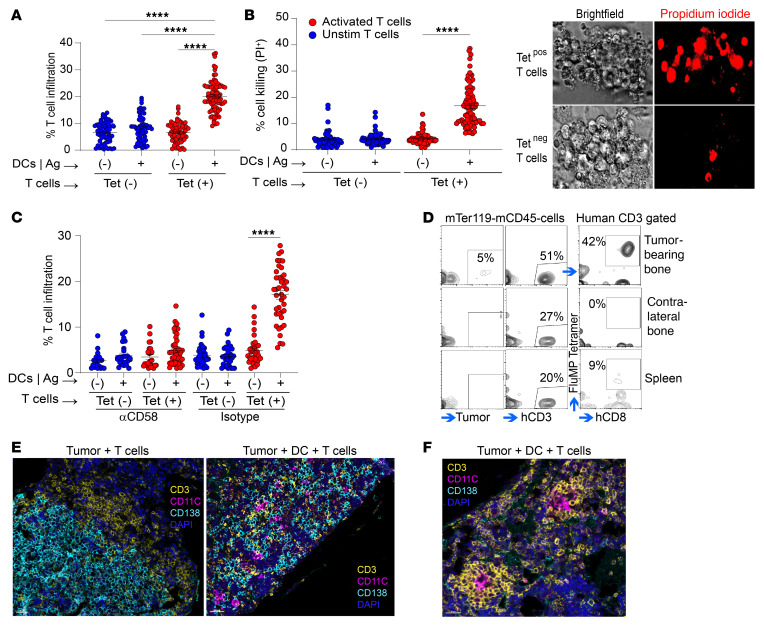
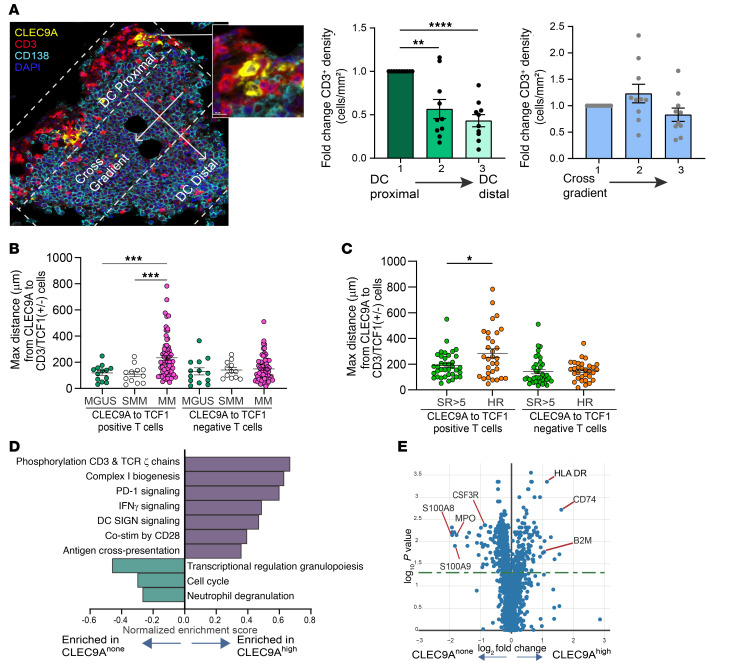
Entry of antigen-specific T cells into human tumors is critical for immunotherapy, but the underlying mechanisms are poorly understood. Here, we combined high-dimensional spatial analyses with in vitro and in vivo modeling to study the mechanisms underlying immune infiltration in human multiple myeloma (MM) and its precursor monoclonal gammopathy of undetermined significance (MGUS). Clustered tumor growth was a feature of MM but not MGUS biopsies, and this growth pattern was reproduced in humanized mouse models. MM biopsies exhibited intralesional as well as spatial heterogeneity, with coexistence of T cell-rich and T cell-sparse regions and the presence of areas of T cell exclusion. In vitro studies demonstrated that T cell entry into MM clusters was regulated by agonistic signals and CD2-CD58 interactions. Upon adoptive transfer, antigen-specific T cells localized to the tumor site but required in situ DC-mediated antigen presentation for tumor entry. C-type lectin domain family 9 member A-positive (CLEC9A+) DCs appeared to mark portals of entry for gradients of T cell infiltration in MM biopsies, and their proximity to T cell factor 1-positive (TCF1+) T cells correlated with disease state and risk status. These data illustrate a role for tumor-associated DCs and in situ activation in promoting the infiltration of antigen-specific T cells in MM and provide insights into spatial alterations in tumor/immune cells with malignant evolution.
抗原特异性 T 细胞进入人体肿瘤对于免疫治疗至关重要,但相关的潜在机制仍不清楚。在这里,我们结合高维空间分析以及体外和体内建模来研究人类多发性骨髓瘤(MM)及其前体意义未明的单克隆丙种球蛋白病(MGUS)中免疫浸润的潜在机制。肿瘤簇集性生长是 MM 活检的特征,但不是 MGUS 活检的特征,这种生长模式在人源化小鼠模型中得到了重现。MM 活检表现出肿瘤内以及空间异质性,存在富含 T 细胞和 T 细胞稀疏的区域共存,以及存在 T 细胞排斥区域。体外研究表明,T 细胞进入 MM 簇的过程受到激动信号和 CD2-CD58 相互作用的调节。在过继转移后,抗原特异性 T 细胞定位于肿瘤部位,但需要原位 DC 介导的抗原呈递才能进入肿瘤。C 型凝集素结构域家族 9 成员 A 阳性(CLEC9A+)DC 似乎标记了 MM 活检中 T 细胞浸润梯度的进入门户,其与 T 细胞因子 1 阳性(TCF1+)T 细胞的接近程度与疾病状态和风险状况相关。这些数据说明了肿瘤相关 DC 和原位激活在促进 MM 中抗原特异性 T 细胞浸润中的作用,并提供了对恶性演变过程中肿瘤/免疫细胞空间改变的深入了解。