Department of Kinesiology, University of Georgia, Athens, GA, USA.
School of Kinesiology, University of Minnesota, Minneapolis, MN, USA.
Exp Physiol. 2023 Oct;108(10):1282-1294. doi: 10.1113/EP091284. Epub 2023 Aug 10.
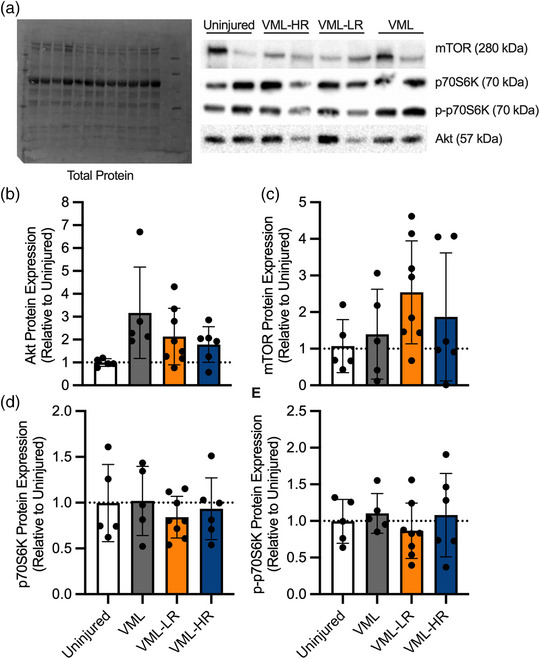
The primary objective of this study was to determine if low- or high-resistance voluntary wheel running leads to functional improvements in muscle strength (i.e., isometric and isokinetic torque) and metabolic function (i.e., permeabilized fibre bundle mitochondrial respiration) after a volumetric muscle loss (VML) injury. C57BL/6J mice were randomized into one of four experimental groups at age 12 weeks: uninjured control, VML untreated (VML), low-resistance wheel running (VML-LR) and high-resistance wheel running (VML-HR). All mice, excluding the uninjured, were subject to a unilateral VML injury to the plantar flexor muscles and wheel running began 3 days post-VML. At 8 weeks post-VML, peak isometric torque was greater in uninjured compared to all VML-injured groups, but both VML-LR and VML-HR had greater (∼32%) peak isometric torque compared to VML. All VML-injured groups had less isokinetic torque compared to uninjured, and there was no statistical difference among VML, VML-LR and VML-HR. No differences in cumulative running distance were observed between VML-LR and VML-HR groups. Because adaptations in VML-HR peak isometric torque were attributed to greater gastrocnemius muscle mass, atrophy- and hypertrophy-related protein content and post-translational modifications were explored via immunoblot; however, results were inconclusive. Permeabilized fibre bundle mitochondrial oxygen consumption was 22% greater in uninjured compared to VML, but there was no statistical difference among VML, VML-LR and VML-HR. Furthermore, neither wheel running group demonstrated a change in the relative protein content of the mitochondrial biogenesis transcription factor, peroxisome proliferator-activated receptor γ coactivator 1-α (PGC-1α). These results indicate that resistance wheel running alone only has modest benefits in the VML-injured muscle. NEW FINDINGS: What is the central question of the study? Does initiation of a resistance wheel running regimen following volumetric muscle loss (VML) improve the functional capacity of skeletal muscle? What is the main finding and its importance? Resistance wheel running led to greater muscle mass and strength in mice with a VML injury but did not result in a full recovery. Neither low- nor high-resistance wheel running was associated with a change in permeabilized muscle fibre respiration despite runners having greater whole-body treadmill endurance capacity, suggesting resilience to metabolic adaptations in VML-injured muscle. Resistance wheel running may be a suitable adjuvant rehabilitation strategy, but alone does not fully mitigate VML pathology.
本研究的主要目的是确定低阻力或高阻力自主轮跑是否会导致肌肉力量(即等长和等速扭矩)和代谢功能(即通透纤维束线粒体呼吸)在容积性肌肉损失(VML)损伤后得到改善。C57BL/6J 小鼠在 12 周龄时随机分为四组实验:未受伤对照组、VML 未处理组(VML)、低阻力轮跑组(VML-LR)和高阻力轮跑组(VML-HR)。所有除未受伤的小鼠均接受足底屈肌单侧 VML 损伤,VML 后 3 天开始轮跑。VML 后 8 周,未受伤的小鼠的最大等长扭矩显著高于所有 VML 损伤组,但 VML-LR 和 VML-HR 的最大等长扭矩比 VML 高约 32%。所有 VML 损伤组的等速扭矩均低于未受伤组,且 VML、VML-LR 和 VML-HR 组之间无统计学差异。VML-LR 和 VML-HR 组之间的累计跑步距离无差异。由于 VML-HR 的最大等长扭矩的适应性归因于比目鱼肌质量的增加,因此通过免疫印迹法探索了萎缩和肥大相关蛋白含量和翻译后修饰;然而,结果尚无定论。未受伤的小鼠的通透纤维束线粒体耗氧量比 VML 高 22%,但 VML、VML-LR 和 VML-HR 组之间无统计学差异。此外,两个轮跑组的线粒体生物发生转录因子过氧化物酶体增殖物激活受体γ共激活因子 1-α(PGC-1α)的相对蛋白含量均未发生变化。这些结果表明,单独进行抗阻轮跑对 VML 损伤肌肉只有适度的益处。新发现:研究的核心问题是什么?在容积性肌肉损失(VML)后开始进行抗阻轮跑方案是否会改善骨骼肌的功能能力?主要发现及其重要性是什么?抗阻轮跑导致 VML 损伤小鼠的肌肉质量和力量增加,但并未完全恢复。低阻力和高阻力轮跑均与通透性肌肉纤维呼吸的变化无关,尽管跑步者的跑步机耐力能力更强,这表明 VML 损伤肌肉对代谢适应具有弹性。抗阻轮跑可能是一种合适的辅助康复策略,但单独使用并不能完全缓解 VML 病变。