Medical Psychology & Medical Sociology, University Medical Center of the Johannes Gutenberg, University Mainz, Duesbergweg 6, 55128, Mainz, Germany.
Leibniz Institute for Resilience Research (LIR) gGmbH Mainz, Wallstr. 7, 55122, Mainz, Germany.
Eur Arch Psychiatry Clin Neurosci. 2024 Oct;274(7):1615-1623. doi: 10.1007/s00406-023-01658-y. Epub 2023 Aug 1.
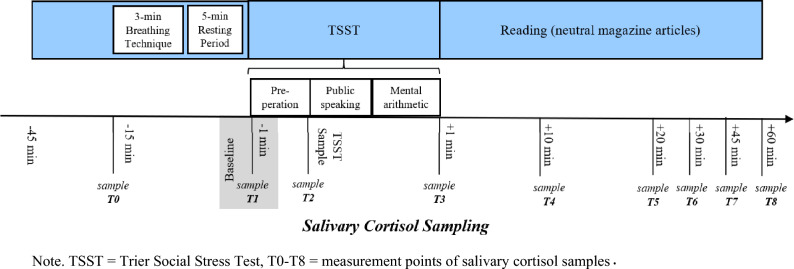
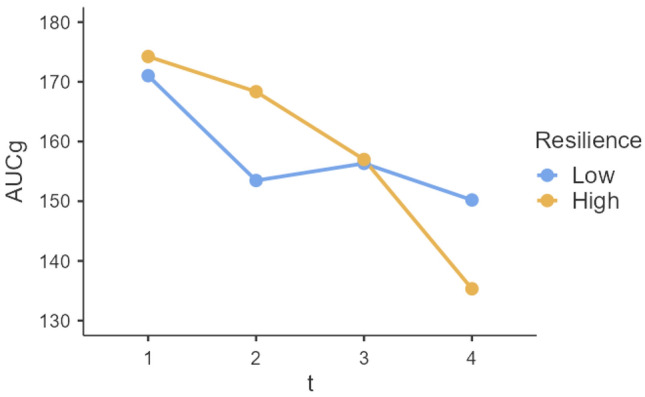
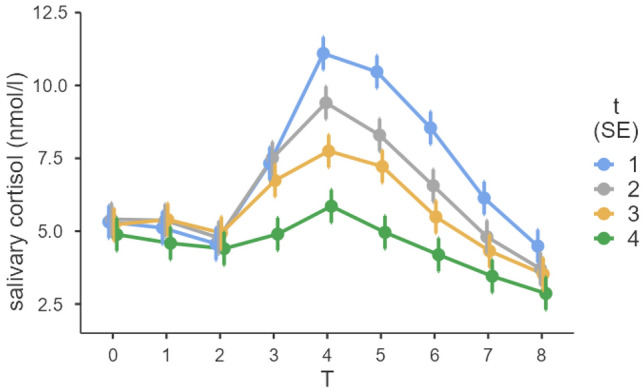
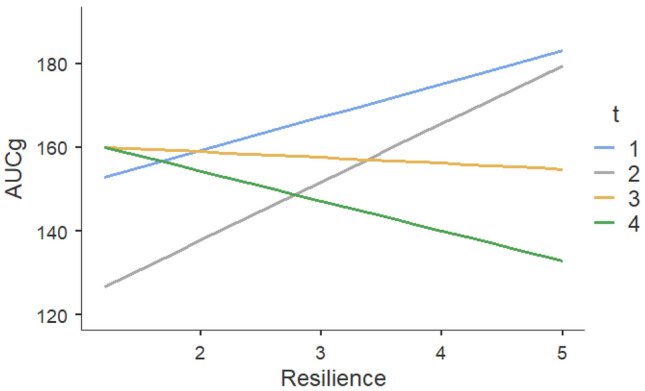
Habituation refers to the physiological adaptation to recurrent stressors, which can be measured by cortisol levels, and is considered a central mechanism in reducing allostatic load. Resilience, a potential factor influencing stress reduction, is the focus of this study. Specifically, the study aims to investigate the impact of resilience, as assessed by the Brief Resilience Scale (BRS), on habituation. The Trier Social Stress Test (TSST) was used as the recurrent stressor, and it was administered to each of the 56 subjects at 4 consecutive measurements. To assess habituation, various physiological parameters including the area under the curve with respect to the ground (AUCg) and with respect to the increase (AUCi), cortisol peak, slope from baseline to peak, and recovery were calculated. Mixed linear models were employed to examine the differences in the influence of resilience on habituation across the different time points. The findings indicate that the influence of resilience significantly varies from the first to the fourth measurement time point for AUCg (p = .048), while no significant differences were observed for the other cortisol parameters. The effects plot suggests that individuals with higher levels of resilience exhibit lower AUCg values throughout the measurements. These findings provide initial evidence supporting resilience as a predictor of cortisol habituation. However, future studies should also consider dynamic resilience models, utilizing longitudinally assessed resilience as a predictor for habituation, to explore whether resilience acts as a determinant of habituation or if habituation itself constitutes a resilience mechanism.
习惯化是指对反复出现的应激源的生理适应,可以通过皮质醇水平来衡量,被认为是减轻适应负荷的核心机制。韧性是影响压力减轻的一个潜在因素,是本研究的重点。具体来说,本研究旨在探讨韧性(通过简明韧性量表(BRS)评估)对习惯化的影响。三重社会应激测试(TSST)被用作反复出现的应激源,在连续的 4 次测量中对 56 名受试者中的每一位进行了测量。为了评估习惯化,计算了各种生理参数,包括与基础相比的曲线下面积(AUCg)和与增加相比的曲线下面积(AUCi)、皮质醇峰值、从基线到峰值的斜率以及恢复。混合线性模型被用来检查韧性对不同时间点习惯化的影响的差异。研究结果表明,在 AUCg 方面,韧性的影响从第 1 次测量到第 4 次测量时显著不同(p=0.048),而其他皮质醇参数则没有显著差异。效应图表明,韧性水平较高的个体在整个测量过程中 AUCg 值较低。这些发现提供了初步证据,支持韧性作为皮质醇习惯化的预测因子。然而,未来的研究还应该考虑动态韧性模型,将纵向评估的韧性作为习惯化的预测因子,以探讨韧性是否作为习惯化的决定因素,或者习惯化本身是否构成韧性机制。