Chmitorz Andrea, Kurth Karolina, Mey Lara K, Wenzel Mario, Lieb Klaus, Tüscher Oliver, Kubiak Thomas, Kalisch Raffael
Department of Psychiatry and Psychotherapy, University Medical Center Mainz, Mainz, Germany.
Faculty of Social Work, Health Care and Nursing Sciences, Esslingen University of Applied Sciences, Esslingen, Germany.
JMIR Ment Health. 2020 Feb 24;7(2):e14566. doi: 10.2196/14566.
Many existing scales for microstressor assessment do not differentiate between objective (ie, observable) stressor events and stressful cognitions or concerns. They often mix items assessing objective stressor events with items measuring other aspects of stress, such as perceived stressor severity, the evoked stress reaction, or further consequences on health, which may result in spurious associations in studies that include other questionnaires that measure such constructs. Most scales were developed several decades ago; therefore, modern life stressors may not be represented. Ecological momentary assessment (EMA) allows for sampling of current behaviors and experiences in real time and in the natural habitat, thereby maximizing the generalization of the findings to real-life situations (ie, ecological validity) and minimizing recall bias. However, it has not been used for the validation of microstressor questionnaires so far.
The aim is to develop a questionnaire that (1) allows for retrospective assessment of microstressors over one week, (2) focuses on objective (ie, observable) microstressors, (3) includes stressors of modern life, and (4) separates stressor occurrence from perceived stressor severity.
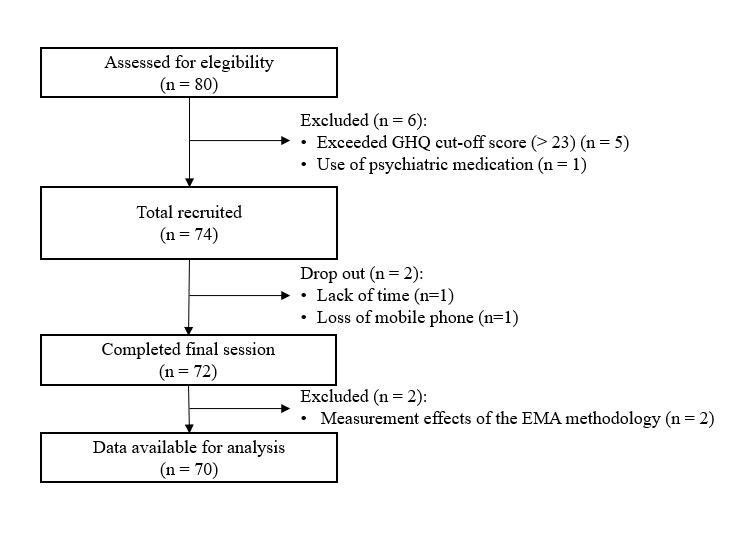
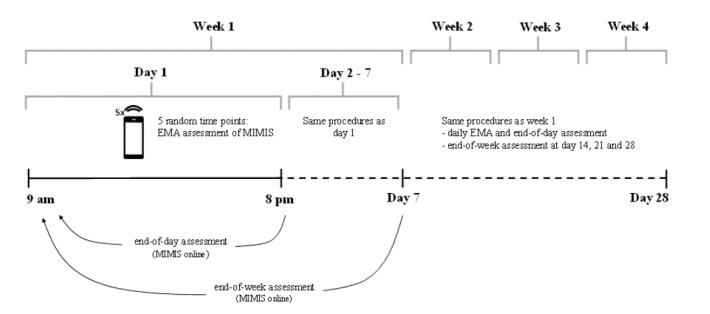
Cross-sectional (N=108) and longitudinal studies (N=10 and N=70) were conducted to evaluate the Mainz Inventory of Microstressors (MIMIS). In the longitudinal studies, EMA was used to compare stressor data, which was collected five times per day for 7 or 30 days with retrospective reports (end-of-day, end-of-week). Pearson correlations and multilevel modeling were used in the analyses.
High correlations were found between end-of-week, end-of-day, and EMA data for microstressor occurrence (counts) (r≥.69 for comparisons per week, r≥.83 for cumulated data) and for mean perceived microstressor severity (r≥.74 for comparisons per week, r≥.85 for cumulated data). The end-of-week questionnaire predicted the EMA assessments sufficiently (counts: beta=.03, 95% CI .02-.03, P<.001; severity: beta=.73, 95% CI .59-.88, P<.001) and the association did not change significantly over four subsequent weeks.
Our results provide evidence for the ecological validity of the MIMIS questionnaire.
许多现有的微压力源评估量表并未区分客观(即可观察到的)压力源事件与压力认知或担忧。它们常常将评估客观压力源事件的条目与测量压力其他方面的条目混在一起,比如感知到的压力源严重程度、诱发的压力反应或对健康的进一步影响,这可能会在包含其他测量此类结构的问卷的研究中导致虚假关联。大多数量表是几十年前开发的;因此,可能未涵盖现代生活中的压力源。生态瞬时评估(EMA)允许在自然环境中实时对当前行为和经历进行抽样,从而最大限度地将研究结果推广到现实生活情境中(即生态效度),并最大限度地减少回忆偏差。然而,到目前为止,它尚未用于微压力源问卷的验证。
旨在开发一种问卷,该问卷要满足以下几点:(1)能够对一周内的微压力源进行回顾性评估;(2)聚焦于客观(即可观察到的)微压力源;(3)纳入现代生活中的压力源;(4)将压力源的发生与感知到的压力源严重程度区分开来。
开展了横断面研究(N = 108)和纵向研究(N = 10和N = 70)以评估美因茨微压力源量表(MIMIS)。在纵向研究中,使用生态瞬时评估来比较压力源数据,该数据每天收集5次,持续7天或30天,并与回顾性报告(每天结束时、每周结束时)进行比较。分析中使用了Pearson相关性分析和多水平模型。
在微压力源发生情况(计数)方面,发现每周结束时、每天结束时的数据与生态瞬时评估数据之间存在高度相关性(每周比较时r≥0.69,累积数据时r≥0.83),在平均感知到的微压力源严重程度方面也存在高度相关性(每周比较时r≥0.74,累积数据时r≥0.85)。每周结束时的问卷对生态瞬时评估的预测效果良好(计数:β = 0.03,95%置信区间0.02 - 0.03,P < 0.001;严重程度:β = 0.73,95%置信区间0.59 - 0.88,P < 0.001),并且在随后的四周内这种关联没有显著变化。
我们的结果为美因茨微压力源量表问卷具有生态效度提供了证据。