Yang Ya-Ting, Wong David, Ashcroft Darren M, Massey Jon, MacKenna Brian, Fisher Louis, Mehrkar Amir, Bacon Sebastian Cj, Hand Kieran, Zhong Xiaomin, Fahmi Ali, Goldacre Ben, van Staa Tjeerd, Palin Victoria
Centre for Health Informatics, School of Health Sciences, Faculty of Biology, Medicine, and Health, University of Manchester, Manchester, UK.
Leeds Institute of Health Sciences, School of Medicine, University of Leeds, Leeds, UK.
EClinicalMedicine. 2023 Jul 5;61:102064. doi: 10.1016/j.eclinm.2023.102064. eCollection 2023 Jul.
Identifying potential risk factors related to severe COVID-19 outcomes is important. Repeated intermittent antibiotic use is known be associated with adverse outcomes. This study aims to examine whether prior frequent antibiotic exposure is associated with severe COVID-19 outcomes.
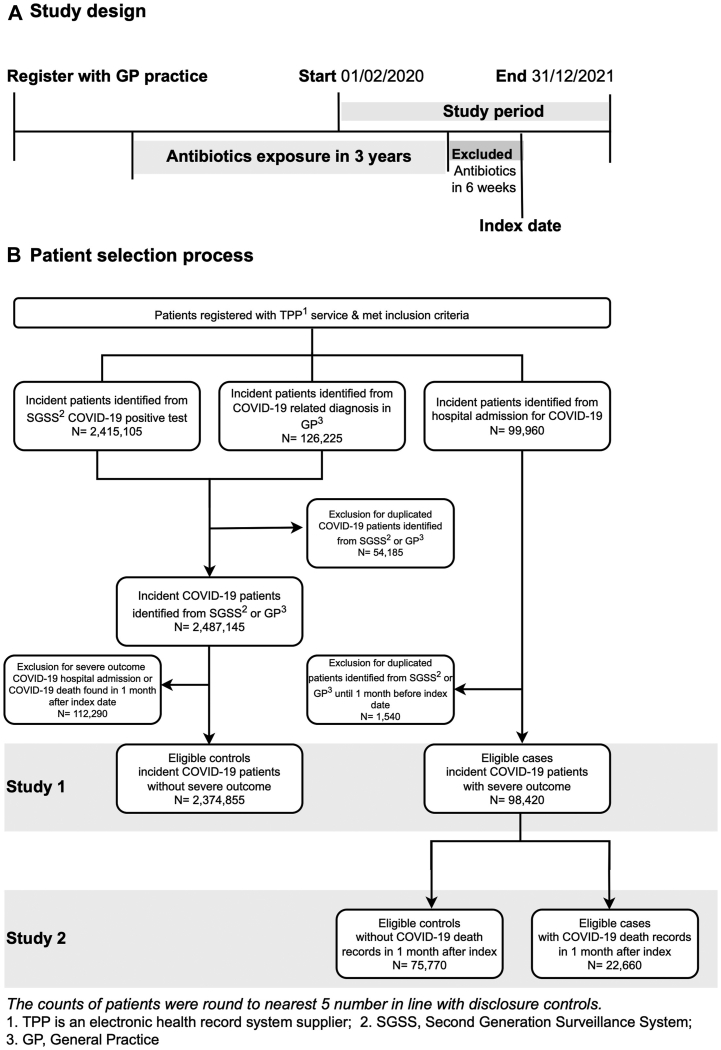
With the approval of NHS England, we used the OpenSAFELY platform, which integrated primary and secondary care, COVID-19 test, and death registration data. This matched case-control study included 0.67 million patients (aged 18-110 years) from an eligible 2.47 million patients with incident COVID-19 by matching with replacement. Inclusion criteria included registration within one general practice for at least 3 years and infection with incident COVID-19. Cases were identified according to different severity of COVID-19 outcomes. Cases and eligible controls were 1:6 matched on age, sex, region of GP practice, and index year and month of COVID-19 infection. Five quintile groups, based on the number of previous 3-year antibiotic prescriptions, were created to indicate the frequency of prior antibiotic exposure. Conditional logistic regression used to compare the differences between case and control groups, adjusting for ethnicity, body mass index, comorbidities, vaccination history, deprivation, and care home status. Sensitivity analyses were done to explore potential confounding and the effects of missing data.
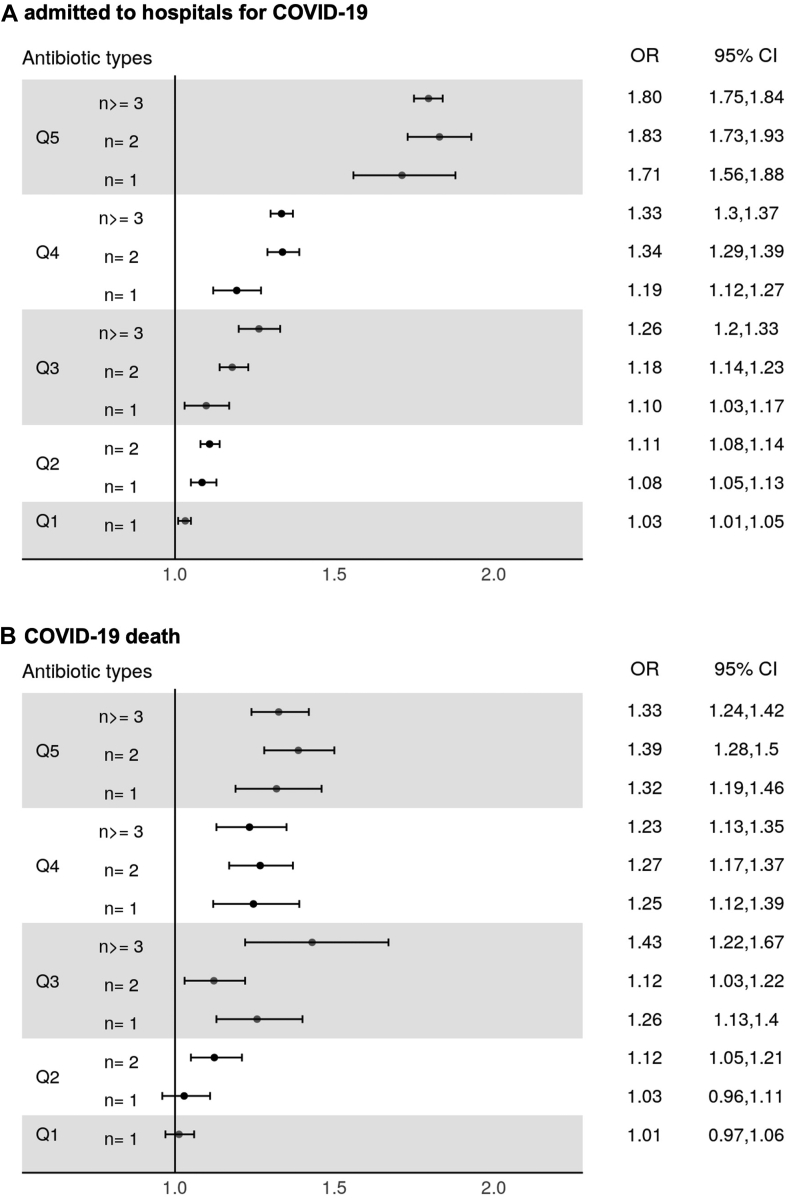
Based on our inclusion criteria, between February 1, 2020 and December 31, 2021, 98,420 patients were admitted to hospitals and 22,660 died. 55 unique antibiotics were prescribed. A dose-response relationship between number of antibiotic prescriptions and risk of severe COVID-19 outcome was observed. Patients in the highest quintile with history of prior antibiotic exposure had 1.80 times greater odds of hospitalisation compared to patients without antibiotic exposure (adjusted odds ratio [OR] 1.80, 95% Confidence Interval [CI] 1.75-1.84). Similarly, the adjusted OR for hospitalised patients with death outcomes was 1.34 (95% CI 1.28-1.41). Larger number of prior antibiotic type was also associated with more severe COVID-19 related hospital admission. The adjusted OR of quintile 5 exposure (the most frequent) with more than 3 antibiotic types was around 2 times larger than quintile 1 (only 1 type; OR 1.80, 95% CI 1.75-1.84 vs. OR 1.03, 95% CI 1.01-1.05).
Our observational study has provided evidence that antibiotic exposure frequency and diversity may be associated with COVID-19 severity, potentially suggesting adverse effects of repeated intermittent antibiotic use. Future work could work to elucidate causal links and potential mechanisms. Antibiotic stewardship should put more emphasis on long-term antibiotic exposure and its adverse outcome to increase the awareness of appropriate antibiotics use.
Health Data Research UK and National Institute for Health Research.
识别与新冠肺炎严重后果相关的潜在风险因素很重要。已知反复间歇性使用抗生素与不良后果相关。本研究旨在探讨既往频繁接触抗生素是否与新冠肺炎严重后果相关。
在英国国家医疗服务体系(NHS)英格兰地区的批准下,我们使用了OpenSAFELY平台,该平台整合了初级和二级医疗、新冠肺炎检测及死亡登记数据。这项匹配病例对照研究通过匹配替换法,从符合条件的247万例新冠肺炎确诊患者中纳入了67万例患者(年龄在18至110岁之间)。纳入标准包括在同一全科诊所注册至少3年且感染新冠肺炎。根据新冠肺炎后果的不同严重程度确定病例。病例和符合条件的对照在年龄、性别、全科诊所所在地区以及新冠肺炎感染的索引年份和月份上进行1:6匹配。根据过去3年抗生素处方数量创建了五个五分位数组,以表明既往抗生素接触频率。使用条件逻辑回归比较病例组和对照组之间的差异,并对种族、体重指数、合并症、疫苗接种史、贫困程度和养老院状况进行调整。进行敏感性分析以探讨潜在的混杂因素和缺失数据的影响。
根据我们的纳入标准,在2020年2月1日至2021年12月31日期间,98420例患者住院,22660例死亡。共开具了55种不同的抗生素。观察到抗生素处方数量与新冠肺炎严重后果风险之间存在剂量反应关系。与未接触抗生素的患者相比,既往有抗生素接触史的最高五分位数组患者住院几率高1.80倍(调整后的优势比[OR]为1.80,95%置信区间[CI]为1.75 - 1.84)。同样,因死亡结果住院患者的调整后OR为1.34(95%CI为1.28 - 1.41)。既往使用抗生素种类较多也与新冠肺炎相关住院更为严重有关。接触5种抗生素(最频繁)且超过3种抗生素类型的五分位数组的调整后OR比接触1种抗生素(仅1种类型)的五分位数组大2倍左右(OR为1.80,95%CI为1.75 - 1.84 对比 OR为1.03,95%CI为1.01 - 1.05)。
我们的观察性研究提供了证据表明抗生素接触频率和多样性可能与新冠肺炎严重程度相关,这可能表明反复间歇性使用抗生素存在不良影响。未来的工作可以致力于阐明因果关系和潜在机制。抗生素管理应更加强调长期抗生素接触及其不良后果,以提高对抗生素合理使用的认识。
英国健康数据研究中心和英国国家卫生研究院。