Wang Yang, Mathai Jared, Alamgeer Muhammad, Parakh Sagun, Paul Eldho, Mitchell Paul, Arulananda Surein
Department of Medical Oncology, Monash Health, Clayton, Australia.
Department of Medical Oncology, Austin Health, Heidelberg, Australia.
JTO Clin Res Rep. 2023 Jun 27;4(8):100544. doi: 10.1016/j.jtocrr.2023.100544. eCollection 2023 Aug.
There are no clinically validated prognostic biomarkers in the management of extensive-stage SCLC (ES-SCLC). We explored the association between clinical characteristics and survival outcomes in patients with ES-SCLC treated with chemoimmunotherapy.
In this retrospective cohort study, patients with ES-SCLC treated with first-line platinum-etoposide chemotherapy and atezolizumab were identified from medical records. Pretreatment clinical characteristics, biochemical parameters, and tumor and treatment characteristics were collected. Univariate and multivariate Cox regression were used to evaluate treatment effect on progression-free survival (PFS) and overall survival (OS).
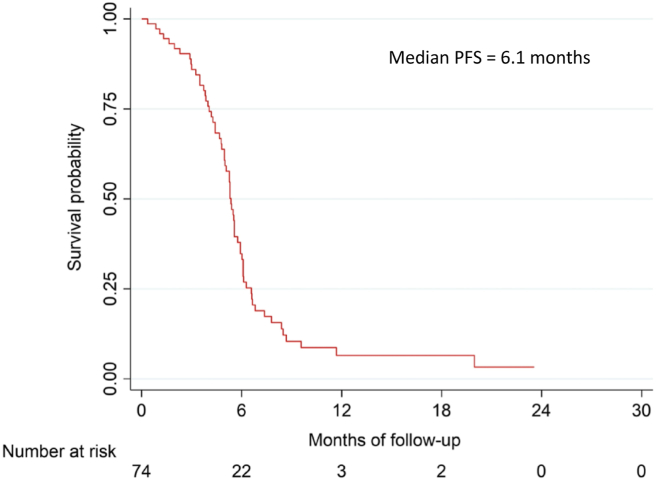
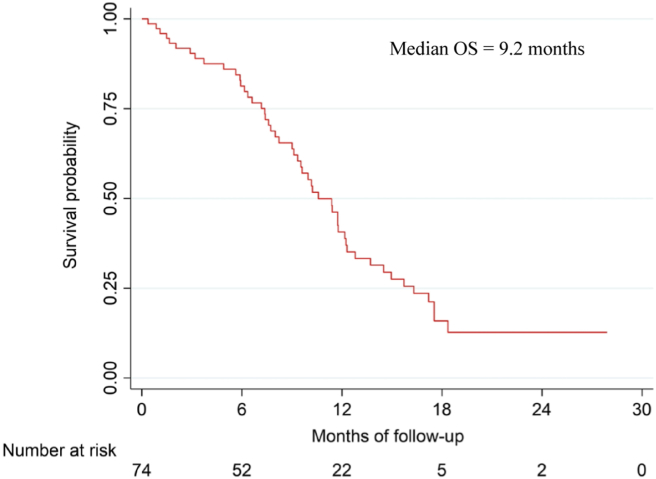
We evaluated 75 patients in total. The median PFS and OS were 6.1 months and 9.2 months, respectively. Statistically significant associations were found with lower lactate dehydrogenase and improved OS (hazard ratio [HR] = 1.0, 95% confidence interval [CI]: 1.0-1.01, = 0.006), whereas higher age (HR = 0.94, 95% CI: 0.90-0.98, = 0.006) and lower neutrophil-to-lymphocyte ratio (HR = 1.08, 95% CI: 1.02-1.14, = 0.005) were associated with improved PFS. The number of chemotherapy cycles received were associated with both an improved PFS (HR = 0.57, 95% CI: 0.37-0.89, = 0.011) and OS (HR = 0.5, 95% CI: 0.30-0.84, = 0.008).
This study highlights the important effect of chemotherapy on survival. Furthermore, the association between lactate dehydrogenase and neutrophil-to-lymphocyte ratio on survival further suggests that baseline tumor burden and optimizing sarcopenia are important factors for clinicians to consider as we seek to develop personalized treatment for this disease.
在广泛期小细胞肺癌(ES-SCLC)的治疗中,尚无经临床验证的预后生物标志物。我们探讨了接受化疗免疫治疗的ES-SCLC患者的临床特征与生存结果之间的关联。
在这项回顾性队列研究中,从病历中识别出接受一线铂类-依托泊苷化疗和阿替利珠单抗治疗的ES-SCLC患者。收集治疗前的临床特征、生化参数以及肿瘤和治疗特征。采用单因素和多因素Cox回归评估治疗对无进展生存期(PFS)和总生存期(OS)的影响。
我们共评估了75例患者。中位PFS和OS分别为6.1个月和9.2个月。发现乳酸脱氢酶水平较低与OS改善存在统计学显著关联(风险比[HR]=1.0,95%置信区间[CI]:1.0-1.01,P=0.006),而年龄较大(HR=0.94,95%CI:0.90-0.98,P=0.006)和中性粒细胞与淋巴细胞比值较低(HR=1.08,95%CI:1.02-1.14,P=0.005)与PFS改善相关。接受化疗的周期数与PFS改善(HR=0.57,95%CI:0.37-0.89,P=0.011)和OS改善(HR=0.5,95%CI:0.30-0.84,P=0.008)均相关。
本研究突出了化疗对生存的重要影响。此外,乳酸脱氢酶和中性粒细胞与淋巴细胞比值与生存之间的关联进一步表明,基线肿瘤负荷和优化肌肉减少症是临床医生在寻求开发针对该疾病的个性化治疗时需要考虑的重要因素。