Azanaw Melkalem Mamuye, Baraki Adhanom Gebreegziabher, Yenit Melaku Kindie
Department of Public Health, College of Health Sciences, Debre Tabor University, Debre Tabor, Ethiopia.
Department of Epidemiology and Biostatistics, Institute of Public Health, College of Medicine and Health Science, University of Gondar, Gondar, Ethiopia.
Front Glob Womens Health. 2023 Jul 17;4:1128988. doi: 10.3389/fgwh.2023.1128988. eCollection 2023.
Although Ethiopia has implemented the Option B+ program over the past 7 years, loss to follow-up among HIV-positive women remains a major problem for antiretroviral therapy (ART) treatment. This study was conducted to investigate the number of women who dropped out of follow-up after the Option B+ program.
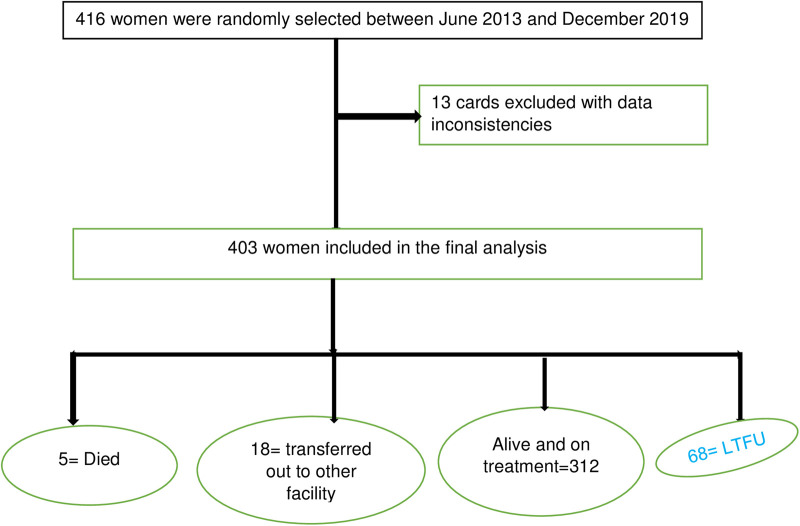
A retrospective follow-up study was conducted among 403 pregnant and lactating women between June 2013 and December 2019 at health facilities in Northwest Ethiopia. The Cox proportional hazards regression model was used to identify predictors of loss to follow-up. The results were reported as hazard ratios with 95% confidence intervals (CIs) at a significance level of = 0.05.
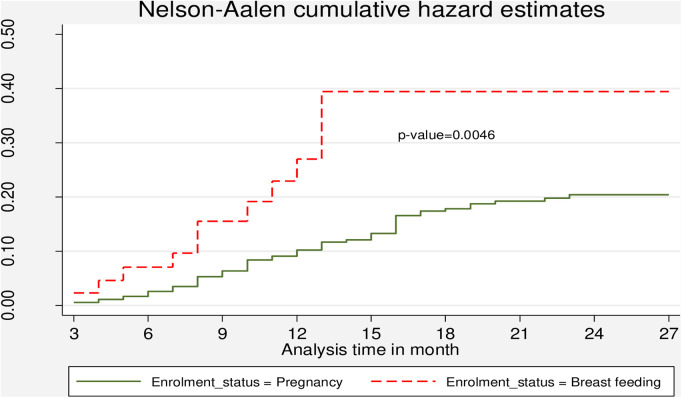
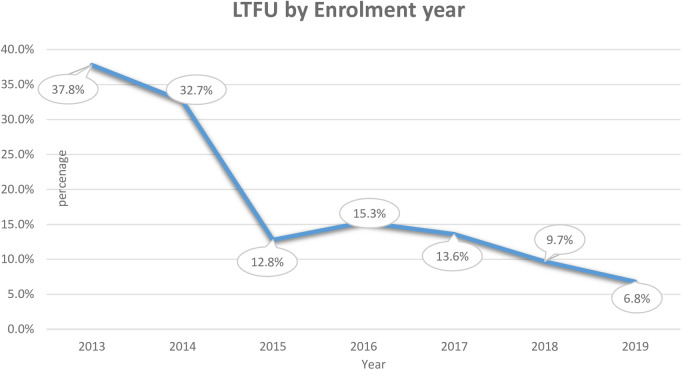
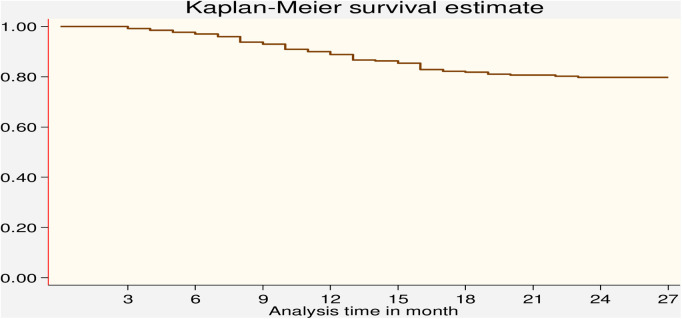
The overall incidence rate of loss to follow-up was 9.4 per 1,000 person-months of observation (95% CI: 7.40-11.90). According to the multivariable Cox regression, rural residency [adjusted hazard ratio (AHR): 2.30; 95% CI: 1.08-4.88], being a Muslim religion follower (AHR: 2.44; 95% CI: 1.23-4.81), having no baseline viral load measurement (AHR: 4.21; 95% CI: 2.23-7.96), being on ART before enrolment (AHR: 0.30; 95% CI: 0.15-0.62), having drug side effects (AHR:1.82; 95% CI: 1.01-3.33), same-day ART initiation (AHR: 3.23; 95% CI: 1.53-6.84), and having suboptimal adherence level (AHR: 3.96; 95% CI: 2.18-7.19) were significant predictors of loss to follow-up.
The incidence of loss to follow-up is lower as compared to evidence from most African countries but slightly higher than the WHO target. It is better to strengthen and expand viral load measurements for all women and to pay attention to women residing in rural areas with fair or poor adherence levels.
尽管埃塞俄比亚在过去7年中实施了B+方案,但艾滋病毒阳性女性的失访仍是抗逆转录病毒疗法(ART)治疗的一个主要问题。本研究旨在调查在B+方案实施后失访的女性人数。
对2013年6月至2019年12月期间埃塞俄比亚西北部卫生设施中的403名孕妇和哺乳期妇女进行了一项回顾性随访研究。采用Cox比例风险回归模型来确定失访的预测因素。结果以风险比及95%置信区间(CIs)表示,显著性水平为α=0.05。
失访的总发生率为每1000人月观察期9.4例(95%CI:7.40-11.90)。根据多变量Cox回归分析,农村居住情况[调整后风险比(AHR):2.30;95%CI:1.08-4.88]、为穆斯林信徒(AHR:2.44;95%CI:1.23-4.81)、未进行基线病毒载量检测(AHR:4.21;95%CI:2.23-7.96)、入组前接受抗逆转录病毒治疗(AHR:0.30;95%CI:0.15-0.62)、出现药物副作用(AHR:1.82;95%CI:1.01-3.33)、当日开始抗逆转录病毒治疗(AHR:3.23;95%CI:1.53-6.84)以及依从性水平欠佳(AHR:3.96;95%CI:2.18-7.19)是失访的显著预测因素。
与大多数非洲国家的证据相比,失访发生率较低,但略高于世界卫生组织的目标。最好加强并扩大对所有女性的病毒载量检测,并关注居住在农村地区且依从性水平一般或较差的女性。