
胸腺素 β4 通过抑制 Th17 细胞应答缓解自身免疫性泪腺炎。
Thymosin β4 Alleviates Autoimmune Dacryoadenitis via Suppressing Th17 Cell Response.
机构信息
Tianjin Key Laboratory of Retinal Functions and Diseases, Tianjin Branch of National Clinical Research Center for Ocular Disease, Eye Institute and School of Optometry, Tianjin Medical University Eye Hospital, Tianjin, China.
Doheny Eye Institute and Department of Ophthalmology, David Geffen School of Medicine, University of California Los Angeles (UCLA), Los Angeles, California, United States.
出版信息
Invest Ophthalmol Vis Sci. 2023 Aug 1;64(11):3. doi: 10.1167/iovs.64.11.3.
PURPOSE
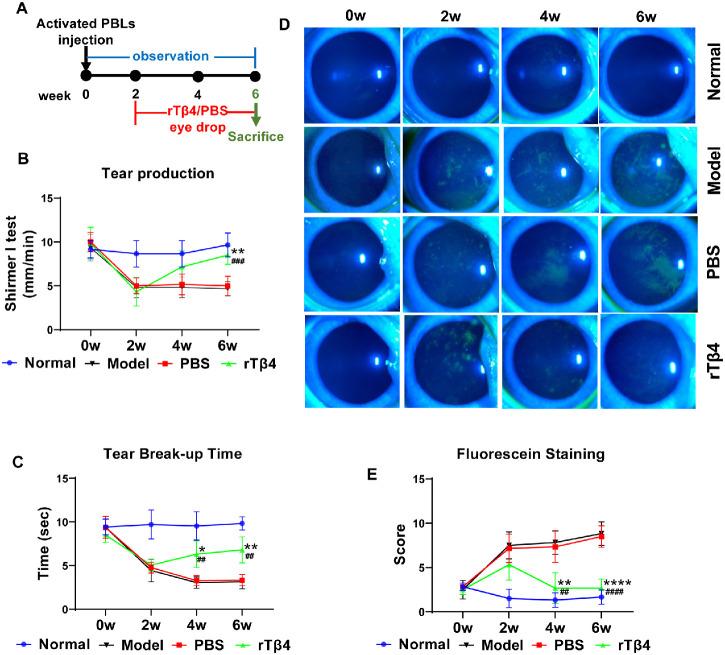
We investigated the therapeutic effect of recombinant thymosin β4 (rTβ4) on rabbit autoimmune dacryoadenitis, an animal model of SS dry eye, and explore its mechanisms.
METHODS
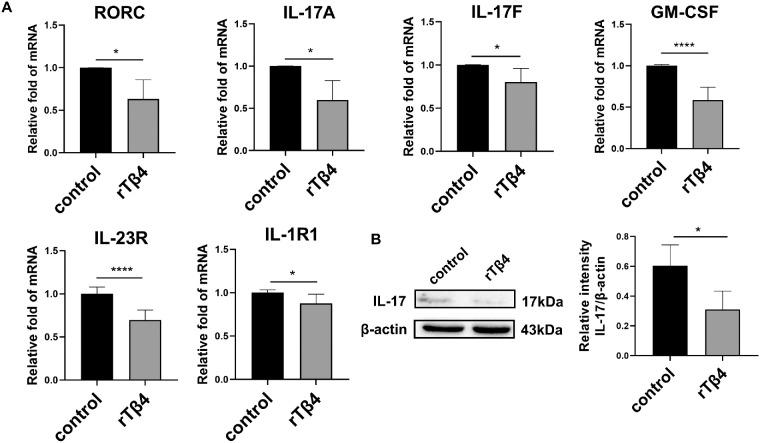
Rabbits were treated topically with rTβ4 or PBS solution after disease onset for 28 days, and clinical scores were determined by assessing tear secretion, break-up time, fluorescein, hematoxylin and eosin staining, and periodic acid-Schiff. The expression of inflammatory mediators in the lacrimal glands were measured by real-time PCR. The expression of T helper 17 (Th17) cell-related transcription factors and cytokines were detected by real-time PCR and Western blotting. The molecular mechanism underlying the effects of rTβ4 on Th17 cell responses was investigated by Western blotting.
RESULTS
Topical administration of rTβ4 after disease onset efficiently ameliorated the ocular surface inflammation and relieved the clinical symptoms. Further analysis revealed that rTβ4 treatment significantly inhibited the expression of Th17-related genes (RORC, IL-17A, IL-17F, IL-1R1, IL-23R, and granulocyte-macrophage colony-stimulating factor) and IL-17 protein in lacrimal glands, and meanwhile decreased the inflammatory mediators expression. Mechanistically, we demonstrated that rTβ4 repressed the phosphorylation of signal transducer and activator of transcription 3 (STAT3) both in vivo and in vitro. Activation of the STAT3 signal pathway by Colivelin partly reversed the suppressive effects of rTβ4 on IL-17 expression in vitro.
CONCLUSIONS
rTβ4 could alleviate ongoing autoimmune dacryoadenitis in rabbits, probably by suppressing Th17 response via partly affecting the STAT3 pathway. These data may provide a new insight into the therapeutic effect and mechanism of rTβ4 in dry eye associated with Sjögren's syndrome.
目的
研究重组胸腺素β4(rTβ4)对兔自身免疫性泪腺炎(干燥综合征 SS 干眼的动物模型)的治疗作用,并探讨其机制。
方法
疾病发病后 28 天,用 rTβ4 或 PBS 溶液局部治疗兔子,通过评估泪液分泌、泪膜破裂时间、荧光素、苏木精和伊红染色以及过碘酸希夫(periodic acid-Schiff)染色来确定临床评分。通过实时 PCR 测量泪腺中炎症介质的表达。通过实时 PCR 和 Western 印迹检测 Th17 细胞相关转录因子和细胞因子的表达。通过 Western 印迹研究 rTβ4 对 Th17 细胞反应的影响的分子机制。
结果
疾病发病后局部给予 rTβ4 可有效改善眼表面炎症并缓解临床症状。进一步分析表明,rTβ4 治疗显著抑制 Th17 相关基因(RORC、IL-17A、IL-17F、IL-1R1、IL-23R 和粒细胞-巨噬细胞集落刺激因子)和泪腺中 IL-17 蛋白的表达,并同时降低炎症介质的表达。在体内和体外均表明 rTβ4 抑制信号转导和转录激活因子 3(STAT3)的磷酸化。Colivelin 激活 STAT3 信号通路部分逆转了 rTβ4 在体外对 IL-17 表达的抑制作用。
结论
rTβ4 可减轻兔正在进行的自身免疫性泪腺炎,可能通过部分影响 STAT3 通路抑制 Th17 反应。这些数据可能为 rTβ4 在干燥综合征相关干眼中的治疗效果和机制提供新的见解。



 Zotero 插件