Department of Pediatrics, Inselspital, Bern University Hospital, University of Bern, Bern, Switzerland.
Pediatric Hematology/Oncology, Department of Pediatrics, Inselspital, Bern University Hospital, University of Bern, Bern, Switzerland.
PLoS One. 2023 Aug 2;18(8):e0287233. doi: 10.1371/journal.pone.0287233. eCollection 2023.
Fever in neutropenia (FN) remains a serious complication of childhood cancer therapy. Clinical decision rules (CDRs) are recommended to help distinguish between children at high and low risk of severe infection. The aim of this analysis was to develop new CDRs for three different outcomes and to externally validate published CDRs.
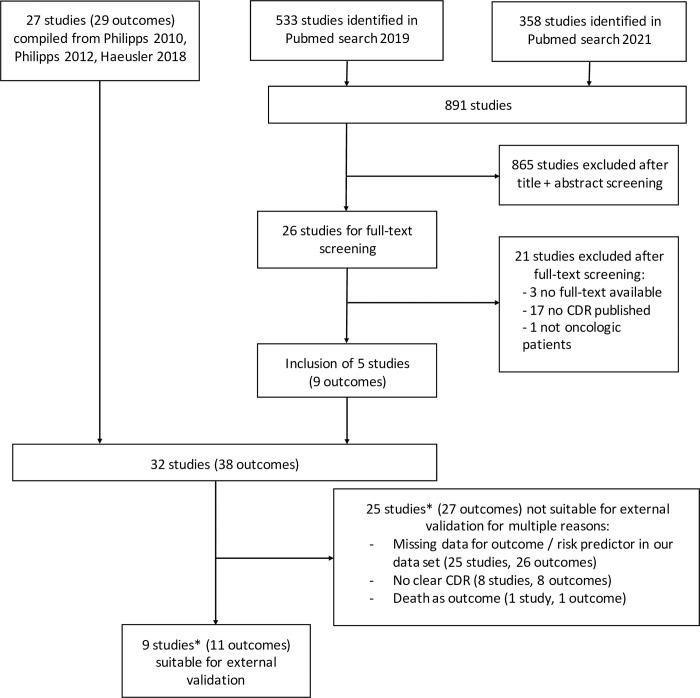
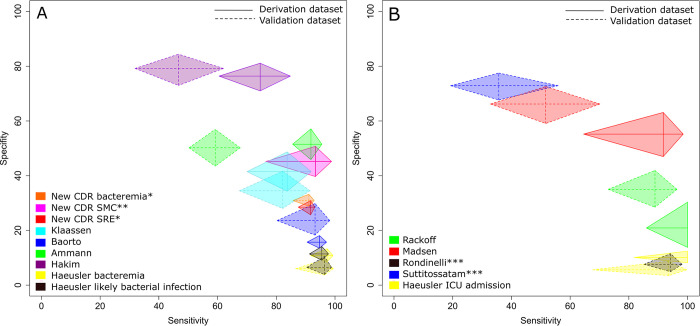
Children undergoing chemotherapy for cancer were observed in a prospective multicenter study. CDRs predicting low from high risk infection regarding three outcomes (bacteremia, serious medical complications (SMC), safety relevant events (SRE)) were developed from multivariable regression models. Their predictive performance was assessed by internal cross-validation. Published CDRs suitable for validation were identified by literature search. Parameters of predictive performance were compared to assess reproducibility.
In 158 patients recruited between April 2016 and August 2018, 360 FN episodes were recorded, including 56 (16%) with bacteremia, 30 (8%) with SMC and 72 (20%) with SRE. The CDRs for bacteremia and SRE used four characteristics (type of malignancy, severely reduced general condition, leucocyte count <0.3 G/L, bone marrow involvement), the CDR for SMC two characteristics (severely reduced general condition and platelet count <50 G/L). Eleven published CDRs were analyzed. Six CDRs showed reproducibility, but only one in both sensitivity and specificity.
This analysis developed CDRs predicting bacteremia, SMC or SRE at presentation with FN. In addition, it identified six published CDRs that show some reproducibility. Validation of CDRs is fundamental to find the best balance between sensitivity and specificity, and will help to further improve management of FN.
中性粒细胞减少症(FN)发热仍然是儿童癌症治疗的严重并发症。建议使用临床决策规则(CDR)来帮助区分高风险和低风险严重感染的儿童。本分析的目的是为三种不同结局开发新的 CDR,并对已发表的 CDR 进行外部验证。
在一项前瞻性多中心研究中观察接受癌症化疗的儿童。从多变量回归模型中开发出预测三种结局(菌血症、严重医疗并发症(SMC)、安全相关事件(SRE))的低风险和高风险感染的 CDR。通过内部交叉验证评估其预测性能。通过文献检索确定适合验证的已发表 CDR。比较预测性能参数以评估可重复性。
在 2016 年 4 月至 2018 年 8 月期间招募的 158 名患者中,记录了 158 名患者的 360 例 FN 发作,其中 56 例(16%)有菌血症,30 例(8%)有 SMC,72 例(20%)有 SRE。菌血症和 SRE 的 CDR 使用了四个特征(恶性肿瘤类型、严重一般状况减退、白细胞计数<0.3 G/L、骨髓受累),SMC 的 CDR 使用了两个特征(严重一般状况减退和血小板计数<50 G/L)。分析了 11 个已发表的 CDR。六个 CDR 显示出可重复性,但只有一个在敏感性和特异性方面均显示出可重复性。
本分析开发了用于预测 FN 发作时出现菌血症、SMC 或 SRE 的 CDR。此外,还确定了六个具有一定可重复性的已发表 CDR。验证 CDR 是在敏感性和特异性之间找到最佳平衡的基础,这将有助于进一步改善 FN 的管理。