Chen Zihe, Feng Ruikang, Wang Wenyu, Tu Shuibin, Hu Yang, Wang Xiancheng, Zhan Renming, Wang Jiao, Zhao Jianzhi, Liu Shuyuan, Fu Lin, Sun Yongming
Wuhan National Laboratory for Optoelectronics, Huazhong University of Science and Technology, Wuhan, 430074, China.
Mirattery Co., Ltd., Wuhan, China.
Nat Commun. 2023 Aug 2;14(1):4648. doi: 10.1038/s41467-023-40369-9.
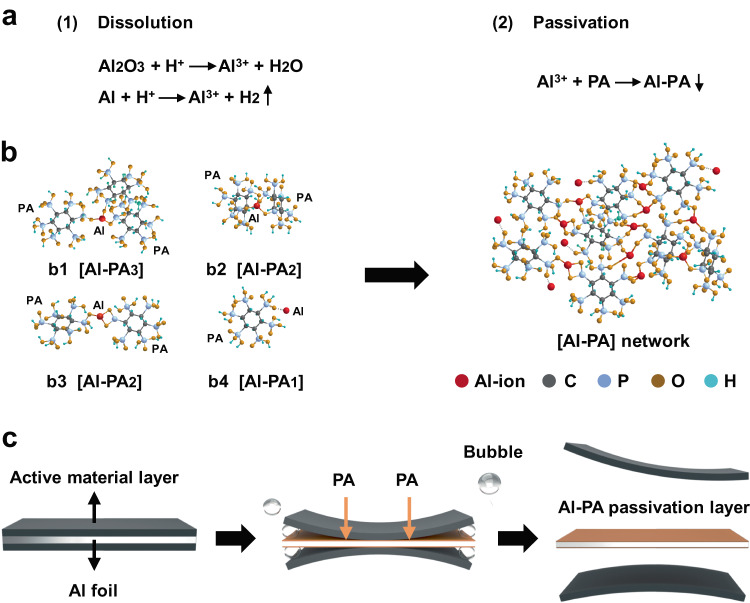
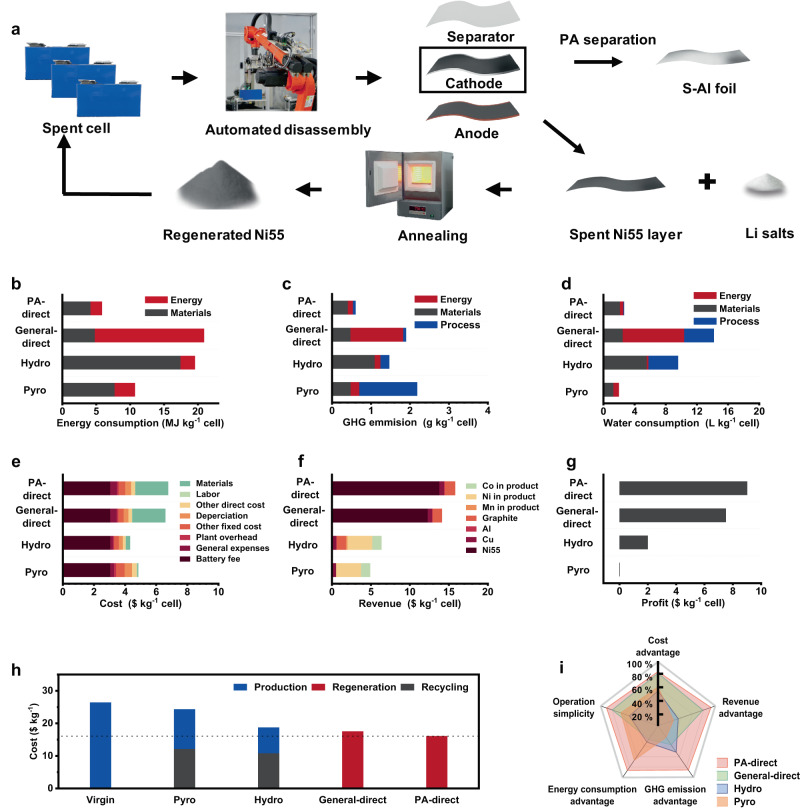
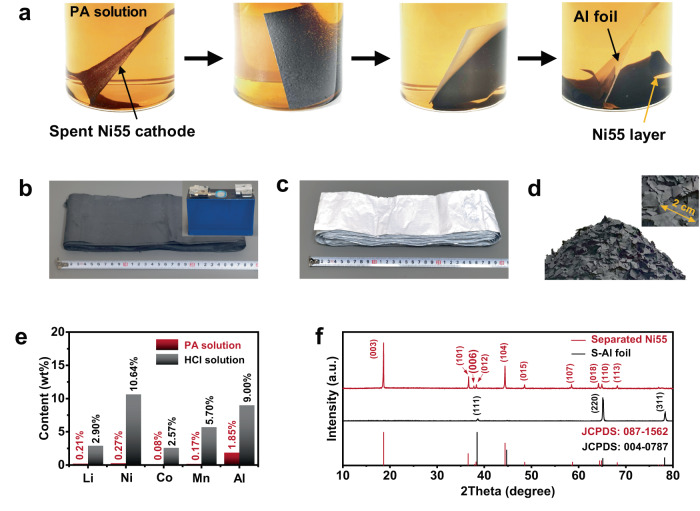
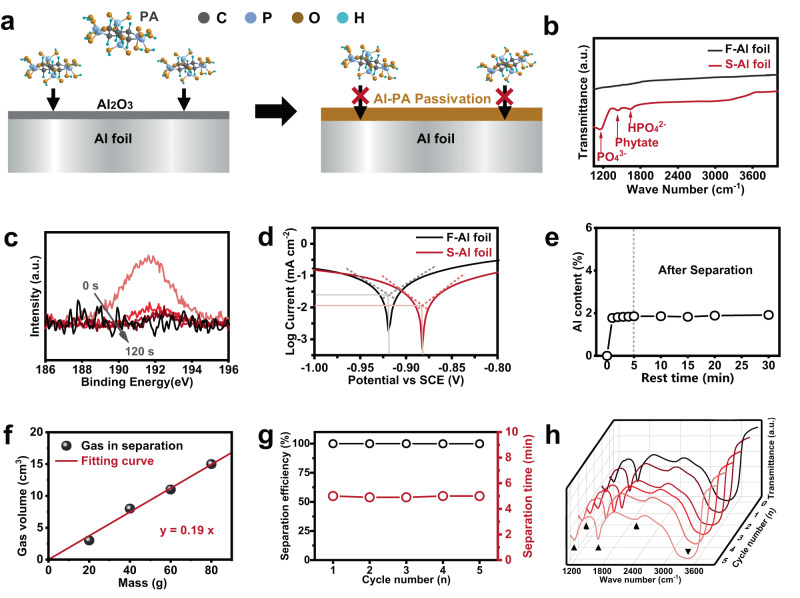
Development of effective recycling strategies for cathode materials in spent lithium-ion batteries are highly desirable but remain significant challenges, among which facile separation of Al foil and active material layer of cathode makes up the first important step. Here, we propose a reaction-passivation driven mechanism for facile separation of Al foil and active material layer. Experimentally, >99.9% separation efficiency for Al foil and LiNiCoMnO layer is realized for a 102 Ah spent cell within 5 mins, and ultrathin, dense aluminum-phytic acid complex layer is in-situ formed on Al foil immediately after its contact with phytic acid, which suppresses continuous Al corrosion. Besides, the dissolution of transitional metal from LiNiCoMnO is negligible and good structural integrity of LiNiCoMnO is well-maintained during the processing. This work demonstrates a feasible approach for Al foil-active material layer separation of cathode and can promote the green and energy-saving battery recycling towards practical applications.
开发用于废旧锂离子电池正极材料的有效回收策略非常必要,但仍面临重大挑战,其中,轻松分离铝箔和正极活性材料层是首要重要步骤。在此,我们提出一种反应-钝化驱动机制,以实现铝箔和活性材料层的轻松分离。实验表明,对于一个102 Ah的废旧电池,在5分钟内铝箔与LiNiCoMnO层的分离效率>99.9%,并且铝箔与植酸接触后立即在其上原位形成超薄、致密的铝-植酸复合层,从而抑制了铝的持续腐蚀。此外,LiNiCoMnO中过渡金属的溶解可忽略不计,并且在处理过程中LiNiCoMnO的良好结构完整性得到了很好的保持。这项工作展示了一种可行的阴极铝箔-活性材料层分离方法,并可推动绿色节能电池回收走向实际应用。