Faculty of Medicine, McMaster University, Hamilton, Canada.
J Cutan Med Surg. 2023 Jul-Aug;27(4):358-367. doi: 10.1177/12034754231188444. Epub 2023 Aug 2.
Biologic agents are emerging as an important treatment option for immune-mediated diseases. Injection site reactions following subcutaneous injection of biologic agents is not well described in the literature.
To summarize injection site reaction data in phase 3 trials of all biologic agents.
MEDLINE, Embase, and CENTRAL databases were systematically searched on February 8, 2022. Proportional meta-analysis was conducted to summarize injection site reaction prevalence for each biologic.
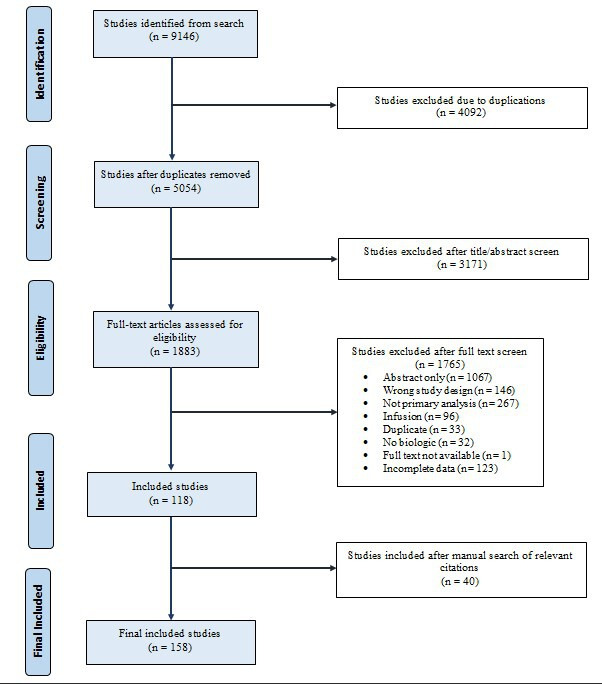
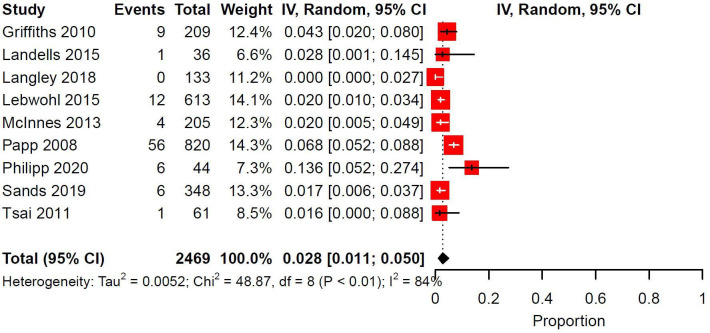
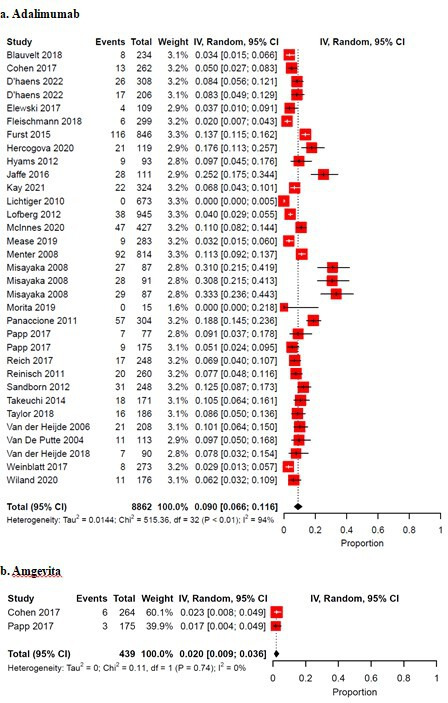
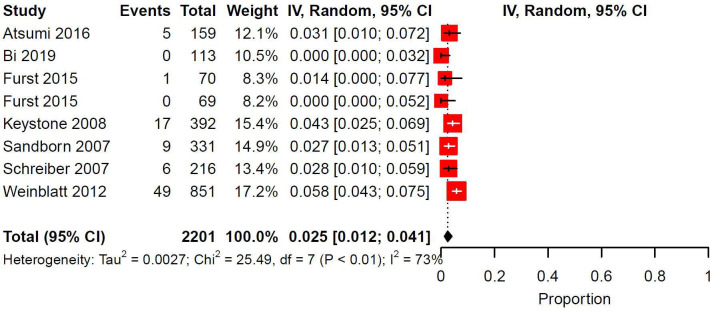
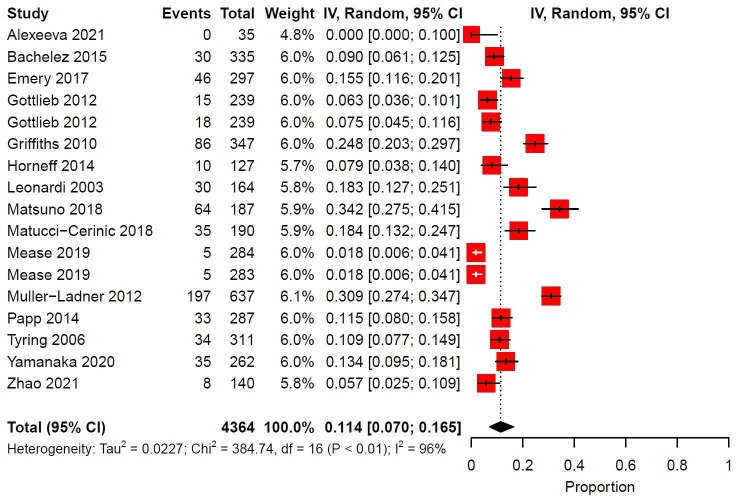
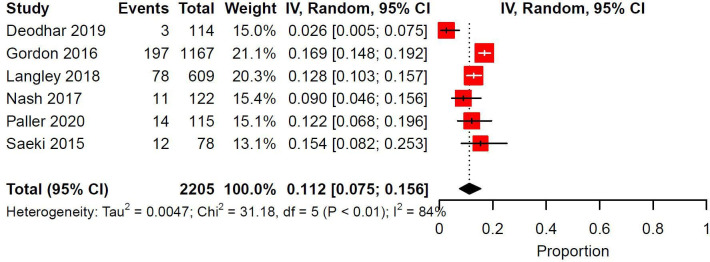
There were 158 articles included in the review. The most common types of injection site reactions were erythema (42.8%), unspecified reaction (23.3%), pain (12.4%), and pruritus (5.7%). No patients discontinued their treatment due to injection site reactions in 39 of the 48 studies that reported on discontinuation data. There were 16 biologics included in meta-analysis across 80 eligible studies. The biologics with the highest point prevalence of patients reporting injection site reactions were Canakinumab (15.5%; 294 patients), Dupilumab (11.4%; 1888 patients), Etanercept (11.4%; 4363 patients), and Ixekizumab (11.2%; 2205 patients). The biologics with the lowest point prevalence of injection site reactions were Risankizumab (0.8%; 707 patients), Brodalumab (1.3%; 1365 patients), Guselkumab (1.3%; 1852 patients), Secukinumab (1.9%; 1277 patients).
The prevalence of injection site reaction in response to biologics ranges from 0.08 to 15.5%. Canakinumab, Dupilumab, Etanercept, and Ixekizumab had the highest prevalence of injection site reactions. Risankizumab, Brodalumab, Guselkumab, and Secukinumab had the lowest prevalence of injection site reactions. Recommendations are made regarding the improvement of adverse event reporting to better understand the epidemiology of injection site reactions.
生物制剂作为治疗免疫介导性疾病的重要手段正在不断涌现。然而,生物制剂皮下注射后的注射部位反应在文献中描述得并不充分。
总结所有生物制剂 3 期临床试验中的注射部位反应数据。
于 2022 年 2 月 8 日系统性检索 MEDLINE、Embase 和 CENTRAL 数据库。采用比例荟萃分析汇总每种生物制剂的注射部位反应发生率。
共纳入 158 篇文章。最常见的注射部位反应类型包括红斑(42.8%)、未特指反应(23.3%)、疼痛(12.4%)和瘙痒(5.7%)。在报告停药数据的 48 项研究中,有 39 项研究无患者因注射部位反应而停药。在纳入 80 项合格研究的 16 项生物制剂的荟萃分析中,报告注射部位反应的患者比例最高的生物制剂依次为康纳单抗(15.5%,294 例)、度普利尤单抗(11.4%,1888 例)、依那西普(11.4%,4363 例)和依奇珠单抗(11.2%,2205 例)。注射部位反应发生率最低的生物制剂依次为里沙鲁单抗(0.8%,707 例)、布罗达单抗(1.3%,1365 例)、古塞库单抗(1.3%,1852 例)、司库奇尤单抗(1.9%,1277 例)。
生物制剂治疗引起的注射部位反应发生率为 0.08%~15.5%。康纳单抗、度普利尤单抗、依那西普和依奇珠单抗的注射部位反应发生率最高,里沙鲁单抗、布罗达单抗、古塞库单抗和司库奇尤单抗的发生率最低。我们建议改进不良事件报告,以更好地了解注射部位反应的流行病学情况。