Frölke Sophie C, Bouwmans Pim, Messchendorp A Lianne, Vervoort Johanna P M, Abrahams Alferso C, de Vries Aiko P J, Nieuwkerk Pythia T, Hemmelder Marc H, Gansevoort Ron T, Hilbrands Luuk B, Reinders Marlies E J, Sanders Jan-Stephan F, Bemelman Frederike J, Geerlings Suzanne E
Amsterdam UMC Location University of Amsterdam, Renal Transplant Unit, Meibergdreef 9, Amsterdam, the Netherlands.
Amsterdam Institute for Infection and Immunity, Infectious Diseases, Amsterdam, the Netherlands.
EClinicalMedicine. 2023 Jul 20;62:102103. doi: 10.1016/j.eclinm.2023.102103. eCollection 2023 Aug.
Kidney transplant recipients (KTRs) were advised to tightly adhere to government recommendations to curb the spread of severe acute respiratory syndrome coronavirus-2 (SARS-CoV-2) because of a high risk of morbidity and mortality and decreased immunogenicity after vaccination. The aim of this study was to analyse the change in adherence to preventive measures after vaccination and awareness of antibody response, and to evaluate its effectiveness.
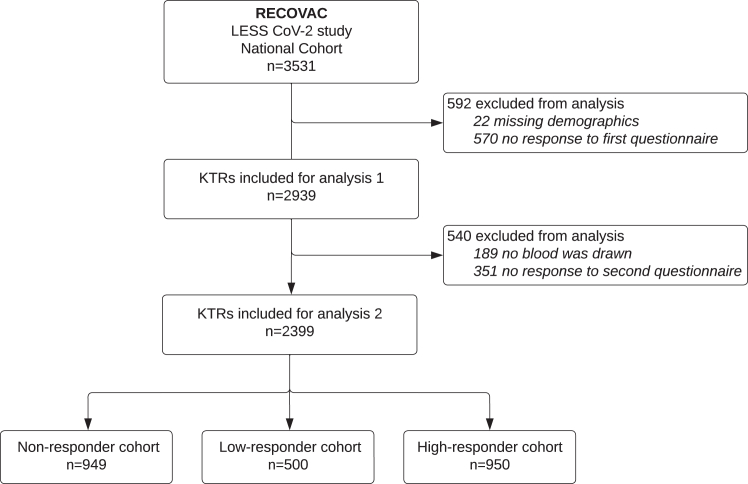
In this large-scale, national questionnaire study, questionnaires were sent to 3531 KTRs enrolled in the Dutch RECOVAC studies, retrospectively asking for adherence to nine preventive measures on a 5-point Likert scale before and after SARS-CoV-2 vaccination and after awareness of antibody response. Blood samples were collected 28 days after the second vaccination. Antibody response was categorised as non-responder (≤50 BAU/mL), low-responder (>50 ≤ 300 BAU/mL) or high-responder (>300 BAU/mL), and shared with participants as a correlate of protection. Participants of whom demographics on sex and age, blood samples and completed questionnaires were available, were included. Our study took place between February 2021 and January 2022. The primary outcome of adherence before and after vaccination was assessed between August and October 2021 and compared via the Wilcoxon signed rank sum test. Logistic regression analysis was performed to estimate the association between antibody response and non-adherence, and adherence on acquiring SARS-CoV-2 infection. This study is registered at ClinicalTrials.gov (NCT04841785).
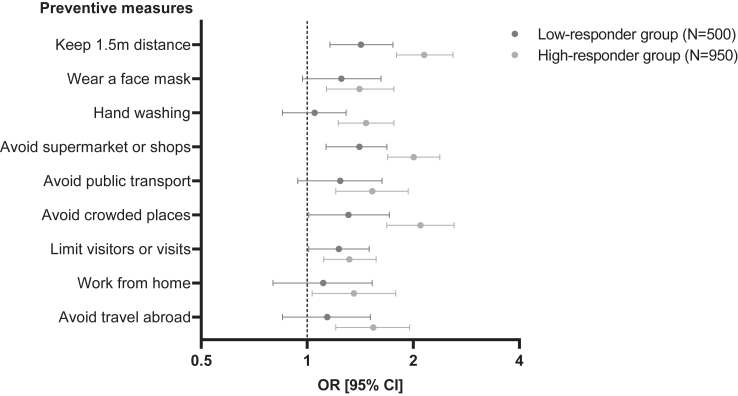
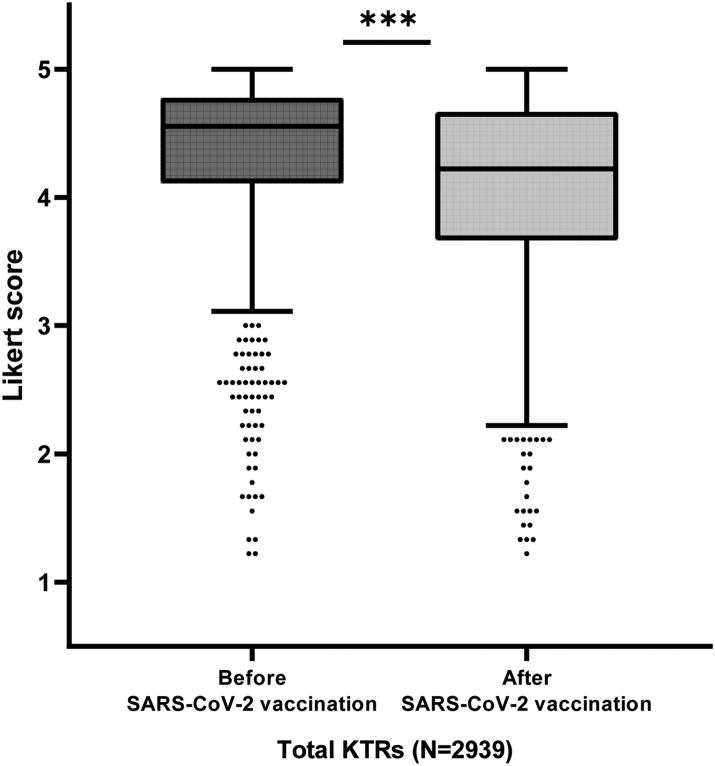
In 2939 KTRs (83%) who completed the first questionnaire on adherence to preventive measures, adherence was higher before than after vaccination (4.56, IQR 4.11-4.78 and 4.22, IQR 3.67-4.67, p < 0.001). Adherence after awareness of antibody response was analysed in 2399 KTRs (82%) of whom also blood samples were available, containing 949 non-responders, 500 low-responders and 950 high-responders. Compared to non-responders, low- and high-responders reported higher non-adherence. Higher adherence was associated with lower infection rates before and after vaccination (OR 0.67 [0.51-0.91], p = 0.008 and OR 0.48 [0.28-0.86], p = 0.010).
Adherence decreased after SARS-CoV-2 vaccination and in KTRs who were aware of a subsequent antibody response compared with those without. Preventive measures in this vulnerable group seem to be effective, regardless of vaccination status. This study starts a debate on sharing antibody results with the patient and future studies should elucidate whether decreased adherence in antibody responders is justified, also in view of future pandemics.
The Netherlands Organization for Health Research and Development and the Dutch Kidney Foundation.
由于严重急性呼吸综合征冠状病毒2(SARS-CoV-2)感染导致发病和死亡风险高,且接种疫苗后免疫原性降低,肾移植受者(KTRs)被建议严格遵守政府防控措施以遏制SARS-CoV-2传播。本研究旨在分析接种疫苗后预防措施依从性的变化以及对抗体反应的认知情况,并评估其有效性。
在这项大规模的全国性问卷调查研究中,向参与荷兰RECOVAC研究的3531名KTRs发送问卷,回顾性询问他们在SARS-CoV-2疫苗接种前后以及知晓抗体反应后对九项预防措施的依从性(采用5分李克特量表)。在第二次接种疫苗28天后采集血样。抗体反应分为无反应者(≤50 BAU/mL)、低反应者(>50≤300 BAU/mL)或高反应者(>300 BAU/mL),并作为保护相关性信息告知参与者。纳入那些提供了性别和年龄等人口统计学信息、血样且完成问卷的参与者。我们的研究于2021年2月至2022年1月进行。2021年8月至10月评估接种疫苗前后的依从性这一主要结局,并通过Wilcoxon符号秩和检验进行比较。进行逻辑回归分析以估计抗体反应与不依从以及感染SARS-CoV-2之间的关联。本研究已在ClinicalTrials.gov注册(NCT04841785)。
在2939名完成首次预防措施依从性问卷的KTRs(83%)中,接种疫苗前的依从性高于接种后(4.56,四分位数间距4.11 - 4.78和4.22,四分位数间距3.67 - 4.67,p < 0.001)。在2399名KTRs(82%)中分析了知晓抗体反应后的依从性,这些参与者也提供了血样,其中包括949名无反应者、500名低反应者和950名高反应者。与无反应者相比,低反应者和高反应者报告的不依从性更高。较高的依从性与接种疫苗前后较低的感染率相关(比值比0.67 [0.51 - 0.91],p = 0.008和比值比0.48 [0.28 - 0.86],p = 0.010)。
与未知晓后续抗体反应的KTRs相比,SARS-CoV-2疫苗接种后以及知晓抗体反应的KTRs的依从性降低。无论疫苗接种状况如何,该弱势群体的预防措施似乎都是有效的。本研究引发了关于向患者分享抗体结果的讨论,未来研究应阐明抗体反应者依从性降低是否合理,这也考虑到未来的大流行情况。
荷兰卫生研究与发展组织和荷兰肾脏基金会。