Kim Hyojune, Hur Seok, Jeon In-Ho, Koh Kyoung Hwan
Department of Orthopaedic Surgery, Eulji University Hospital, Daejeon, Republic of Korea.
Department of Orthopaedic Surgery, Asan Medical Center, University of Ulsan College of Medicine, Seoul, Republic of Korea.
Orthop J Sports Med. 2023 Jul 31;11(7):23259671231186408. doi: 10.1177/23259671231186408. eCollection 2023 Jul.
The impact of retear after arthroscopic rotator cuff repair (ARCR) on clinical outcomes of patients remains controversial.
PURPOSE/HYPOTHESIS: The purpose of this study was to determine the effects of retear on strength recovery, return to previous levels of work, and return to sports participation. It was hypothesized that retears (1) would not have a significant effect on patient-reported outcome measures (PROMs) and (2) would significantly inhibit strength recovery and return to previous work and sports.
Cohort study; Level of evidence, 3.
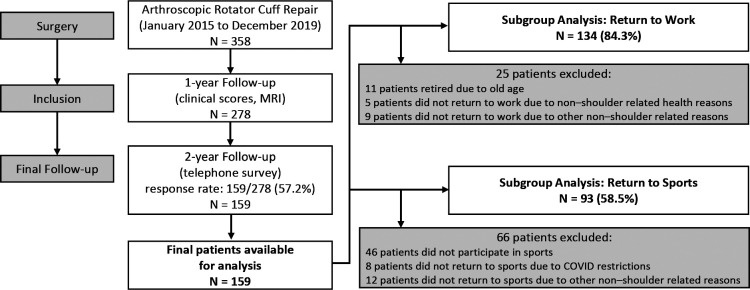
The authors collected data from patients who underwent ARCR between January 2015 and December 2019. All included patients had undergone magnetic resonance imaging (MRI) and strength measurements 1 year postoperatively. Minimum 2-year postoperative PROMs (Constant score, pain visual analog scale, American Shoulder and Elbow Surgeons score, and Single Assessment Numeric Evaluation) and status on work and sports participation were collected, and PROM scores, strength recovery (percentage compared with the contralateral shoulder), return to work, and return to sports were compared between patients with versus without retear on 1-year postoperative MRI. Additionally, factors related to return to work and sports were identified through multivariable regression analysis.
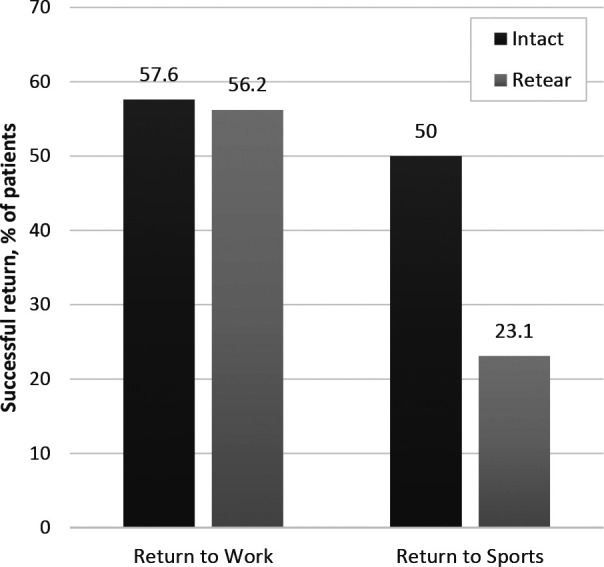
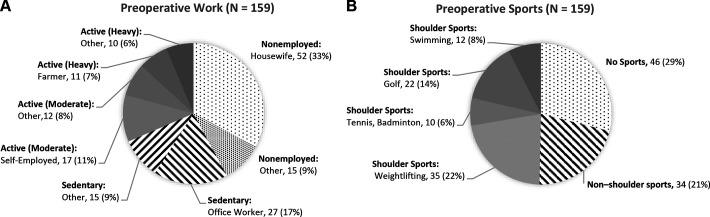
A total of 159 patients were included, of whom 19 (11.9%) had evidence of retear. Return-to-work and return-to-sports status was evaluated in 134 (84.3%) and 93 (58.5%) patients, respectively. There were no significant differences in PROM scores between patients with and without retears; however, patients with retears exhibited significantly worse supraspinatus strength recovery (73% vs 86%; = .018) and external rotation strength recovery (78% vs 88%; = .030) compared with patients with intact shoulders. There were no between-group differences in return to work or sports. Active workload was associated with unsuccessful return to work, whereas preoperative participation in shoulder sports was associated with successful return to work.
Patients with postoperative retears had significantly worse postoperative strength recovery than patients with intact shoulders. Active workload and preoperative shoulder sports participation were factors associated with ability to return to work.
关节镜下肩袖修复术(ARCR)后再撕裂对患者临床结局的影响仍存在争议。
目的/假设:本研究的目的是确定再撕裂对力量恢复、恢复至先前工作水平以及恢复运动参与的影响。研究假设为,再撕裂(1)对患者报告的结局指标(PROMs)无显著影响,(2)会显著抑制力量恢复以及恢复至先前的工作和运动状态。
队列研究;证据等级,3级。
作者收集了2015年1月至2019年12月期间接受ARCR的患者的数据。所有纳入患者在术后1年均接受了磁共振成像(MRI)检查和力量测量。收集术后至少2年的PROMs(Constant评分、疼痛视觉模拟量表、美国肩肘外科医师协会评分和单项评估数值评定)以及工作和运动参与状态,并比较术后1年MRI检查显示有再撕裂与无再撕裂患者之间的PROMs评分、力量恢复情况(与对侧肩部相比的百分比)、恢复工作情况和恢复运动情况。此外,通过多变量回归分析确定与恢复工作和运动相关的因素。
共纳入159例患者,其中19例(11.9%)有再撕裂证据。分别对134例(84.3%)患者的恢复工作情况和93例(58.5%)患者的恢复运动情况进行了评估。有再撕裂与无再撕裂患者的PROMs评分无显著差异;然而,与肩部完好的患者相比,有再撕裂的患者冈上肌力量恢复情况明显更差(73%对86%;P = 0.018),外旋力量恢复情况也明显更差(78%对88%;P = 0.030)。恢复工作或运动方面两组之间无差异。工作负荷大与恢复工作失败相关,而术前参与肩部运动与恢复工作成功相关。
术后有再撕裂的患者术后力量恢复情况明显比肩部完好的患者差。工作负荷大和术前参与肩部运动是与恢复工作能力相关的因素。