Zhu Manmin, Huang Hao
Department of Neurology, Affiliated Hospital of Zunyi Medical University, Guizhou, People's Republic of China.
Nat Sci Sleep. 2023 Jul 28;15:579-591. doi: 10.2147/NSS.S414174. eCollection 2023.
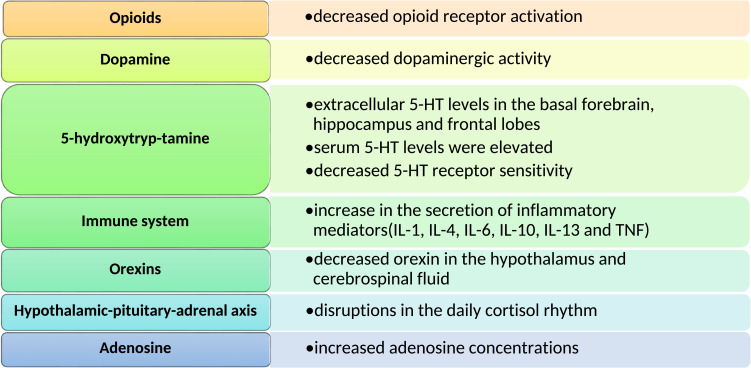
Pain disrupts sleep, and sleep deprivation or interference can alter pain perception in animals and humans, for example by increasing sensitivity to pain. However, the mechanism by which sleep affects neuropathic pain remains unclear. In this review, we discuss the available evidence from the epidemiologic, clinical, and human, as well as laboratory studies. In previous studies, we have found that sleep deprivation affects various injurious systems, including opioids, dopaminergic, immune, orexins, hypothalamic-pituitary-adrenal axis, and adenosine. At the same time, these systems play a crucial role in neuropathic pain regulation. In the complex interactions between these neurobiological systems, there may be potential regulatory pathways through which sleep deprivation amplifies neuropathic pain. Because of the impact sleep problems and neuropathic pain can have on the patients' quality of life, studying the link between sleep and neuropathic pain is important for neuropathic pain prevention and public health.
疼痛会扰乱睡眠,而睡眠剥夺或干扰会改变动物和人类的疼痛感知,例如通过增加对疼痛的敏感性。然而,睡眠影响神经性疼痛的机制仍不清楚。在这篇综述中,我们讨论了来自流行病学、临床、人体以及实验室研究的现有证据。在先前的研究中,我们发现睡眠剥夺会影响各种损伤系统,包括阿片类物质、多巴胺能、免疫、食欲素、下丘脑-垂体-肾上腺轴和腺苷。同时,这些系统在神经性疼痛调节中起着关键作用。在这些神经生物学系统之间的复杂相互作用中,可能存在睡眠剥夺加剧神经性疼痛的潜在调节途径。由于睡眠问题和神经性疼痛会对患者的生活质量产生影响,研究睡眠与神经性疼痛之间的联系对于预防神经性疼痛和公共卫生具有重要意义。