do Nascimento João Henrique Fonseca, da Silva Cleonice Nascimento, Gusmão-Cunha André, Neto Marinho Marques Silva, de Andrade André Bouzas
Life Sciences Department, Universidade do Estado da Bahia (UNEB), Salvador 41150-000, Brazil.
https://orcid.org/0000-0001-8750-6116.
Ecancermedicalscience. 2023 Jul 7;17:1570. doi: 10.3332/ecancer.2023.1570. eCollection 2023.
Short period from diagnosis to breast cancer (BC) treatment initiation remains challenging for the public health system in Brazil, which may have been further affected by the coronavirus disease-2019 (COVID-19) pandemic. This study assessed BC diagnosis-to-treatment intervals (DTi) in Brazil and the possible effects of the COVID-19 outbreak on delays.
The Painel de Monitoramento de Tratamento Oncológico database was queried to obtain the number of Brazilian patients with a BC confirmed diagnosis and initiating cancer treatment in the pre-COVID-19 (2013-2019) and during the COVID-19 (2020-2021) periods, adopting a 60-day limit as timely treatment. A -value of <0.05 was considered significant.
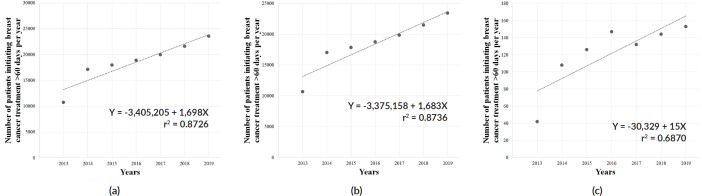
A total of 315,951 cases were included (females: 99.3% and males: 0.7%), of which 251,667 and 64,284 records were computed before and during the COVID-19 years, respectively. Most patients failed to perform the first cancer treatment within 60 days (>60: 51.8%). We observed an upward trend in the number of BC treatments provided in the pre-COVID-19 years ( = 0.9575; < 0.05), but the volume of treatments exhibited an average reduction of 24.6% yearly during the COVID-19 pandemic. The average DTi in days was 122.4, 122.5 and 122.3 in the total period studied, before and during the COVID-19 outbreak, respectively. The arrival of COVID-19 in Brazil increased the chances of treatment delay (OR = 1.043; < 0.05) and inverted the proportion of early/advanced stages at BC diagnosis (55.8%/44.2%-48.4%/51.6%).
COVID-19 has imposed changes in BC care in Brazil, reducing the number of treatments provided by the Brazilian public health system, increasing the chances of delayed treatment initiation despite no differences in DTi averages being identified, and raising the proportion of advanced-stage diagnoses.
在巴西,从乳腺癌(BC)诊断到开始治疗的时间间隔较短,这对公共卫生系统来说仍然是一项挑战,而2019冠状病毒病(COVID-19)大流行可能进一步加剧了这一情况。本研究评估了巴西乳腺癌的诊断至治疗间隔(DTi)以及COVID-19疫情对治疗延迟的可能影响。
查询肿瘤治疗监测面板数据库,以获取在COVID-19之前(2013 - 2019年)和COVID-19期间(2020 - 2021年)确诊为乳腺癌并开始癌症治疗的巴西患者数量,将60天作为及时治疗的时限。P值<0.05被认为具有统计学意义。
共纳入315,951例病例(女性:99.3%,男性:0.7%),其中分别计算出COVID-19之前和期间的记录为251,667例和64,284例。大多数患者未能在60天内进行首次癌症治疗(>60天:51.8%)。我们观察到在COVID-19之前的年份里提供的乳腺癌治疗数量呈上升趋势(P = 0.9575;P < 0.05),但在COVID-19大流行期间治疗量平均每年减少24.6%。在整个研究期间、COVID-19疫情之前和期间,平均DTi(以天为单位)分别为122.4、122.5和122.3。COVID-19在巴西的出现增加了治疗延迟的几率(优势比=1.043;P < 0.05),并使乳腺癌诊断时早期/晚期的比例发生了反转(55.8%/44.2% - 48.4%/51.6%)。
COVID-19给巴西的乳腺癌护理带来了变化,减少了巴西公共卫生系统提供的治疗数量,增加了治疗开始延迟的几率,尽管未发现DTi平均值有差异,并且提高了晚期诊断的比例。