Bonadio Renata Colombo, Messias Ana Paula, Moreira Otavio Augusto, Leis Letícia Vecchi, Orsi Bruna Zanin, Testa Laura, Estevez-Diz Maria Del Pilar
These authors contributed equally to this work.
Medical Oncology - Instituto do Cancer do Estado de Sao Paulo (ICESP), Av. Dr. Arnaldo, 251, São Paulo - SP, 01246-000, Brazil.
Ecancermedicalscience. 2021 Oct 4;15:1299. doi: 10.3332/ecancer.2021.1299. eCollection 2021.
The COVID-19 pandemic has led to the need for health services adjustments, which may have compromised management of other diseases. For cancer patients, delays may significantly impair outcomes in some situations. We aimed to assess the impact of the COVID-19 pandemic in breast and cervical cancer diagnosis and treatment compared to the same period prior to the pandemic.
Data were collected from patients attending their first visit to a Brazilian cancer centre from 1 September 2020 to 31 January 2021 and from 1 September 2019 to 31 January 2020. The pandemic started in February 2020 in Brazil and is still ongoing. We considered this period (September/20-January/21) to be representative of the pandemic impact on cancer management. The primary endpoint was breast and cervical cancer stages at diagnosis.
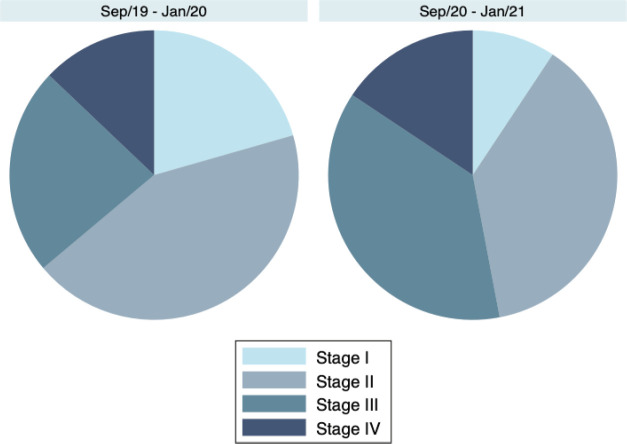
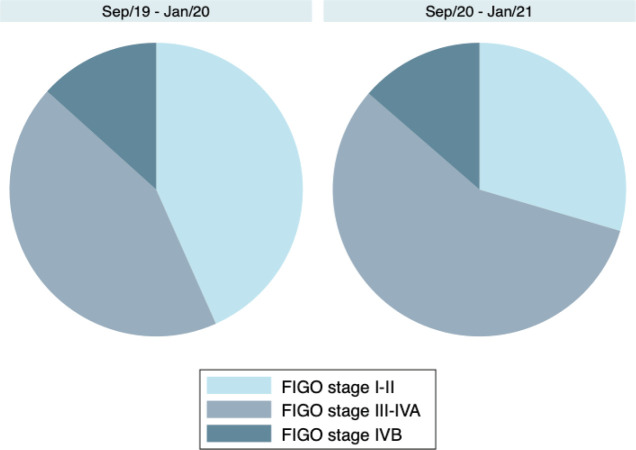
A total of 268 breast cancer patients and 44 cervical cancer patients had their first consult in our cancer centre from September/20 to January/21; 457 and 60, respectively, occurred from September/19 to January/20. Patients who attended their first visit during the pandemic (September/20-January/21) presented with more advanced-stage breast cancer ( < 0.001) and cervical cancer ( = 0.328) than those in the period prior to the pandemic (September/19-January/20), although the difference was not statistically significant for cervical cancer. The proportion of cervical cancer patients diagnosed with locally advanced disease (stages III-IVA) was 56.8% ( = 25) in September/20-January/21 compared to 43.3% ( = 26) in September/19-January/20. Similarly, 37.3% ( = 100) of breast cancer patients had stage III disease in September/20-January/21 compared to 23.2% ( = 106) in September/19-January/20. Fewer breast cancer patients (13.7%) were diagnosed due to screening tests during the pandemic than before it (25.5%) ( < 0.001).
Breast and cervical cancer patients had more advanced-stage diseases in their first visit to a cancer centre during the COVID-19 pandemic compared to a similar period prior to the pandemic. Efforts should be made not to compromise essential cancer services since this results in long-term negative impacts for oncologic patients.
新冠疫情导致需要对医疗服务进行调整,这可能会影响其他疾病的管理。对于癌症患者而言,在某些情况下,治疗延迟可能会显著影响治疗效果。我们旨在评估新冠疫情对乳腺癌和宫颈癌诊断及治疗的影响,并与疫情前同期进行比较。
收集了2020年9月1日至2021年1月31日以及2019年9月1日至2020年1月31日首次就诊于巴西一家癌症中心的患者数据。巴西的疫情于2020年2月开始,目前仍在持续。我们认为这一时期(20年9月至21年1月)能够代表疫情对癌症管理的影响。主要终点为诊断时的乳腺癌和宫颈癌分期。
2020年9月至2021年1月期间,共有268例乳腺癌患者和44例宫颈癌患者在我们的癌症中心进行了首次咨询;2019年9月至2020年1月期间分别为457例和60例。与疫情前时期(2019年9月至2020年1月)相比,在疫情期间(2020年9月至2021年1月)首次就诊的患者中,乳腺癌(<0.001)和宫颈癌(=0.328)的分期更晚,不过宫颈癌的差异无统计学意义。2020年9月至2021年1月期间诊断为局部晚期疾病(III-IVA期)的宫颈癌患者比例为56.8%(=25),而2019年9月至2020年1月期间为43.3%(=26)。同样,2020年9月至2021年1月期间37.3%(=100)的乳腺癌患者为III期疾病,而2019年9月至2020年1月期间为23.2%(=106)。与疫情前(25.5%)相比,疫情期间因筛查检测而被诊断出的乳腺癌患者较少(13.7%)(<0.001)。
与疫情前的类似时期相比,新冠疫情期间乳腺癌和宫颈癌患者在首次就诊于癌症中心时疾病分期更晚。应努力确保不影响基本的癌症服务,因为这会对肿瘤患者产生长期负面影响。