Phipps Daniel J, Hagger Martin S, Hamilton Kyra
Faculty of Sport and Health Sciences, University of Jyväskylä, Jyväskylä, Finland.
School of Applied Psychology, Griffith University, Brisbane, Australia.
Brain Behav. 2023 Oct;13(10):e3200. doi: 10.1002/brb3.3200. Epub 2023 Aug 3.
High levels of sugar intake are associated with multiple maladaptive health outcomes in adult and younger populations. Identifying the psychological determinants of sugar intake in adolescents, and the processes involved, may help identify potentially modifiable targets and inform intervention development. We tested the predictions of an extended theoretical model based on the theory of planned behavior (TPB), which specified social cognition constructs, habit, and self-control as correlates of sugar intake in an adolescent sample.
Adolescents aged 12 to 14 years (N = 88) recruited via a survey panel company and consenting to participate in the study completed online self-report measures of constructs from the TPB alongside measures of habit and self-control. One month later, participants completed a follow-up measure of free-sugar intake. Hypothesized effects of our proposed extended model were tested using partial least squares structural equation modeling.
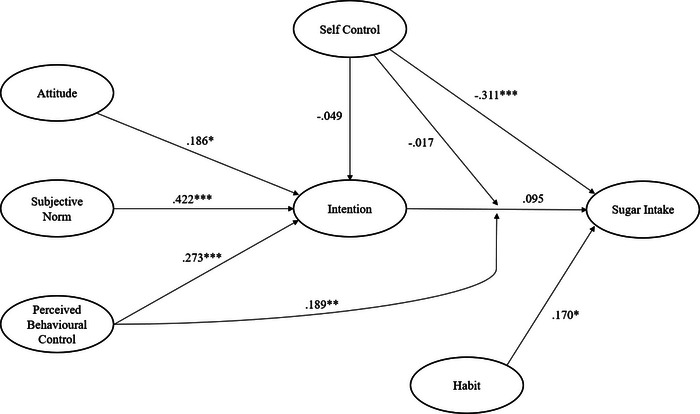
We found statistically significant effects of attitude, subjective norm, and perceived behavioral control on sugar intake intentions. We also found significant effects of habit and self-control on sugar intake measured at follow-up, but no effect for intention. Perceived behavioral control moderated the intention-behavior relationship such that intention effects on behavior were larger when perceived behavioral control was high. However, self-control did not moderate the intention-behavior relationship.
Results indicate that sugar intake in this sample was a function of habits and self-control, and the effect of sugar intake intentions was conditional on perceived behavioral control. Results contribute to an evidence base of determinants and associated processes that relate to sugar intake in adolescents and may signal potentially modifiable targets for intervention.
高糖摄入量与成年人和年轻人的多种不良健康结果相关。确定青少年糖摄入量的心理决定因素及其涉及的过程,可能有助于识别潜在的可改变目标并为干预措施的制定提供信息。我们基于计划行为理论(TPB)测试了一个扩展理论模型的预测,该模型将社会认知结构、习惯和自我控制指定为青少年样本中糖摄入量的相关因素。
通过一家调查小组公司招募了12至14岁的青少年(N = 88),他们同意参与研究,完成了TPB结构的在线自我报告测量以及习惯和自我控制的测量。一个月后,参与者完成了一次游离糖摄入量的随访测量。使用偏最小二乘结构方程模型测试了我们提出的扩展模型的假设效应。
我们发现态度、主观规范和感知行为控制对糖摄入意图有统计学上的显著影响。我们还发现习惯和自我控制对随访时测量的糖摄入量有显著影响,但对意图没有影响。感知行为控制调节了意图与行为之间的关系,使得当感知行为控制较高时,意图对行为的影响更大。然而,自我控制并没有调节意图与行为之间的关系。
结果表明,该样本中的糖摄入量是习惯和自我控制的函数,糖摄入意图的影响取决于感知行为控制。研究结果为与青少年糖摄入量相关的决定因素和相关过程提供了证据基础,并可能为潜在的可改变干预目标提供信号。