Department of Materials Science and Engineering, University of Illinois Urbana Champaign, 1304 W. Green St. MC 246, Urbana, IL, 61801, USA.
Eur Phys J E Soft Matter. 2023 Aug 3;46(8):67. doi: 10.1140/epje/s10189-023-00322-6.
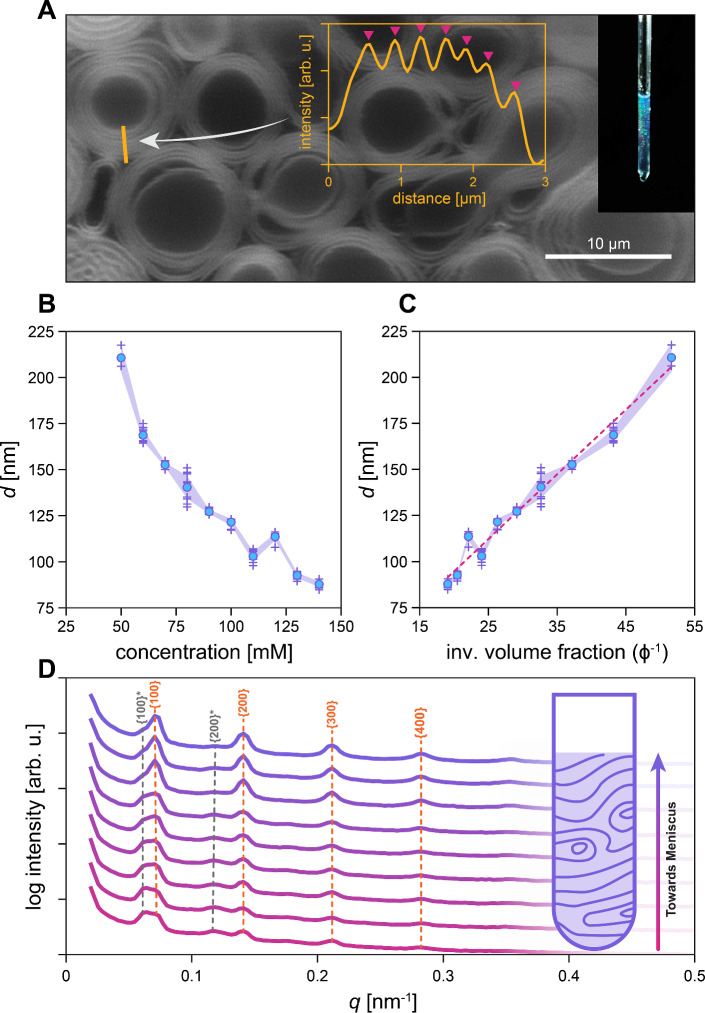
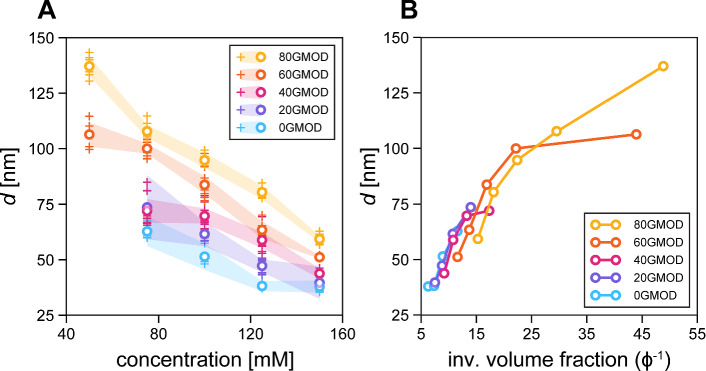
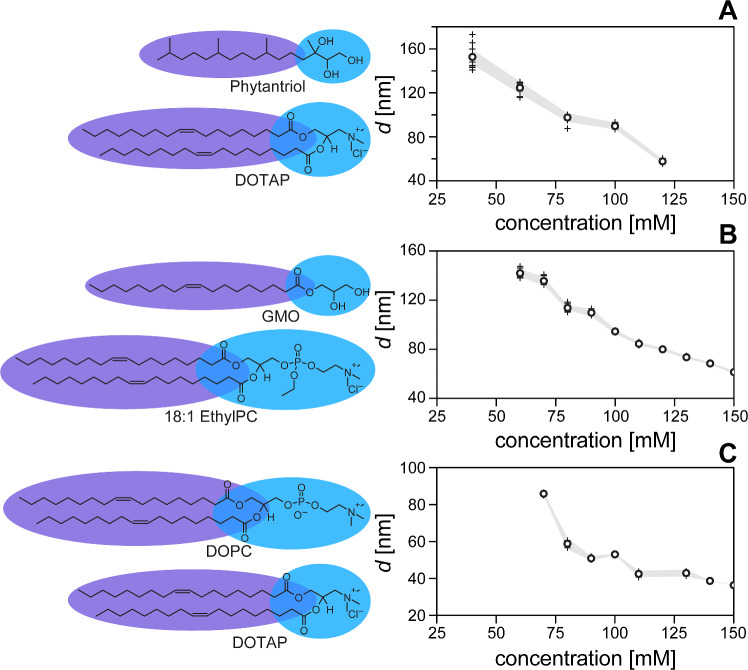
Bilayer systems comprising lipid mixtures are the most well-studied model of biological membranes. While the plasma membrane of the cell is a single bilayer, many intra- and extra-cellular biomembranes comprise stacks of bilayers. Most bilayer stacks in nature are periodic, maintaining a precise water layer separation between bilayers. That equilibrium water separation is governed by multiple inter-bilayer forces and is highly responsive. Biomembranes re-configure inter-bilayer spacing in response to temperature, composition, or mass transport cues. In synthetic bilayer systems for applications in cosmetics or topical treatments, control of the hydration level is a critical design handle. Herein we investigate a binary lipid system that leverages key inter-bilayer forces leading to unprecedented levels of aqueous swelling while maintaining a coherent multilamellar form. We found that combining cationic lipids with bicontinuous cubic phase-forming lipids (lipids with positive Gaussian modulus), results in the stabilization of multilamellar phases against repulsive steric forces that typically lead to bilayer delamination at high degrees of swelling. Using ultra-small-angle X-ray scattering alongside confocal laser scanning microscopy, we characterized various super-swelled states of 1,2-dioleoyl-3-trimethylammonium-propane (DOTAP) and glycerol monooleate (GMO) lipids, as well as other analogous systems, at varied concentration and molar ratios. Through these experiments we established swelling profiles of various binary lipid systems that were near-linear with decreasing lipid volume fraction, showing maximum swelling with periodicity well above 200 nanometers. Confocal fluorescence micrograph of super-swelled multilamellar structures in 90GMOD sample at 25 mM concentration. Inset plot shows intensity profile of orange line, with pink triangles indicating maxima.
由脂质混合物组成的双层系统是研究最广泛的生物膜模型。虽然细胞膜是单层双层,但许多细胞内和细胞外生物膜由双层堆栈组成。自然界中大多数双层堆栈是周期性的,在双层之间保持精确的水层分离。这种平衡水分离受多种双层间力的控制,并且响应非常迅速。生物膜会根据温度、组成或质量传输线索重新配置双层间的间隔。在用于化妆品或局部治疗的合成双层系统中,控制水合水平是一个关键的设计因素。本文研究了一种二元脂质系统,该系统利用关键的双层间力,在保持连贯的多层形式的同时,实现了前所未有的水膨胀。我们发现,将阳离子脂质与双连续立方相形成脂质(具有正高斯模量的脂质)结合使用,可稳定多层相,防止由于排斥的位阻力而导致双层分层,这种排斥的位阻力通常会在高膨胀度下导致双层分层。我们使用超小角 X 射线散射和共聚焦激光扫描显微镜,对 1,2-二油酰基-3-三甲铵丙烷(DOTAP)和甘油单油酸酯(GMO)脂质以及其他类似系统的各种超膨胀状态进行了表征,这些状态的浓度和摩尔比各不相同。通过这些实验,我们建立了各种二元脂质系统的膨胀曲线,这些系统的膨胀曲线与脂质体积分数的降低几乎呈线性关系,表明在周期性远高于 200 纳米的情况下,达到最大膨胀。在 25 mM 浓度的 90GMOD 样品中,超膨胀多层结构的共焦荧光显微镜图像。插图显示了橙色线的强度曲线,粉色三角形表示最大值。