Oklahoma Center for Geroscience and Healthy Brain Aging, University of Oklahoma Health Sciences Center, Oklahoma City, OK, United States of America.
Department of Neurosurgery, Vascular Cognitive Impairment, Neurodegeneration and Healthy Brain Aging Program, University of Oklahoma Health Sciences Center, Oklahoma City, OK, United States of America.
PLoS One. 2023 Aug 3;18(8):e0289508. doi: 10.1371/journal.pone.0289508. eCollection 2023.
Mild cognitive impairment (MCI) is a prodromal stage to dementia, affecting up to 20% of the aging population worldwide. Patients with MCI have an annual conversion rate to dementia of 15-20%. Thus, conditions that increase the conversion from MCI to dementia are of the utmost public health concern. The COVID-19 pandemic poses a significant impact on our aging population with cognitive decline as one of the leading complications following recovery from acute infection. Recent findings suggest that COVID-19 increases the conversion rate from MCI to dementia in older adults. Hence, we aim to uncover a mechanism for COVID-19 induced cognitive impairment and progression to dementia to pave the way for future therapeutic targets that may mitigate COVID-19 induced cognitive decline.
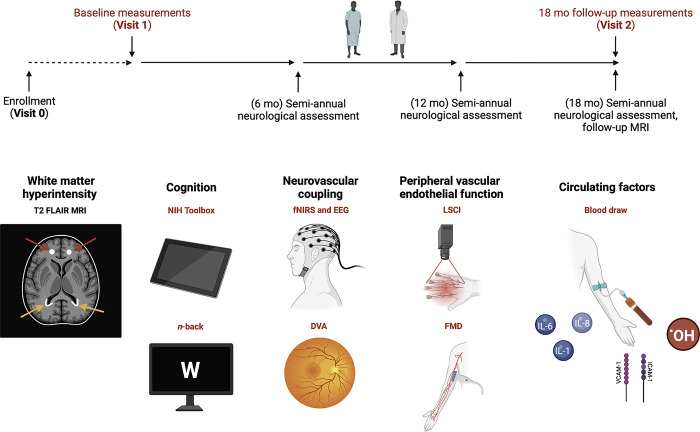
A prospective longitudinal study is conducted at the University of Oklahoma Health Sciences Center. Patients are screened in the Department of Neurology and must have a formal diagnosis of MCI, and MRI imaging prior to study enrollment. Patients who meet the inclusion criteria are enrolled and followed-up at 18-months after their first visit. Visit one and 18-month follow-up will include an integrated and cohesive battery of vascular and cognitive measurements, including peripheral endothelial function (flow-mediated dilation, laser speckle contrast imaging), retinal and cerebrovascular hemodynamics (dynamic vessel retinal analysis, functional near-infrared spectroscopy), and fluid and crystalized intelligence (NIH-Toolbox, n-back). Multiple logistic regression will be used for primary longitudinal data analysis to determine whether COVID-19 related impairment in neurovascular coupling and increases in white matter hyperintensity burden contribute to progression to dementia.
轻度认知障碍(MCI)是痴呆的前驱阶段,影响着全球高达 20%的老年人群。MCI 患者每年向痴呆的转化率为 15-20%。因此,增加从 MCI 向痴呆转化的条件是公共卫生最关注的问题。COVID-19 大流行对我们的老年人群造成了重大影响,认知能力下降是急性感染后最主要的并发症之一。最近的研究结果表明,COVID-19 会增加老年人中从 MCI 向痴呆的转化率。因此,我们旨在揭示 COVID-19 引起的认知障碍和向痴呆发展的机制,为未来可能减轻 COVID-19 引起的认知衰退的治疗靶点铺平道路。
在俄克拉荷马大学健康科学中心进行前瞻性纵向研究。患者在神经病学系进行筛选,并且必须在研究入组前有正式的 MCI 诊断和 MRI 成像。符合纳入标准的患者将被招募,并在首次就诊后 18 个月进行随访。第 1 次就诊和 18 个月随访将包括血管和认知综合测量的综合测试,包括外周内皮功能(血流介导的扩张,激光散斑对比成像),视网膜和脑血管血液动力学(动态血管视网膜分析,功能近红外光谱),以及流体和晶体智力(NIH-Toolbox,n-back)。多元逻辑回归将用于主要的纵向数据分析,以确定 COVID-19 是否与神经血管耦合的损害以及白质高信号负担的增加有关,这些损害与进展为痴呆有关。