Centro de Investigación para la Salud en América Latina, Facultad de Ciencias Exactas y Naturales, Pontificia Universidad Católica del Ecuador, Quito, Ecuador.
Center for Global Health and Interdisciplinary Research, College of Public Health, University of South Florida, FL, Tampa, USA.
Malar J. 2023 Aug 3;22(1):225. doi: 10.1186/s12936-023-04640-0.
Knowledge of the diversity of invasion ligands in malaria parasites in endemic regions is essential to understand how natural selection influences genetic diversity of these ligands and their feasibility as possible targets for future vaccine development. In this study the diversity of four genes for merozoite invasion ligands was studied in Ecuadorian isolates of Plasmodium vivax.
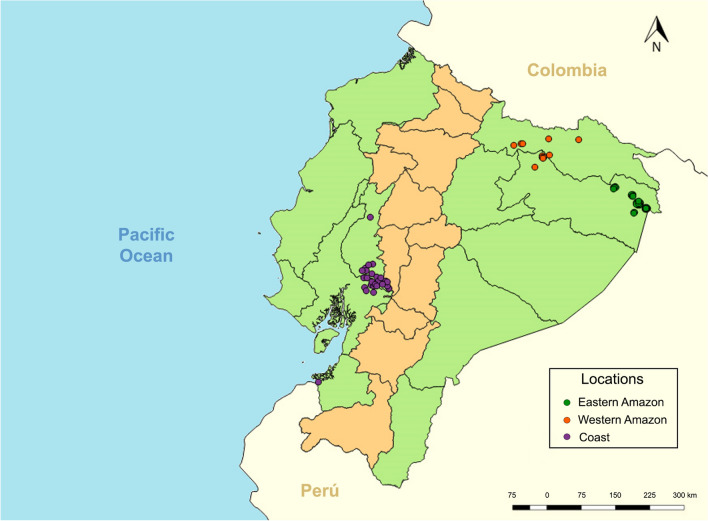
Eighty-eight samples from P. vivax infected individuals from the Coast and Amazon region of Ecuador were obtained between 2012 and 2015. The merozoite invasion genes pvmsp-1-19, pvdbpII, pvrbp1a-2 and pvama1 were amplified, sequenced, and compared to the Sal-1 strain. Polymorphisms were mapped and genetic relationships between haplotypes were determined.
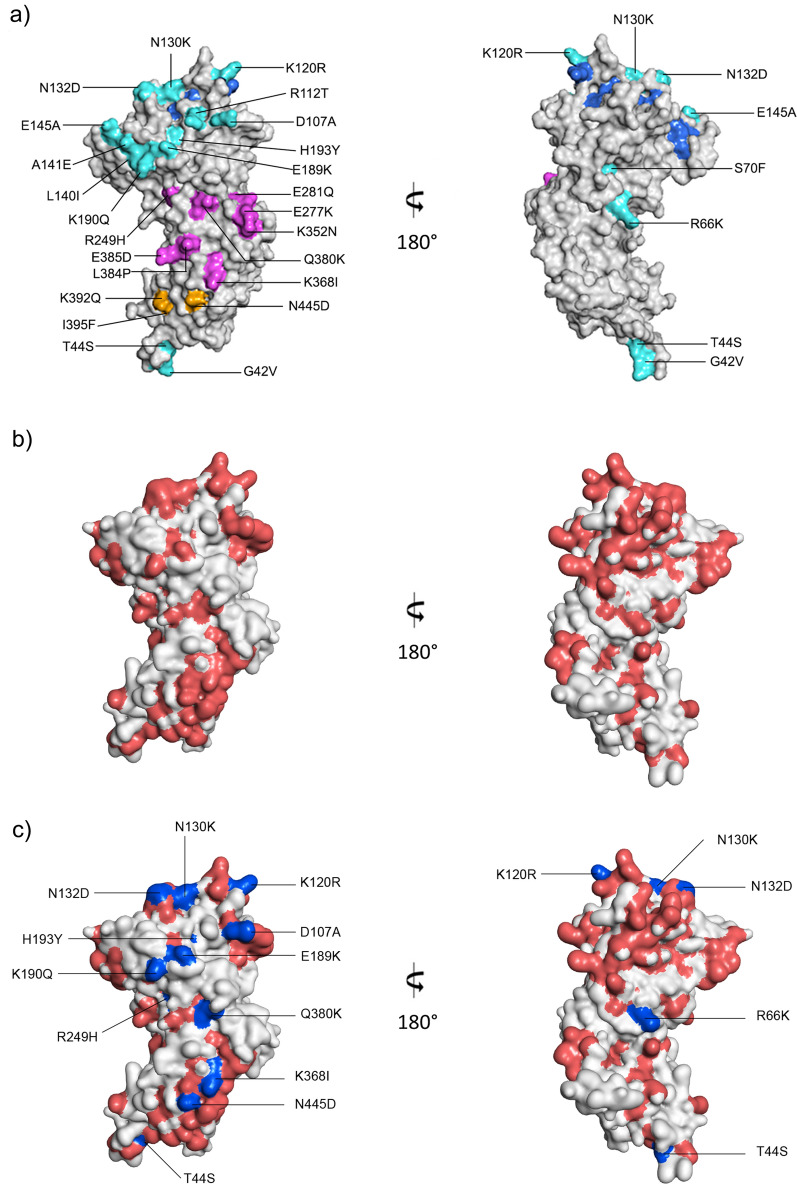
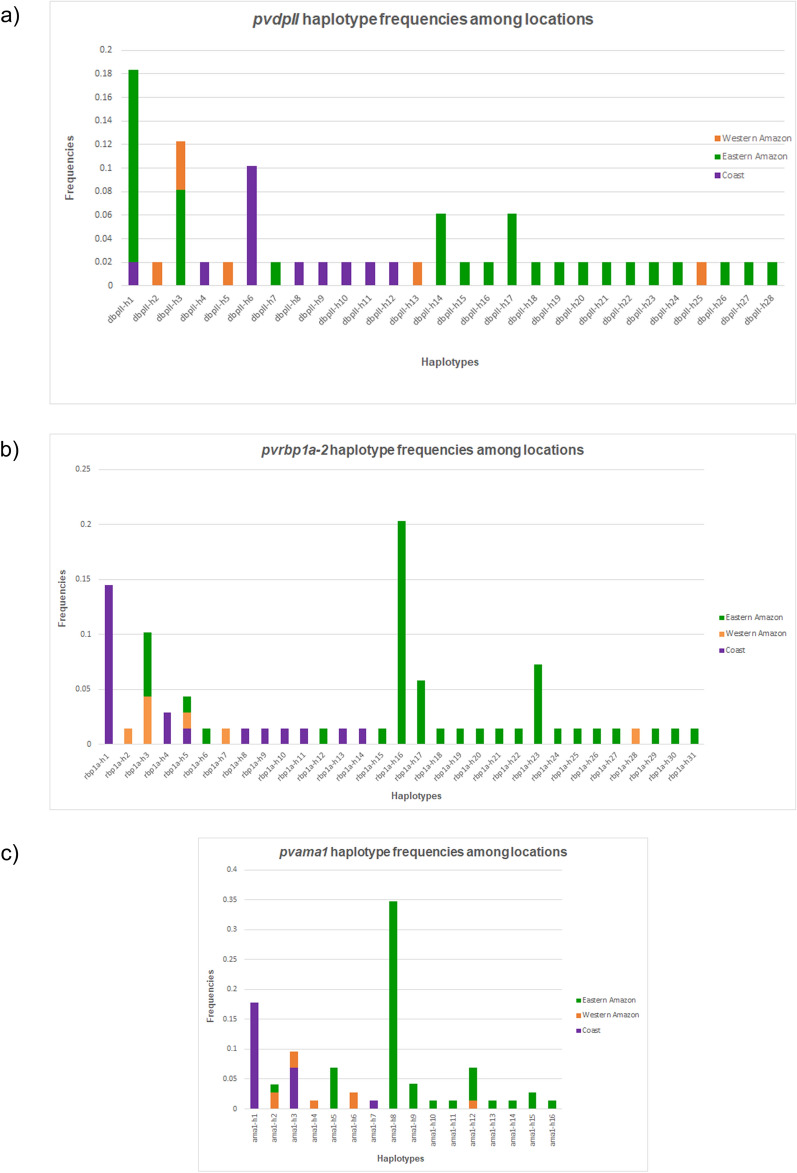
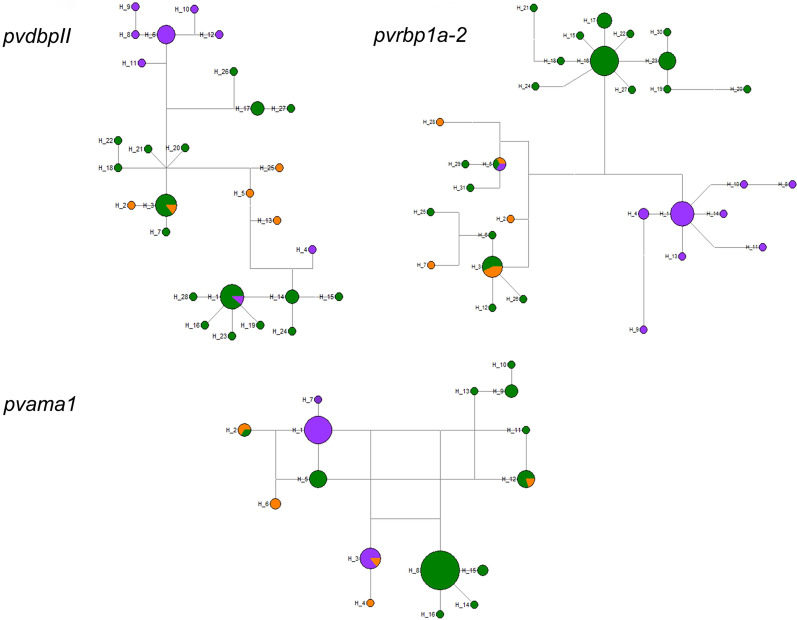
Only one nonsynonymous polymorphism was detected in pvmsp-1-19, while 44 nonsynonymous polymorphisms were detected in pvdbpII, 56 in pvrbp1a-2 and 33 in pvama1. While haplotypes appeared to be more related within each area of study and there was less relationship between parasites of the coastal and Amazon regions of the country, diversification processes were observed in the two Amazon regions. The highest haplotypic diversity for most genes occurred in the East Amazon of the country. The high diversity observed in Ecuadorian samples is closer to Brazilian and Venezuelan isolates, but lower than reported in other endemic regions. In addition, departure from neutrality was observed in Ecuadorian pvama1. Polymorphisms for pvdbpII and pvama1 were associated to B-cell epitopes.
pvdbpII and pvama1 genetic diversity found in Ecuadorian P. vivax was very similar to that encountered in other malaria endemic countries with varying transmission levels and segregated by geographic region. The highest diversity of P. vivax invasion genes in Ecuador was found in the Amazonian region. Although selection appeared to have small effect on pvdbpII and pvrbp1a-2, pvama1 was influenced by significant balancing selection.
了解寄生虫中入侵配体的多样性对于理解自然选择如何影响这些配体的遗传多样性以及它们作为未来疫苗开发的可能靶标具有重要意义。在这项研究中,研究了厄瓜多尔间日疟原虫分离株中四种裂殖子入侵配体基因的多样性。
在 2012 年至 2015 年期间,从厄瓜多尔海岸和亚马逊地区的感染个体中获得了 88 个样本。扩增、测序并将merozoite invasion 基因 pvmsp-1-19、pvdbpII、pvrbp1a-2 和 pvama1 与 Sal-1 株进行比较。对多态性进行了映射,并确定了单倍型之间的遗传关系。
仅在 pvmsp-1-19 中检测到一个非同义多态性,而在 pvdbpII 中检测到 44 个非同义多态性,在 pvrbp1a-2 中检测到 56 个,在 pvama1 中检测到 33 个。虽然单倍型在每个研究区域内似乎更为相关,而且该国沿海和亚马逊地区的寄生虫之间的关系较少,但在两个亚马逊地区都观察到了多样化过程。该国东部亚马逊地区的大多数基因出现了最高的单倍型多样性。厄瓜多尔样本中观察到的高多样性与巴西和委内瑞拉的分离株更为接近,但低于其他流行地区的报告。此外,厄瓜多尔 pvama1 中观察到了偏离中性。pvdbpII 和 pvama1 的多态性与 B 细胞表位有关。
在厄瓜多尔发现的 P. vivax 中的 pvdbpII 和 pvama1 遗传多样性与其他疟疾流行国家非常相似,这些国家的传播水平不同,并且按地理区域划分。厄瓜多尔裂殖子入侵基因的最高多样性是在亚马逊地区发现的。尽管 pvdbpII 和 pvrbp1a-2 似乎受到选择的影响较小,但 pvama1 受到显著平衡选择的影响。