Department of Translational Hematology and Oncology Research, Taussig Cancer Institute, Cleveland Clinic, 9620 Carnegie Ave N Building, Building NE6-250, Cleveland, OH, 44106, USA.
Division of Medical Oncology & Hematology, School of Medicine, University of Louisville, Louisville, KY, USA.
J Hematol Oncol. 2023 Aug 3;16(1):91. doi: 10.1186/s13045-023-01480-y.
TP53 mutations (TP53) occur in diverse genomic configurations. Particularly, biallelic inactivation is associated with poor overall survival in cancer. Lesions affecting only one allele might not be directly leukemogenic, questioning the presence of cryptic biallelic subclones in cases with dismal prognosis.
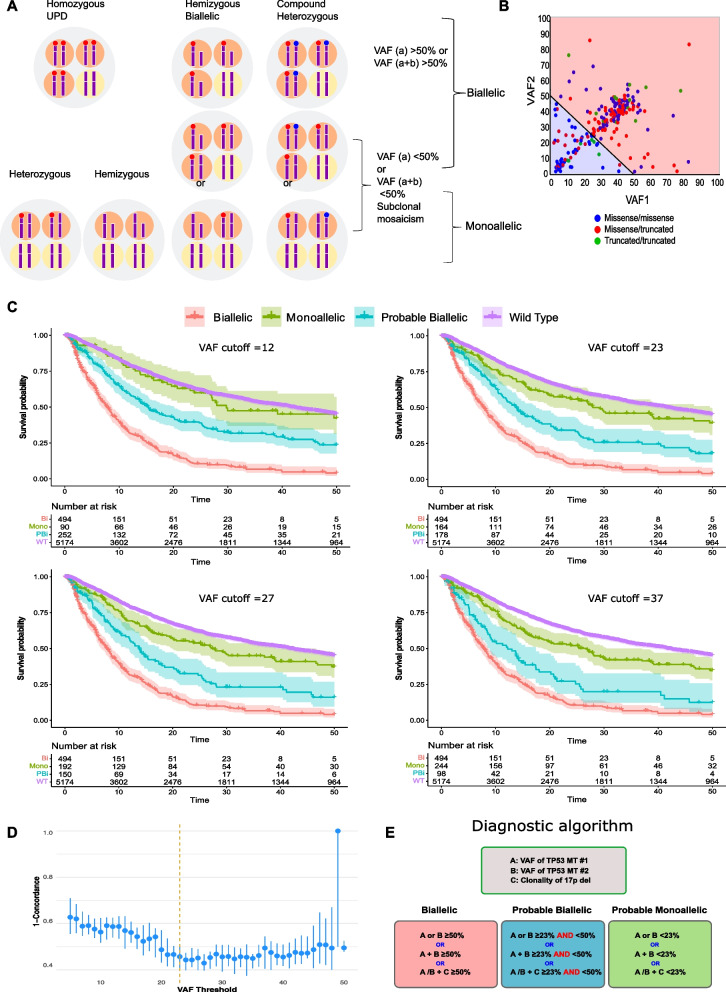
We have collected clinical and molecular data of 7400 patients with myeloid neoplasms and applied a novel model by identifying an optimal VAF cutoff using a statistically robust strategy of sampling-based regression on survival data to accurately classify the TP53 allelic configuration and assess prognosis more precisely.
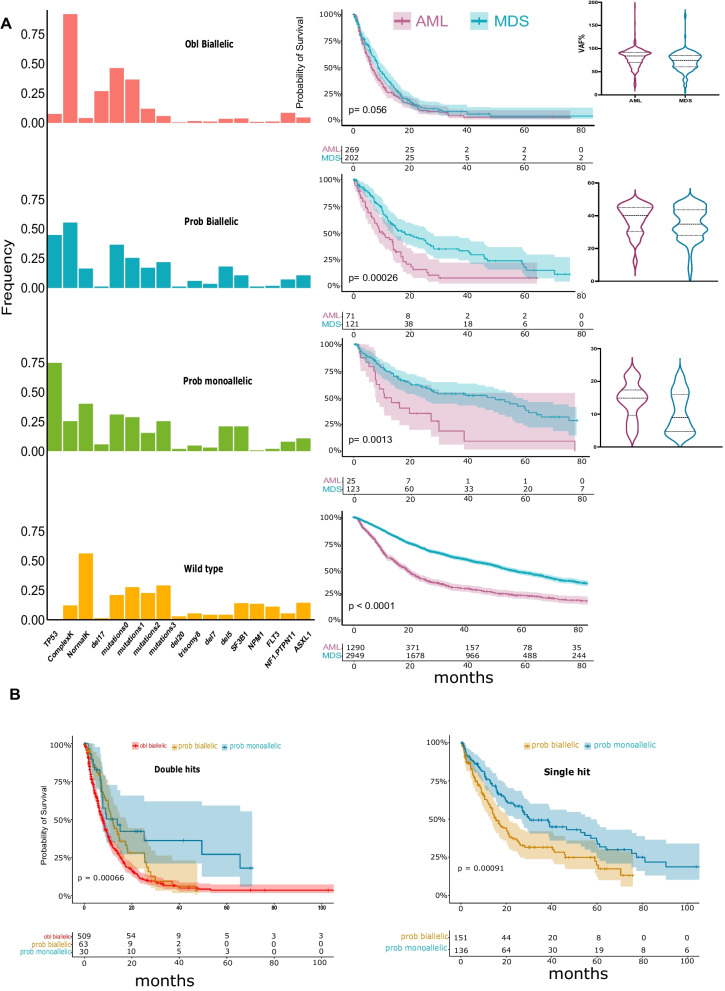
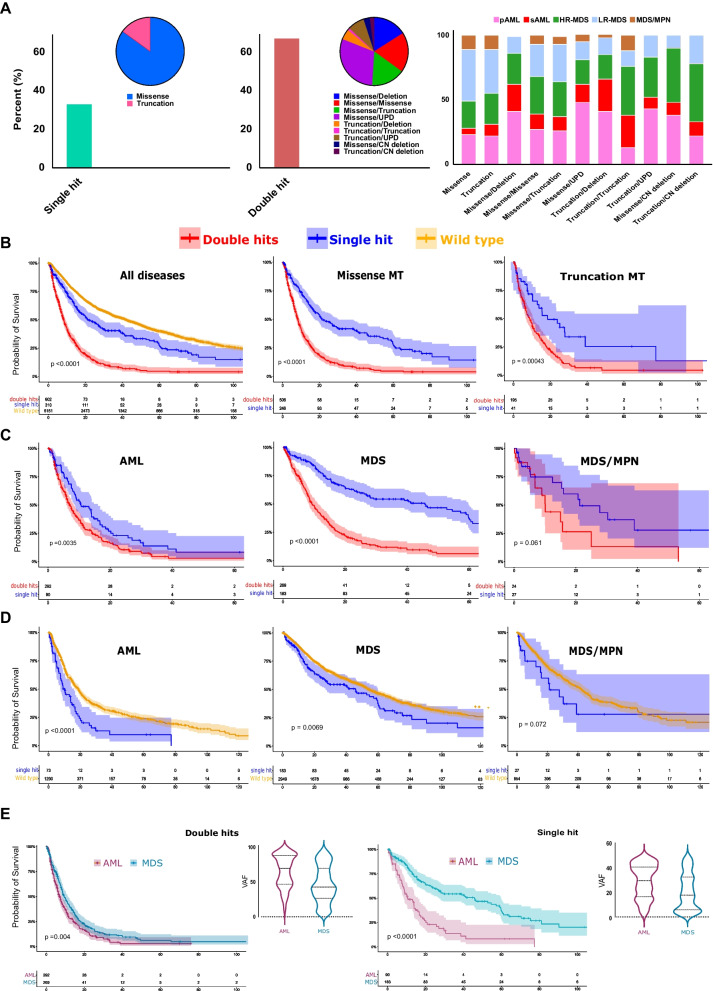
Overall, TP53 were found in 1010 patients. Following the traditional criteria, 36% of the cases were classified as single hits, while 64% exhibited double hits genomic configuration. Using a newly developed molecular algorithm, we found that 579 (57%) patients had unequivocally biallelic, 239 (24%) likely contained biallelic, and 192 (19%) had most likely monoallelic TP53. Interestingly, our method was able to upstage 192 out of 352 (54.5%) traditionally single hit lesions into a probable biallelic category. Such classification was further substantiated by a survival-based model built after re-categorization. Among cases traditionally considered monoallelic, the overall survival of those with probable monoallelic mutations was similar to the one of wild-type patients and was better than that of patients with a biallelic configuration. As a result, patients with certain biallelic hits, regardless of the disease subtype (AML or MDS), had a similar prognosis. Similar results were observed when the model was applied to an external cohort. In addition, single-cell DNA studies unveiled the biallelic nature of previously considered monoallelic cases.
Our novel approach more accurately resolves TP53 genomic configuration and uncovers genetic mosaicism for the use in the clinical setting to improve prognostic evaluation.
TP53 突变(TP53)发生在多种基因组构型中。特别是,双等位基因失活与癌症患者的总体生存率差有关。仅影响一个等位基因的病变可能不会直接导致白血病,这使得在预后不良的病例中存在隐匿性双等位基因亚克隆受到质疑。
我们收集了 7400 例骨髓增生性肿瘤患者的临床和分子数据,并应用了一种新的模型,通过使用基于统计稳健的抽样回归方法对生存数据进行分析,确定最佳 VAF 截断值,从而准确分类 TP53 等位基因构型,并更准确地评估预后。
总体而言,在 1010 例患者中发现了 TP53。根据传统标准,36%的病例被归类为单击,而 64%的病例表现出双击基因组构型。使用新开发的分子算法,我们发现 579 例(57%)患者的 TP53 等位基因具有明确的双等位基因性,239 例(24%)可能包含双等位基因性,192 例(19%)最有可能为单等位基因 TP53。有趣的是,我们的方法能够将传统上归类为单击的 192 例病变升级为可能的双等位基因类别。通过重新分类后建立的基于生存的模型进一步证实了这种分类。在传统上被认为是单等位基因的病例中,具有可能的单等位基因突变的患者的总体生存率与野生型患者相似,并且优于具有双等位基因构型的患者。因此,具有某些双等位基因突变的患者,无论疾病亚型(AML 或 MDS)如何,其预后相似。当该模型应用于外部队列时,观察到了类似的结果。此外,单细胞 DNA 研究揭示了先前被认为是单等位基因的病例的双等位基因性质。
我们的新方法更准确地解析了 TP53 基因组构型,并揭示了遗传镶嵌现象,可用于临床环境中以改善预后评估。