
MALAT1长链非编码RNA及其在乳腺癌发生中的作用
MALAT1 Long Non-coding RNA and Its Role in Breast Carcinogenesis.
作者信息
Tsyganov M M, Ibragimova M K
机构信息
Cancer Research Institute, Tomsk National Research Medical Center, Russian Academy of Sciences, Tomsk, 634050 Russian Federation.
Siberian State Medical University, Tomsk, 634050 Russian Federation.
出版信息
Acta Naturae. 2023 Apr-Jun;15(2):32-41. doi: 10.32607/actanaturae.11905.
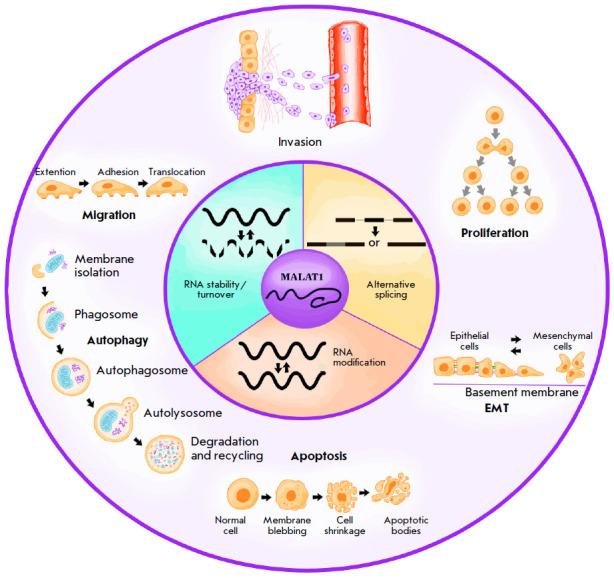
Our genome consists not only of protein-coding DNA, but also of the non-coding part that plays a very important role in the regulation of all cellular processes. A part of the non-coding genome comes with non-coding RNAs (ncRNAs), and disruption of the functional activity of these RNAs may be associated with oncogenesis in various cancer types. There exist two types of ncRNAs: small and long non-coding RNAs, which are classified according to their transcript length. Long non-coding metastasis-associated lung adenocarcinoma transcript 1, RNA (), is a long non-coding RNA of particular interest. The aforementioned transcript takes part in the regulation of numerous cellular processes and pathogenesis of different malignant tumors, including breast tumors. This review focuses on experimental and clinical studies into the role of MALAT1 in carcinogenesis and the progression of breast cancer.
我们的基因组不仅由蛋白质编码DNA组成,还包括在所有细胞过程调控中发挥非常重要作用的非编码部分。非编码基因组的一部分由非编码RNA(ncRNAs)组成,这些RNA功能活性的破坏可能与多种癌症类型的肿瘤发生有关。ncRNAs存在两种类型:小非编码RNA和长非编码RNA,它们根据转录本长度进行分类。长链非编码转移相关肺腺癌转录本1(MALAT1)是一种特别受关注的长非编码RNA。上述转录本参与众多细胞过程的调控以及不同恶性肿瘤(包括乳腺肿瘤)的发病机制。本综述聚焦于MALAT1在乳腺癌发生和进展中的作用的实验和临床研究。
 Zotero 插件