
微生物代谢产物在糖尿病肾病中的作用。
The role of microbial metabolites in diabetic kidney disease.
作者信息
Zhu Ting, Hu Bi-Ying, Zhang Yi-Qing, Zhang Ze-Yu, Cai Kai-Wen, Lei Lei, Hu Bo, Wang Xiao-Hua, Tang Chun, Lu Yong-Ping, Zheng Zhi-Hua
机构信息
Department of Nephrology, Center of Kidney and Urology, the Seventh Affiliated Hospital, Sun Yat-sen University, Shenzhen, China.
Department of Nephrology, the First Affiliated Hospital of Jinan University, Guangzhou, China.
出版信息
Heliyon. 2023 Jul 4;9(7):e17844. doi: 10.1016/j.heliyon.2023.e17844. eCollection 2023 Jul.
BACKGROUND
Growing evidence suggests a complex bidirectional interaction between gut microbes, gut-derived microbial metabolites, and diabetic kidney disease (DKD), known as the "gut-kidney axis" theory. The present study aimed to characterize the role of microbial metabolites in DKD.
METHODS
Six-week-old db/db and littermate db/m mice were raised to 20 weeks old. The serum, urine, feces, liver, perinephric fat, and kidney were analyzed using liquid chromatography with tandem mass spectrometry (LC-MS/MS)-based metabolomic analyses.
RESULTS
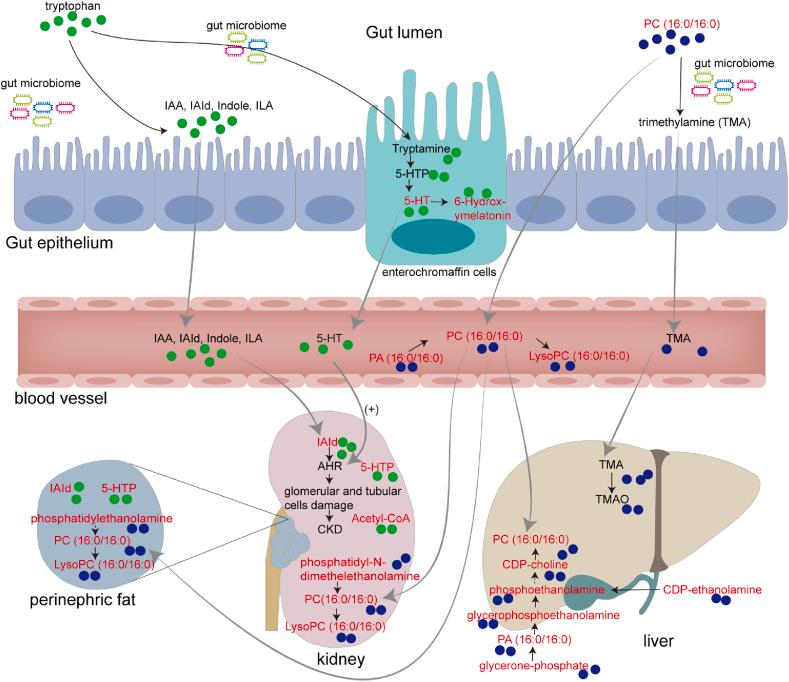
The db/db mice showed obvious pathological changes and worse renal functions than db/m mice. Indoleacetaldehyde (IAld) and 5-hydroxy-l-tryptophan (5-HTP) in kidney samples, and serotonin (5-HT) in fecal samples were increased in the db/db group. Phosphatidylcholine (PC), phosphatidate (PA), and 1-acylglycerophosphocholine (lysoPC) were decreased in liver and serum samples of the db/db group, while PC and lysoPC were decreased in kidney and perinephric fat samples. Suggested metabolomic homeostasis was disrupted in DKD mice, especially glycerophospholipid and tryptophan metabolism, which are closely related to the gut microbiome.
CONCLUSIONS
Our findings reveal the perturbation of gut microbial metabolism in db/db mice with DKD, which may be useful for building a bridge between the gut microbiota and the progression of DKD and provide a theoretical basis for the intestinal treatment of DKD.
背景
越来越多的证据表明,肠道微生物、肠道来源的微生物代谢产物与糖尿病肾病(DKD)之间存在复杂的双向相互作用,即“肠-肾轴”理论。本研究旨在阐明微生物代谢产物在DKD中的作用。
方法
将6周龄的db/db小鼠和同窝的db/m小鼠饲养至20周龄。采用基于液相色谱-串联质谱(LC-MS/MS)的代谢组学分析方法,对血清、尿液、粪便、肝脏、肾周脂肪和肾脏进行分析。
结果
与db/m小鼠相比,db/db小鼠表现出明显的病理变化和更差的肾功能。db/db组肾脏样本中的吲哚乙醛(IAld)和5-羟色氨酸(5-HTP)以及粪便样本中的血清素(5-HT)均升高。db/db组肝脏和血清样本中的磷脂酰胆碱(PC)、磷脂酸(PA)和溶血磷脂酰胆碱(lysoPC)降低,而肾脏和肾周脂肪样本中的PC和lysoPC降低。提示DKD小鼠的代谢组稳态受到破坏,尤其是甘油磷脂和色氨酸代谢,这与肠道微生物群密切相关。
结论
我们的研究结果揭示了DKD的db/db小鼠肠道微生物代谢的紊乱,这可能有助于在肠道微生物群与DKD进展之间架起一座桥梁,并为DKD的肠道治疗提供理论依据。


 Zotero 插件